How to Choose a C50 carbon steel billet for Forging and Machining
Table of Contents
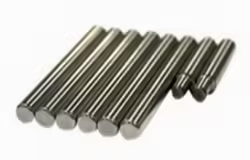
C50 carbon steel billet is widely used in forging industries where moderate strength, wear resistance, and predictable heat treatment response are required. Engineers select this grade when parts must balance hardness and machinability without the cost of alloy steels.
Chemical Composition and Standards
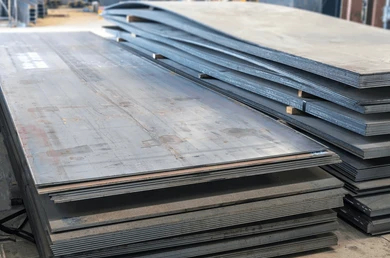
C50 carbon steel billet belongs to the medium carbon steel category, typically containing 0.47–0.55% carbon. This carbon range allows effective quenching and tempering while maintaining structural integrity.
In European standards it corresponds to EN 1.0540. Equivalent grades include AISI 1050 and JIS S50C. Cross-reference tables published by SteelNumber confirm these equivalencies and help international buyers avoid grade confusion.
Reference: https://www.steelnumber.com/en/steel_composition_eu.php?name_id=855
Mechanical Properties After Heat Treatment
When supplied in normalized condition, C50 carbon steel billet offers moderate tensile strength and good machinability. After quenching and tempering, hardness can increase significantly, improving fatigue resistance and wear behavior.
According to EN material summaries, tensile strength and hardness depend heavily on section size and cooling medium. Controlled tempering restores toughness after quenching.
Why Forging Plants Prefer This Grade
Forging facilities choose C50 carbon steel billet for crankshafts, transmission components, axles, and heavy-duty shafts. The material responds consistently to thermal cycles, which simplifies production planning.
The uniform microstructure achievable in C50 carbon steel billet reduces distortion risks compared to higher carbon grades. This is especially important in precision machining operations.
Machinability and Processing Considerations
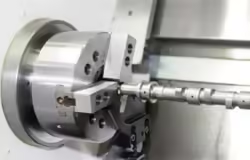
In annealed condition, C50 carbon steel billet machines efficiently with standard carbide tooling. However, cutting parameters must be adjusted after heat treatment due to increased hardness.
For welding, preheating is generally recommended. Medium carbon steels are more susceptible to cracking than low carbon steels. Proper interpass temperature control reduces hydrogen cracking
Heat Treatment Parameters
Industrial heat treatment of C50 carbon steel billet typically includes:
- Austenitizing within controlled temperature ranges
- Oil or polymer quenching
- Tempering to reach required mechanical properties
Technical briefs from steel manufacturers emphasize precise temperature control to achieve uniform martensitic transformation.
Inspection and Quality Assurance
Before forging, inspection of C50 carbon steel billet should include:
- Chemical composition verification via mill certificate
- Ultrasonic testing for internal defects
- Surface crack detection
- Hardness spot checks
Traceability records are essential for industrial clients. Batch documentation improves accountability and simplifies failure analysis.
Surface Strengthening Options
For applications requiring enhanced wear resistance, C50 carbon steel billet can undergo induction hardening or nitriding. These processes strengthen the surface layer while maintaining a tougher core.
Surface engineering improves fatigue life in dynamic components such as gears and rotating shafts.
Procurement and Global Supply
International buyers sourcing C50 carbon steel billet should specify:
- Required delivery condition (normalized, annealed, or hot rolled)
- Mechanical property targets
- Inspection standards
- Dimensional tolerances
Clear technical specifications reduce misunderstandings between mills and forging plants.
Sustainability and Recycling
Medium carbon steels are highly recyclable. Scrap management directly affects cleanliness and inclusion levels in C50 carbon steel billet production.
Sustainable sourcing policies increasingly influence procurement decisions in automotive and heavy equipment sectors.
Practical Summary
C50 carbon steel billet offers a balanced combination of strength, heat treatment adaptability, and cost efficiency. With proper processing, inspection, and specification control, it remains a reliable material for medium-duty mechanical components across global industries.
If you want to learn more related information, please click here.