1020 Carbon Steel Material Properties: Cost & Value
In today’s highly competitive industrial environment, buyers and engineers continually search for materials that deliver reliable performance without unnecessary cost inflation. Among low-carbon steels, 1020 carbon steel retains a uniquely stable market presence because of its balanced material properties, predictable machinability, and versatile application range.
In sectors such as automotive parts manufacturing, mechanical engineering, heavy-equipment components, steel fabrication, agricultural machinery, and general industrial machining, 1020 steel consistently appears as a cost-efficient choice.
What makes it so enduring?
Why do manufacturers continue selecting it over slightly harder or stronger steel grades?
Where exactly does 1020 steel create—or lose—value?
This comprehensive guide explains everything you need to know.
Table of Contents
Key Takeaways
- A deep dive into the mechanical, chemical, processing, and structural characteristics of 1020 carbon steel
- Data-driven analysis of cost drivers, performance metrics, and market factors
- Clear value assessment for manufacturers, engineers, procurement teams, and industry buyers
- Detailed comparisons with A36, 1018, 1045, and other widely used steels
- Engineering concepts broken down into easy-to-understand sections
- FAQ section crafted around natural, conversational search queries
- Real-world applications, case studies, and expert viewpoints from metallurgical engineers
Understanding 1020 Carbon Steel Material Properties and Market Value
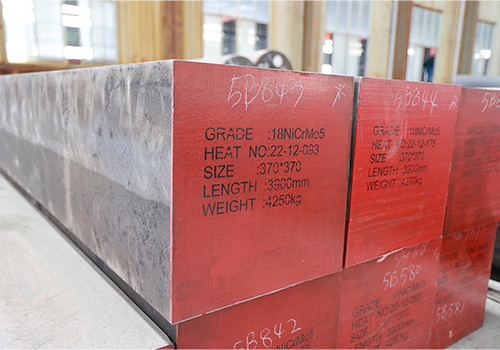
1020 steel belongs to the family of plain carbon steels, specifically the low-carbon segment. Its properties—mechanical, chemical, thermal, and structural—allow precise engineering predictions. The stability of its composition reduces variability, meaning manufacturers experience fewer surprises during forming, machining, or heat treatment.
Below is a breakdown of how its material characteristics directly influence real-world cost, performance, and long-term value.
What Defines the Cost of 1020 Steel?
Material Purity and Carbon Composition
1020 steel contains approximately 0.17–0.23% carbon, with manganese levels around 0.30–0.60%.
This low carbon content significantly impacts processing costs:
- It requires less intense heat treatment, lowering energy consumption.
- It reduces risk of cracking during welding, meaning fewer rejected parts.
- It increases ductility, which simplifies forming and bending operations.
Industry note:
A study by the American Iron and Steel Institute (AISI) indicates that low-carbon steels like 1020 reduce production-related waste by up to 18% compared with medium-carbon steels due to their forgiving mechanical behavior.
Manufacturing and Processing Factors
Processing can contribute to 20–40% of total cost depending on finishing requirements.
Common Processing States
- Hot-rolled (most affordable)
- Cold-drawn/cold-finished (higher precision, more expensive)
- Normalized (improved grain structure)
- Annealed (softened for machining or forming)
- Turned, Ground, and Polished (TGP) (for high-precision shafts)
Each step adds value but also increases price.
Cost Impact Examples
| Processing Type | Price Impact | Value Added |
|---|---|---|
| Hot Rolled | Baseline | Good for structural components |
| Cold Drawn | +10–25% | Higher dimensional accuracy |
| TGP | +30–40% | Ideal for rotating shafts and precision parts |
Market Conditions and Supply Chain
Prices fluctuate with:
- Global steel demand
- Energy costs (electric arc furnace operations)
- Shipping and logistics constraints
- Domestic production rates versus imports
2024 Q4 data from global steel analytics firms show carbon steel price volatility of 6–12% per quarter, making stable, low-cost steels like 1020 more appealing for long-term contracts.
Core 1020 Carbon Steel Material Properties
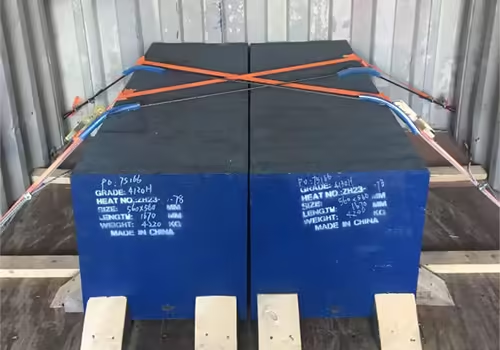
Mechanical Strength
Typical mechanical values for 1020 steel:
- Tensile Strength: ~420–550 MPa
- Yield Strength: ~350 MPa (cold drawn) / ~210 MPa (hot rolled)
- Elongation: 15–30% depending on processing
- Brinell Hardness: 111–180 HB
These values show that 1020 steel is not a high-strength steel, but its moderate strength works well for components requiring flexibility and formability rather than extreme durability.
Ductility and Toughness
Low-carbon steels typically feature high ductility, and 1020 is no exception.
Benefits include:
- Easier bending
- Reduced cracking risk during rolling or forging
- Greater impact resistance at room temperature
Many machinery manufacturers choose 1020 specifically for parts exposed to shock loads but not extreme stress.
Machinability Performance
1020 steel offers machinability rating of ~65% (based on 1212 free-cutting steel = 100%).
This makes it excellent for:
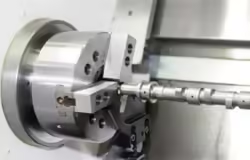
- Turning
- Drilling
- Threading
- Milling
- Boring
Because it does not contain significant alloying elements, its cutting behavior is predictable across batches.
Weldability Characteristics
Thanks to its low carbon content, 1020 steel is highly weldable using:
- MIG
- TIG
- Stick welding
- Spot welding
No preheat or postheat is typically required, reducing welding costs and labor time.
Professional Concepts That Explain the Value of 1020 Steel

Material Efficiency
Material efficiency measures how effectively a steel type supports fabrication without excessive waste or rework.
1020 steel demonstrates high efficiency due to:
- Gentler cutting forces
- Lower risk of tool breakage
- Reduced forming resistance
- Predictable deformation behavior
In practice, this can reduce machining time by 8–12% compared with medium-carbon steels.
Lifecycle Cost
Lifecycle cost includes:
- Raw material price
- Processing
- Machining
- Welding
- Heat treatment
- Long-term maintenance
Because 1020 generally requires no stress relieving, minimal surface treatment, and simple machining, it achieves one of the lowest lifecycle costs in its category.
Application Suitability
1020 steel excels where:
- Medium strength
- Simple machining
- High ductility
- Economical procurement
are priorities.
Typical use cases:
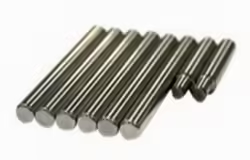
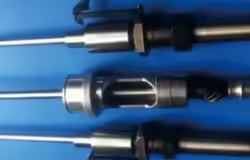
- Shafts
- Pins
- Gears
- Machine parts
- Bolts, studs, and fasteners
- Structural tubing
- Agricultural equipment frames
Comparing 1020 Steel With Similar Grades
1020 vs. 1045 Steel
| Property | 1020 | 1045 | Winner |
|---|---|---|---|
| Strength | Moderate | High | 1045 |
| Machinability | Better | Slightly lower | 1020 |
| Weldability | Excellent | Moderate | 1020 |
| Cost | Lower | Higher | 1020 |
| Hardness | Lower | Higher | 1045 |
Conclusion:
Choose 1020 for cost efficiency and ease of machining.
Choose 1045 for strength-demanding components.
1020 vs. A36 Steel
| Property | 1020 | A36 |
|---|---|---|
| Chemical consistency | Higher | Variable |
| Machinability | Better | Moderate |
| Strength | Slightly lower | Slightly higher |
| Price | Slightly higher | Slightly lower |
Insight:
A36 is often used for structural beams.
1020 is preferred for machined components requiring uniformity.
1020 vs. 1018 Steel
1018 offers slightly tighter tolerances and better surface finish in cold-drawn form.
However:
- 1018 is generally 10–15% more expensive
- 1020 offers comparable service life
- For most industrial tasks, 1020 provides better cost-value ratio
Cost & Value Evaluation: Is 1020 Steel Worth It?
Balancing Affordability and Performance
1020 steel delivers:
- Adequate strength
- Excellent machinability
- Low price
- Wide processing flexibility
This combination is rare in the carbon steel category.
Practical Value in Industrial Use
Large manufacturing companies—especially automotive suppliers—choose 1020 for:
- Repeatability
- Low scrap rates
- Simple forming characteristics
A metallurgical engineer from an automotive Tier-1 supplier noted:
“We prefer 1020 steel for shaft components because the material maintains consistent ductility and machinability across large batch orders. It reduces machining costs and minimizes dimensional rejection rates.”
1020 Steel in Real-World Applications

Automotive Sector
Used in:
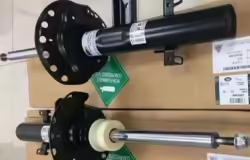
- Steering shafts
- Differential components
- Engine pins
- Mild-load gears
Reason: predictable behavior and low distortion after machining.
Agricultural Machinery
Popular for:
- Axles
- Linkages
- Mounting brackets
Its toughness supports shock loads from uneven terrain.
General Manufacturing
Applications include:
- Bushings
- Sleeves
- Hydraulic fittings
- Custom machining parts
Engineering Concepts for Better Understanding
Strain Hardening
During cold work, 1020 steel increases in hardness and strength, improving load capacity.
Grain Structure
Normalizing creates uniform grains, increasing toughness and reducing internal stresses.
Thermal Conductivity
1020’s thermal conductivity allows efficient heat dissipation during forming or machining.
Industry Expert Opinions
Metallurgical Engineer Comment
“1020’s low carbon content makes it extremely forgiving. For high-volume machining environments, its predictable chip formation and low tool wear are major cost savers.”
Mechanical Design Consultant
“For non-critical rotating components, I almost always specify 1020. It meets strength requirements without inflating material costs.”
Advanced Technical Data Sheet (Engineering Reference)
Chemical Composition
| Element | Percentage |
|---|---|
| Carbon | 0.17–0.23% |
| Manganese | 0.30–0.60% |
| Phosphorus | ≤0.04% |
| Sulfur | ≤0.05% |
| Iron | Balance |
Mechanical Properties
| Property | Hot Rolled | Cold Drawn |
|---|---|---|
| Tensile Strength | 420 MPa | 550 MPa |
| Yield Strength | 210 MPa | 350 MPa |
| Elongation | 30% | 15% |
| Hardness | 111 HB | 180 HB |
Market Outlook for 1020 Steel
- Demand expected to grow steadily due to automotive and agricultural sectors
- Increasing popularity in fabrication due to rising prices of alloy steels
- Reduced volatility compared to high-carbon or alloy grades
Conclusion
1020 carbon steel provides a rare combination of affordability, mechanical stability, machinability, and versatility, making it a top choice for manufacturers, engineers, and procurement planners. Its material properties ensure predictable performance across diverse applications, while its cost structure keeps production budgets in check.
Whether you’re selecting steel for a new design, comparing materials for large-scale production, or evaluating long-term lifecycle cost, 1020 steel remains one of the most value-driven choices in the low-carbon category.
FAQ
Is 1020 carbon steel strong enough for machinery parts?
Yes—it’s ideal for shafts, pins, gears, and similar parts requiring moderate strength.
Why is 1020 steel cheaper?
Its low carbon content reduces heat-treating costs and enables easier processing.
Does 1020 rust easily?
It can rust like any carbon steel, so coatings or paints are recommended.
Is 1020 steel easy to weld?
Very easy. Its low carbon composition enhances weldability without preheat.
Should I choose 1020 or 1045 for shafts?
Choose 1045 for higher strength.
Choose 1020 for cost efficiency and easier machining.
Is 1020 suitable for pressure vessels?
Typically no—it lacks the required strength and toughness for high-pressure environments.