1080 Steel Billet: Composition, Heat Treatment, and Practical Applications Explained
Table of Contents
1080 steel billet is a widely used material in forging and machining industries due to its balanced carbon content, predictable heat treatment response, and reliable mechanical performance. For manufacturers, fabricators, and engineers, understanding how this material behaves in real production scenarios is essential when selecting raw steel for structural or wear-resistant components.
This article explains the material properties, processing considerations, and typical use cases of 1080-grade steel billets from a technical and practical perspective.
What Is an 1080 Steel Billet?
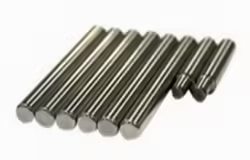
An 1080 steel billet is a semi-finished steel product produced from medium–high carbon steel, typically containing around 0.75%–0.88% carbon. As a billet, it serves as an intermediate form that can be further forged, rolled, or machined into final components.
The billet form allows manufacturers to control the internal structure before shaping, making the material suitable for applications that require consistent hardness and strength after heat treatment.
Chemical Composition and Material Characteristics
Its defining feature is a relatively high carbon content compared with mild steels. This composition provides excellent hardenability while still allowing controlled toughness through proper tempering.
Typical elements include carbon for hardness, manganese for strength and wear resistance, and trace elements that help stabilize the steel structure during heat treatment. Because of this balance, 1080 steel billet performs well in parts exposed to repeated stress, surface wear, or impact loading.
From a processing standpoint, the steel offers good machinability in normalized condition and strong performance after quenching and tempering.
Heat Treatment Behavior of 1080 Steel Billet
Heat treatment plays a critical role in determining the final performance of this high-carbon steel material. Common processes include normalizing quenching and tempering.
Normalizing helps refine grain structure and improve uniformity before machining. Quenching significantly increases hardness but also introduces internal stress, which is why tempering is essential afterward. By adjusting tempering temperature, manufacturers can tailor the hardness-to-toughness ratio based on application needs.
When heat treated correctly, 1080 steel billet achieves a combination of strength and wear resistance that makes it suitable for demanding industrial components.
Typical Industrial Applications
Due to its predictable behavior, 1080 steel billet is commonly used in:
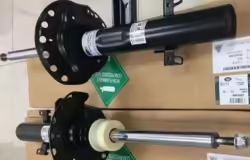
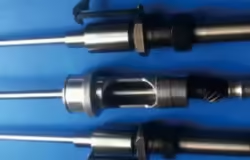
- Shafts and axles
- Cutting tools and blades
- Wear-resistant machine components
- Forged mechanical parts
- Springs and high-load connectors
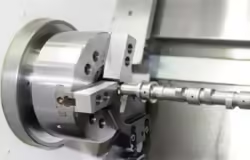
In machining environments, components made from 1080 steel billet maintain dimensional stability after heat treatment, reducing rework and improving assembly consistency.
In forging operations, the billet’s uniform structure helps ensure even material flow, which is critical for structural integrity in finished parts.
Quality Inspection and Testing Considerations
Quality control is essential when working with 1080 steel billet, especially for safety-critical or load-bearing applications. Typical inspections include chemical composition analysis, hardness testing, microstructure evaluation, and ultrasonic testing for internal defects.
Consistent documentation, including mill test certificates and heat treatment records, allows manufacturers to trace material performance throughout production. This traceability is particularly important for long-term equipment reliability.
Selecting a Reliable 1080 Steel Billet Supplier
When sourcing 1080 steel billet, buyers should evaluate suppliers based on material consistency, testing capability, delivery stability, and the ability to provide custom dimensions. Reliable suppliers also maintain strict process controls during melting, casting, and rolling stages.
From a production efficiency perspective, consistent billet quality reduces machining variation, similar to how precise calibration improves performance consistency in mechanical systems.
Storage and Handling Recommendations
Proper storage helps maintain the integrity of 1080 steel billet before processing. Billets should be kept in dry environments, protected from corrosion, and clearly labeled by batch. During cutting and handling, avoiding excessive heat buildup and mechanical impact helps prevent microcracks or stress concentration.
Good handling practices ensure that the billet’s internal structure remains stable until final processing.
Conclusion
Understanding the composition, heat treatment response, and application potential of 1080 steel billet allows manufacturers and engineers to make informed material decisions. With proper processing and quality control, this material delivers reliable performance across a wide range of industrial uses.