4130 vs 4140 Steel: Key Differences
When engineers, fabricators, or manufacturers consider which alloy steel to use, the choice between 4130 vs 4140 steel often comes up. These two chromium‑molybdenum steels share similar chemistry but are tailored for different performance niches. Choosing the wrong one can mean higher cost, reduced service life, or unexpected failure in the field.
In high‑performance structures such as aerospace tubing or automotive components, understanding how carbon, manganese, and heat treatment affect properties like tensile strength, fatigue resistance, and weldability is critical. This guide breaks down complex materials science into practical comparisons and real engineering insights that help you decide which steel best suits your needs — from cost and manufacturability to performance and longevity.
Table of Contents
Blog Key Points
- A compelling introduction to why 4130 vs 4140 steel comparison matters
- Detailed alloy chemistry and what it means in practice
- Mechanical properties with real industry ranges
- Cost and lifecycle value analysis
- Performance contrasts: toughness, wear, and machinability
- Heat treatment behaviors that define real world behavior
- Typical application cases across industries
- Design and engineering considerations
- Maintenance, safety, and failure modes
- Expert insights and authoritative observations
- FAQ addressing common search‑oriented questions
Chemical Composition: The Foundation of Differences
Alloy Element Breakdown
4130 and 4140 steels have the same base elements — iron, chromium, molybdenum — but differ in carbon and manganese levels.
| Element | 4130 Steel (%) | 4140 Steel (%) | Impact in Practice |
|---|---|---|---|
| Carbon (C) | 0.28–0.33 | 0.38–0.43 | Higher carbon increases hardness & tensile strength in 4140. |
| Manganese (Mn) | 0.40–0.60 | 0.75–1.00 | Higher Mn boosts hardenability in 4140. |
| Chromium (Cr) | 0.80–1.10 | 0.80–1.10 | Adds strength & corrosion resistance equally. |
| Molybdenum (Mo) | 0.15–0.25 | 0.15–0.25 | Improves toughness & temper resistance. |
In practice: 4140’s higher carbon and manganese give it the potential for higher hardness and load‑bearing capacity, while 4130’s lower carbon makes it easier to weld and form into complex shapes.
Why Composition Matters
Alloying elements control how steel responds to heat treatment and stress. The greater carbon content in 4140 means it can produce a stronger martensitic microstructure when quenched and tempered, whereas 4130, with lower carbon, leans toward a tougher but less robust final state after processing.
Mechanical Properties: Performance in Numbers
Tensile Strength & Yield
Mechanical behavior reflects real world demands:
| Property | 4130 Steel (Typical) | 4140 Steel (Typical) |
|---|---|---|
| Tensile Strength | ≈ 560–700 MPa | ≈ 650–850 MPa |
| Yield Strength | ≈ 460–650 MPa | ≈ 415–750 MPa |
| Elongation | ≈ 15–25 % | ≈ 15–25 % |
| Brinell Hardness (annealed) | ≈ 180–250 HB | ≈ 220–285 HB |
| Hardened Hardness | ~24–28 HRC | ~28–32 HRC |
Key insight: 4140 steel consistently delivers higher tensile strength and hardness, which translates to better resistance under heavy mechanical loads, while 4130 retains slightly higher ductility and formability.
Impact Toughness and Deformation
Impact toughness measures a material’s ability to absorb energy under sudden loading. 4130 tends to show higher toughness under shock loads, while 4140 trades some of that for increased hardness.
Cost and Lifecycle Value
Raw Material Cost
On the raw material front, 4130 steel often costs slightly less due to its lower carbon content and simpler processing in certain stock forms. 4140, with higher alloying and demand for strength, is moderately more expensive.
Total Cost of Ownership
Deciding between 4130 vs 4140 steel requires balancing initial purchase cost against service life and performance:
- 4130: Lower upfront cost and higher weldability reduce fabrication expenses.
- 4140: Higher long‑term value in high‑stress applications due to superior wear resistance and strength.
In many industrial settings, 4140’s lower failure rate under cyclic stress results in lower total lifecycle cost, even at a higher initial price point.
Performance Comparison: What Engineers Need to Know
Strength Under Load
4140 steel stands out when axial loads, bending, or torsion require maximum strength and stability. This makes it ideal for gears, crankshafts, and heavy‑duty drives.
Wear Resistance & Fatigue
4140’s higher hardenability and ability to reach up to ≈ 55 HRC in quenched and tempered conditions enhances wear resistance for surfaces subject to repeated cycles and surface contact.
4130 doesn’t harden as much but exhibits excellent fatigue resistance when the application involves dynamic loads, such as tubing structures in aerospace or automotive suspensions.
Machinability & Fabrication
4130 steel is easier to machine and form due to its lower carbon, which reduces tool wear and machining times. 4140, when machined in an annealed state, still machines well but typically requires slower feeds and more frequent tool changes for heavier alloys.
Heat Treatment: How Each Grade Behaves
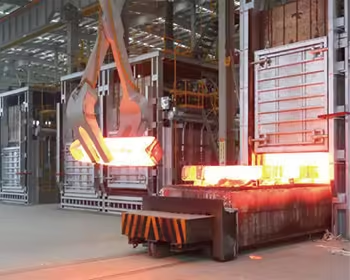
Annealing
- 4130: Typically annealed around 840–900 °C, producing a soft, machinable structure.
- 4140: Annealed between roughly 850–900 °C, preparing the material for subsequent hardening.
Quenching and Tempering
When hardened and tempered:
- 4140 Steel: Exhibits deeper case hardening and higher achievable tensile strengths with standard quench and temper techniques — ideal for heavy bearing surfaces.
- 4130 Steel: Responds well to carburizing followed by quenching to enhance surface hardness while maintaining a tough core.
Stress Relief and Warping
Because 4140 steel hardens to higher strengths, it can be more prone to distortion if not heat treated under controlled conditions. 4130’s lower carbon helps it maintain shape after welding or forming, reducing post‑processing steps.
Typical Applications: Where Each Steel Shines
4130 Steel Applications
4130 is often chosen for:
- Aerospace tubing and structural components due to its excellent weldability and toughness.
- Roll cages and frames in motorsport thanks to ductility.
- Hydraulic systems and high‑stress tubing requiring balance of strength and flexibility.
4140 Steel Applications
4140 is ideal for:
- Shafts, axles, and spindles under intense loads.
- Gears and crank components needing high tensile strength.
- Heavy machinery parts where wear and fatigue resistance is essential.
Engineering and Design Considerations
Load and Environmental Conditions
Designers evaluating 4130 vs 4140 steel should map the expected load regime: dynamic, cyclic loads favor 4130’s ductility, while consistent high stress demands the strength of 4140.
Weldability and Joining
4130’s lower carbon content makes it significantly easier to weld, especially in complex assemblies. 4140 often requires preheat and stress relief treatments to prevent cracking during welding.
Maintenance, Safety, and Failure Modes
Inspection and Wear Monitoring
Due to higher hardness, 4140 components under wear conditions benefit from regular inspections for micro‑cracks and surface fatigue. 4130 requires monitoring of deformation under dynamic loading.
Handling Heat Treatment Safely
Proper heat treatment controls are essential. Over‑quenching either steel without correct tempering can lead to brittleness or unexpected failure under load.
Expert Insights
Material science professionals often point out that steel selection is a systems decision — not just alloy choice but heat treat, machining, welding, and service environment collectively determine performance. In practical manufacturing, many engineers sequence machining before heat treat for 4140 in high precision parts to maintain tight tolerances.
Conclusion
Understanding 4130 vs 4140 steel is essential for making informed choices about materials in engineering and fabrication. If your priority is strength, wear resistance, and mechanical performance, 4140 often leads. But when weldability, flexibility, and cost‑controlled fabrication matter, 4130 is the superior choice — especially in aerospace, structural, and tubular applications.
FAQ
What’s the key difference between 4130 vs 4140 steel?
The main difference is carbon and manganese content: 4140 generally delivers higher strength and hardness, while 4130 offers better weldability and ductility.
Which steel is stronger in mechanical applications?
4140 steel typically provides higher tensile and yield strength, making it better for high‑load components.
Is 4130 easier to weld than 4140?
Yes — 4130 has superior weldability and often does not require complex pre‑ or post‑weld thermal cycles.
Can 4140 replace 4130 in structural components?
Yes, but careful heat treating and welding protocols are needed to avoid cracking and distortion.
Which steel offers better fatigue life?
Both steels can perform well under cyclic loading, but 4140’s hardened structures often provide better life in rotational components like gears and shafts.