Steel Billet: Technological Innovation and Future Trends
Steel billets are the backbone of the steel industry, serving as semi-finished materials that are transformed into bars, rods, wires, and structural profiles. As industries demand higher performance, lighter weight, and lower carbon emissions, innovations in steel billet production have become crucial. Modern technological developments are not only improving product quality but also enhancing efficiency, sustainability, and cost-effectiveness. This article explores the current innovations, compares production methods, examines material parameters, and forecasts future trends of steel billets.
Table of Contents
Understanding Steel Billets
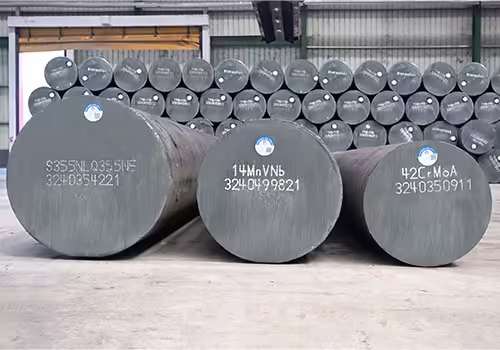
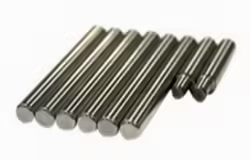
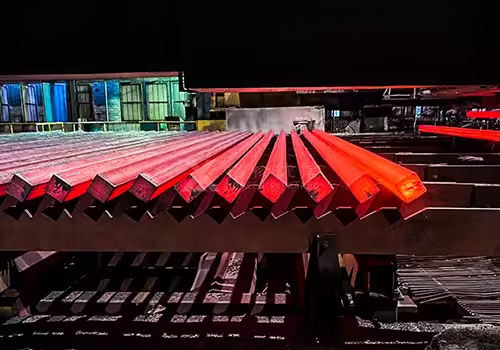
A steel billet is a semi-finished steel product, typically with a square or round cross-section ranging from 100 to 250 millimeters and a length of three to twelve meters. It is primarily produced through continuous casting and serves as the starting point for downstream products such as rods, wires, and structural steel profiles. The quality of steel billets directly influences the mechanical properties, surface finish, and dimensional accuracy of the final products. Factors such as chemical composition—including carbon, manganese, silicon, chromium, nickel, and molybdenum—as well as precise temperature control during casting and cooling rates, are critical to ensuring minimal internal defects like cracks, porosity, or segregation.
Understanding what makes a billet high-quality helps readers appreciate why innovations in this area are so impactful. High-quality billets provide a stable foundation for manufacturing processes, reduce waste, and improve the performance of end products.
Innovations Transforming Steel Billet Production
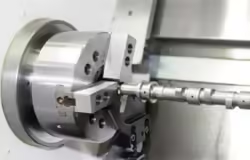
The production of steel billets has evolved significantly through smart manufacturing, automation, and data-driven quality control. Modern production lines integrate robotics for handling billets, precise control of cooling and heating rates, and real-time monitoring systems. These innovations reduce human error, stabilize grain structure, and improve dimensional accuracy, even at high production rates.
Artificial intelligence is increasingly used to monitor casting speed, thermal profiles, and surface conditions. Predictive algorithms can detect potential defects early and automatically adjust process parameters, ensuring consistent product quality. This combination of automation and AI not only reduces defects but also minimizes energy consumption and material waste.
High-performance steel billets are another major area of innovation. By carefully controlling alloying elements such as vanadium, titanium, and niobium, and applying advanced heat treatment techniques like controlled rolling and rapid quenching, manufacturers can produce billets with tensile strengths of 450 to 700 MPa and elongation rates of 18 to 25 percent. These properties make billets suitable for applications requiring high strength and toughness, such as automotive components, heavy machinery, and structural steel.
Sustainability and Low-Carbon Steel Billets

Environmental concerns have driven significant innovation in low-carbon steel billet production. Using scrap steel in electric arc furnaces reduces energy consumption and carbon emissions, while emerging hydrogen-based steelmaking technologies can lower CO2 emissions by up to 90 percent compared to traditional blast furnace processes. Precise temperature management and continuous cooling techniques also reduce thermal stress and maintain consistent mechanical properties, while minimizing energy use.
Modern plants increasingly adopt closed-loop recycling systems that reuse heat and materials, reducing waste and further enhancing environmental performance. These innovations demonstrate that high-quality, high-performance steel billets can be produced sustainably without compromising mechanical properties.
Comparing Steel Billet Production Methods
Continuous casting has become the standard method for producing steel billets due to its efficiency and superior product quality. In continuous casting, molten steel solidifies directly into billets, resulting in smoother surfaces, more uniform dimensions, and lower defect rates. In contrast, traditional ingot casting is slower, more labor-intensive, and prone to surface irregularities and internal defects, which require additional machining and increase waste.
When considering furnace type, electric arc furnaces (EAFs) provide flexibility, allowing the use of scrap steel and direct reduced iron. EAFs typically consume 350 to 400 kWh per ton of billet and produce significantly lower CO2 emissions than traditional blast furnaces, which consume 20 to 25 GJ per ton and emit much more carbon dioxide. However, blast furnaces are still used for large-scale production of standard billets because they deliver continuous output with stable quality. Understanding these differences helps engineers select the production method that balances cost, environmental goals, and the desired properties of the steel billets.
Future Trends in Steel Billets
The future of steel billet production lies at the intersection of digitization, sustainability, and material innovation. Smart mills equipped with IoT devices and AI-driven monitoring systems can track billets throughout the production process, allowing for predictive adjustments that reduce defects and improve yield. The development of high-strength and specialized billets is expanding the use of lightweight, ultra-strong steel for automotive and aerospace applications, with tensile strengths exceeding 1000 MPa achieved through microalloying and controlled cooling techniques.
Global research continues to advance vacuum degassing, rapid solidification, and innovative alloying methods, improving corrosion resistance, fatigue performance, and overall billet quality. The integration of intelligent automation with environmentally conscious processes is expected to accelerate, making steel billet production more efficient, sustainable, and suitable for high-performance industrial applications.
Concept Comparisons for Choosing Steel Billets
Choosing the right steel billet requires understanding the differences between materials and processing methods. Carbon steel billets, with a carbon content of 0.2 to 0.5 percent, are suitable for general construction due to their lower cost and adequate strength. Low-alloy steel billets, incorporating controlled additions of chromium, nickel, molybdenum, or vanadium, offer higher tensile strength, improved toughness, and better corrosion resistance, making them ideal for automotive and heavy machinery applications.
Similarly, hot-rolled billets are easier to shape and commonly used for structural steel, while cold-rolled billets offer tighter dimensional tolerances and smoother surfaces, making them suitable for machining or precision components. By understanding these distinctions, engineers can select billets that optimize performance, reduce waste, and match specific application requirements.
Conclusion
Steel billets are the foundation of modern steel production, and technological innovations are transforming both their manufacture and application. Smart manufacturing, low-carbon production methods, and high-performance material development are shaping a future where steel billets meet higher performance requirements while reducing environmental impact. Understanding production methods, material parameters, and application-specific distinctions enables manufacturers and engineers to optimize production, improve efficiency, and meet the evolving demands of high-performance industries. As the steel sector continues to embrace digitalization and sustainability, steel billets will remain a key focus of innovation and competitive advantage.
FAQ
What are steel billets used for?
Steel billets serve as the starting material for producing bars, rods, wires, structural profiles, and machinery components. They are foundational to a wide range of industrial applications.
How do I choose the right type of steel billet?
Selection depends on chemical composition, mechanical properties, downstream applications, and cost. Low-alloy billets are preferred for high-strength or specialized applications, while carbon steel billets are suitable for general construction needs.
Are steel billets eco-friendly?
Yes, particularly when produced using scrap steel, EAFs, or hydrogen-based processes. These methods reduce energy consumption and carbon emissions compared to traditional blast furnace production.
Can smart manufacturing improve billet quality?
Absolutely. AI-driven monitoring and automation allow for predictive defect control, real-time process adjustments, and consistent quality, which reduces waste and improves efficiency.
What is the difference between steel billets and slabs?
Billets are smaller in cross-section, typically 100–250 millimeters, and are used for long products such as bars and rods. Slabs are larger and used for flat products like sheets and plates.