Precision machined steel Tolerance Explained: What Really Matters in High-Performance Applications
In the world of manufacturing, tolerance is often discussed—but rarely fully understood. For buyers, engineers, and decision-makers, precision machined steel tolerance is not just a technical detail; it directly impacts product performance, assembly success, cost efficiency, and long-term reliability.
Many sourcing problems—unexpected rework, assembly failure, excessive cost, or delayed delivery—can be traced back to one root cause: incorrect tolerance decisions.
This article provides a deep, practical, and industry-aligned explanation of how tolerance works in precision machined steel, why it matters, and how to make smarter tolerance choices that balance accuracy and cost.
Table of Contents
Key Takeaways of This Article
- What tolerance truly means in precision machined steel
- Industry-standard tolerance ranges and real-world benchmarks
- How tolerance influences performance, fit, and durability
- The cost–precision trade-off explained with data
- Precision machined steel vs standard machining tolerance
- How engineers and buyers should specify tolerance correctly
- Common tolerance mistakes and how to avoid them
- FAQs based on real procurement and engineering questions
Understanding Precision machined steel Tolerance

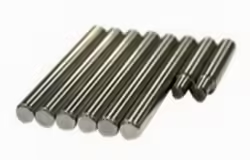
Precision machined steel refers to steel components manufactured through controlled machining processes designed to achieve high dimensional accuracy and repeatability.
Tolerance defines the acceptable variation in dimensions that allows a part to function correctly without compromising performance or assembly.
In precision machined steel applications, tolerance is often measured in:
- Micrometers (µm)
- Thousandths of an inch (0.001 in)
Even small deviations can lead to:
- Improper fit
- Increased friction
- Premature wear
- Assembly failure
What Is Tolerance in Precision machined steel?
Dimensional Tolerance Explained
Dimensional tolerance specifies how much a measured dimension may vary from its nominal value. For example, a shaft specified as Ø20.00 mm ±0.01 mm can legally range from 19.99 to 20.01 mm.
In precision machined steel, this control ensures compatibility between mating components.
Geometric Tolerances (GD&T)
Beyond size, precision machined steel also relies on geometric tolerances such as:
- Flatness
- Roundness
- Perpendicularity
- Concentricity
These tolerances control shape and alignment, which are critical in rotating or load-bearing assemblies.
Why Precision machined steel Tolerance Matters More Than You Think
Functional Performance
Tighter tolerance ensures predictable motion, alignment, and load transfer.
Precision machined steel parts used in gear systems, hydraulic components, or linear motion assemblies rely heavily on dimensional consistency.
Assembly Efficiency
Poor tolerance leads to:
- Forced assembly
- Manual adjustments
- Increased scrap rates
Well-controlled precision machined steel tolerance enables smooth, repeatable assembly, especially in high-volume production.
Long-Term Reliability
Incorrect tolerance accelerates wear, increases vibration, and reduces component lifespan.
According to industry studies, over 60% of premature mechanical failures are linked to dimensional or fit issues, not material strength.
Common Tolerance Standards for Precision machined steel
ISO Tolerance Grades (IT System)
The ISO 286 system classifies tolerances from IT01 to IT16.
Precision machined steel components typically fall within:
- IT6–IT7: High-precision mechanical parts
- IT8–IT9: General precision components
These standards help buyers and manufacturers align expectations globally.
ANSI and ASME Standards
In North America, precision machined steel tolerances often reference:
- ASME Y14.5 (GD&T)
- ANSI B4.1 (fits and tolerances)
These standards provide detailed guidance on fits, limits, and functional relationships.
Typical Tolerance Ranges for Precision machined steel
| Feature Type | Industry Typical Tolerance |
|---|---|
| Linear dimensions | ±0.01 – ±0.05 mm |
| Hole diameter | ±0.008 – ±0.02 mm |
| Shaft diameter | ±0.01 – ±0.03 mm |
| Flatness | 0.01 – 0.03 mm |
| Parallelism | 0.01 – 0.05 mm |
| Concentricity | ≤0.02 mm |
These values are widely used in automotive, industrial equipment, and automation sectors.
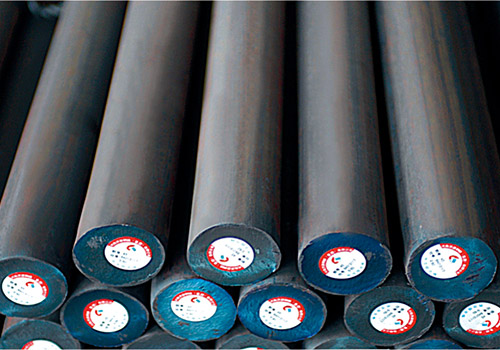
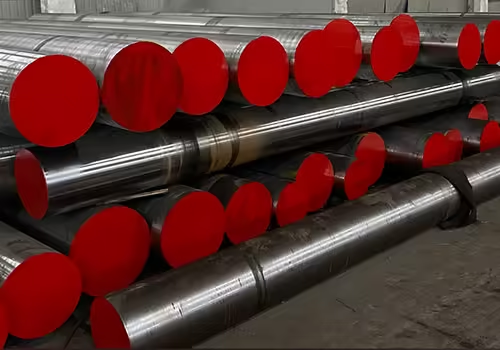
Precision machined steel vs Standard Machined Steel
Tolerance Capability Comparison
| Aspect | Precision Machined Steel | Standard Machined Steel |
|---|---|---|
| Dimensional control | Very tight | Moderate |
| Repeatability | High | Medium |
| Inspection level | Advanced | Basic |
| Cost per part | Higher | Lower |
| Application criticality | High | Low to medium |
Application Scenarios
Precision machined steel is ideal for:
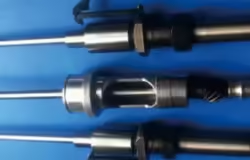
- Precision shafts and bushings
- Bearing housings
- Hydraulic valve components
Standard machined steel suits:
- Structural brackets
- Frames
- Non-critical mounting parts
Factors That Affect Tolerance in Precision machined steel
Steel Grade and Metallurgy
Different steel grades behave differently under cutting forces.
For example:
- Alloy steels with uniform grain structure allow tighter tolerance
- High-carbon steels may deform more under heat
Material selection directly influences achievable precision.
Machining Process Selection
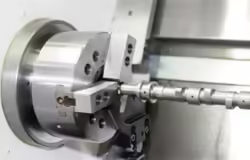
- CNC turning: Excellent for round parts
- CNC milling: Versatile geometry control
- Grinding: Ultra-tight tolerance finishing
Grinding is commonly used when tolerance below ±0.01 mm is required.
Thermal Effects
Steel expands approximately 11–13 µm per meter per °C.
Temperature variation during machining can significantly impact precision machined steel dimensions, especially in tight tolerance work.
Precision machined steel Tolerance and Cost Relationship
Why Tighter Tolerance Increases Cost
Industry data shows:
- Tightening tolerance by 50% can increase machining cost by 20–30%
- Ultra-tight tolerance (<±0.005 mm) may double production time
Reasons include:
- Slower cutting speeds
- Additional finishing steps
- More inspection cycles
Optimizing Cost Without Sacrificing Quality
Experienced manufacturers help customers:
- Identify functional tolerance needs
- Relax non-critical dimensions
- Focus precision where it matters
This approach often reduces total cost by 15–25% without affecting performance.
How to Specify Tolerance Correctly
Start With Function, Not Precision
The best tolerance decision starts with how the part works—not how precise it looks on paper.
Ask:
- Does this dimension affect fit or motion?
- Is this surface load-bearing?
Only functional dimensions need tight tolerance.
Communicate Clearly With Suppliers
Precision machined steel suppliers rely on:
- Clear drawings
- GD&T symbols
- Defined inspection requirements
Ambiguity often leads to over-processing or unexpected variation.
Inspection and Quality Control in Precision machined steel
Common Measurement Tools
Precision machined steel inspection uses:
- Coordinate Measuring Machines (CMM)
- Digital micrometers
- Optical comparators
CMM systems can measure features with accuracy up to ±1.5 µm.
Statistical Process Control (SPC)
SPC tracks machining variation over time.
By monitoring process capability (Cp, Cpk), manufacturers ensure consistent tolerance control in high-volume production.
When Do You Truly Need Tight Tolerance?
High-Speed or Rotating Assemblies
Shafts, gears, and bearings require tight tolerance to minimize vibration and noise.
Even minor deviation can amplify dynamic imbalance.
Safety-Critical Systems
Pressure vessels, hydraulic components, and load-bearing assemblies demand strict tolerance to maintain safety margins.
In these cases, precision machined steel tolerance directly impacts risk management.
Common Tolerance Mistakes in Precision machined steel
Over-Tolerancing
Specifying tight tolerance everywhere increases cost with no added benefit.
This is one of the most common errors in early-stage design.
Ignoring Assembly Stack-Up
Tolerance stack-up across multiple components can cause cumulative misalignment.
System-level thinking is essential in precision machined steel assemblies.
Future Trends in Precision machined steel Tolerance
Digital Twin and Simulation
Advanced simulation tools predict tolerance behavior before production.
This reduces trial-and-error and improves first-pass yield.
Smart Machining Systems
AI-driven CNC systems adjust parameters in real time to maintain tolerance consistency.
This technology is increasingly adopted in high-precision steel machining.
Final Thoughts: Making Smarter Tolerance Decisions
Precision machined steel tolerance is not about pursuing maximum accuracy—it is about achieving the right accuracy.
By understanding how tolerance affects function, cost, and reliability, engineers and buyers can make informed decisions that lead to better products and more efficient manufacturing.
A well-defined tolerance strategy is the foundation of successful precision machined steel applications.
FAQ
What is a normal tolerance for precision machined steel?
Most precision machined steel components operate within ±0.01 mm to ±0.05 mm, depending on function and size.
Does tighter tolerance always mean better quality?
No. Quality means meeting design intent. Overly tight tolerance can increase cost without improving performance.
How do I know if my tolerance is too tight?
If cost, lead time, or supplier options are limited, tolerance may be tighter than necessary.
Can CNC machining achieve ultra-tight tolerance alone?
CNC machining handles most needs. Grinding or honing is used for tolerance below ±0.01 mm.
Are all steel grades suitable for tight tolerance?
No. Alloy composition, heat treatment, and internal stress affect achievable precision.