Why Do Tiny Hard Particles Matter When Steel Becomes Tire Wire?
Table of Contents
Steel cord filaments become progressively thinner during drawing, making an internal particle more significant relative to the surrounding section.
Tiny hard particles can matter in tire wire because the steel around them becomes progressively thinner during drawing, while a particle that does not deform readily can disturb that flow. A feature that occupies a small fraction of a thick rod can become more significant relative to the cross-section of a fine filament. This is one reason the internal cleanliness of steel cord feedstock matters.
Steel cord consists of fine steel filaments assembled into a reinforcing structure used in tires. The visible cord is already small; the individual wires within it are smaller still.
Zoom through three scales
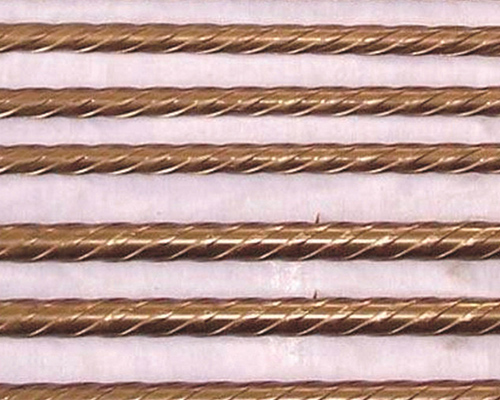
Start with a tire, then look at its reinforcement, then at one filament. The material has traveled a long way in size from the steel rod that began the drawing process.
Drawing pulls steel through successively smaller openings. Each reduction redistributes solid metal into a narrower, longer shape. A microscopic particle inside the steel must pass through this deformation along with its surroundings.
Nonmetallic inclusions are particles of compounds such as oxides or sulfides. They are not all equally hard, equally shaped, or equally able to deform. The contrast between their behavior and that of the surrounding steel is central to the problem.
Three descriptions help keep the scale changes clear. The starting rod is material for further reduction. A filament is an individual fine wire. Cord is an assembly of filaments. Those objects belong to connected stages, but their dimensions and jobs are not identical.
The forming journey is substantial even when every individual reduction seems modest. At each stage, the surrounding steel becomes narrower and longer. An internal feature travels through the same sequence, carrying its own composition, shape, and mechanical response into increasingly confined surroundings.
This is different from dissolving the whole rod and casting a new thin shape. In drawing, the existing solid material is deformed. A particle already inside it is not automatically removed because the outside becomes smaller.
Imagine the surroundings shrinking around a feature
As a simple geometric thought experiment, place a small rigid bead inside a cylinder that becomes much thinner. Even without enlarging the bead, its size relative to the cylinder increases. The surrounding material has less space in which to flow around it.
An actual inclusion can deform, fracture, or interact with the steel in several ways, depending on what it is made of. The bead picture explains the importance of relative scale rather than claiming that every inclusion remains unchanged.
Nippon Steel discusses inclusion control among the concerns for high-performance wire rod applications, including demanding fine-wire uses. Research into oxide inclusion deformability in tire-cord steel examines why inclusion composition and deformation behavior deserve attention alongside size.
A ten-micrometer thought experiment
Suppose a hypothetical particle has a width of 10 micrometers and remains unchanged in size while its surrounding wire is reduced. In a wire 1 millimeter across, or 1,000 micrometers, that width is 1 percent of the wire diameter. In a 0.2-millimeter wire, or 200 micrometers, it is 5 percent.
The particle has not grown, but its relative width has increased fivefold. The wire’s cross-sectional area has fallen by a factor of 25 because diameter is squared in the circle-area formula. A dimension that looked small beside the earlier section occupies a more significant scale beside the later section.
If both the particle’s section and the wire section were ideal circles of those diameters, their area ratio would rise from 0.01 percent to 0.25 percent. These are separate ratios from the 1 and 5 percent width comparisons. Mixing a linear percentage with an area percentage would misrepresent the geometry.
The example assumes an unchanged circular particle solely to make the scale relationship transparent. It is not an inclusion limit, a representative cord diameter, or a prediction that a particular wire will break. Real particles can have irregular shapes and can respond to deformation rather than staying circular.
There is also a local-versus-average distinction. A single particle’s cross-section affects the region where it occurs. Averaging its volume over a long length of wire can produce a tiny overall fraction while concealing its local significance. The question is what the surrounding metal experiences near that feature, not only what percentage of an entire coil it occupies.
The particle and the steel do not always move together
When the matrix stretches along the wire, an inclusion may elongate readily, resist shape change, or fracture, depending on its nature and conditions. “Nonmetallic” is therefore not one mechanical behavior. Composition and structure help determine how a particle responds during the reduction sequence.
A deformable inclusion can change shape along with the surrounding steel to a greater extent than a rigid one. That does not make every elongated inclusion harmless. It explains why size alone is an incomplete description: the particle’s response and its interaction with the matrix also matter.
A resistant particle can disturb local flow. The steel must accommodate the mismatch between its own deformation and that of the inclusion. The surrounding region can experience a more complicated strain and stress pattern than a uniform-particle-free model would show.
Fracture of an inclusion is not equivalent to making it disappear. Breaking one object into smaller pieces changes its geometry and interactions; the fragments still occupy material locations. Their arrangement and the condition of the surrounding matrix remain relevant.
The research on oxide inclusion deformability linked above examines this material-specific behavior. Its value is the distinction between different inclusion compositions and responses, not a universal claim that one numerical particle size determines the outcome of every drawing route.
Cleanliness is an internal description

Washing the outside of the rod cannot remove a particle trapped within its metal. Steel cleanliness concerns the inclusion population established during steelmaking and processing. Surface cleanliness is a separate, also important, part of preparing wire for drawing.
Likewise, a smooth outside does not reveal every internal feature. The particle becomes relevant through the way it interacts with the material under deformation, not through whether it is visible in a photograph of the rod.
The issue is also different from fatigue in a finished bearing. There, repeated service loading can concentrate stress around an inclusion. Here, the steel must first survive a manufacturing journey through substantial reductions in cross-section.
Two rods can therefore look equally clean in a photograph while differing internally. Removing grease or scale from the outside deals with the external surface. It cannot reach an inclusion enclosed within solid steel. Conversely, controlling internal inclusions does not remove the need to prepare the outside appropriately for later drawing.
A microscopic view also samples a particular section. A feature must intersect the observed region to appear in that image. The absence of a visible particle in one small field is not the same statement as absence throughout a long volume of feedstock. The method and sample size determine what an observation can support.
Why the feedstock matters before the cord exists
The steel must first survive the manufacturing sequence before its properties can contribute to a tire. A break during reduction is a manufacturing event. Fatigue or other damage after the finished cord is in service is a different stage, with a different loading history. Treating the two as identical would miss when and how the relevant deformation occurs.
Internal features are important early because later drawing cannot simply turn every unfavorable inclusion into favorable steel. Deformation changes geometry, but it is not a general purification process. The starting material carries its internal population into the route that makes it fine.
Jiyuan lists steel for steel-cord applications among its downstream products. The connection is upstream of the tire: steel feedstock must be suitable for a route that reduces and assembles fine filaments. This is a more specific material use than the general phrase “steel wire.”
There is no single visual threshold at which an inclusion suddenly becomes important. Its effect belongs to the combination of particle, surrounding steel, and deformation path. The 10-micrometer model makes just one of those relationships visible: reducing the wire from 1 millimeter to 0.2 millimeter multiplies that unchanged feature’s relative width by five.
Inclusions Along the Journey to Tire Wire
Why can an unchanged particle become more important as wire gets thinner?
Its size becomes larger relative to the surrounding section. In the article’s hypothetical example, a 10-micrometer feature spans 1 percent of a 1 mm wire diameter but 5 percent of a 0.2 mm diameter. That geometry is not a universal breakage limit.
Can drawing purify steel by making its inclusions disappear?
No. Drawing changes the shape of existing solid material rather than generally removing its enclosed particles. Inclusions may deform, resist deformation, or fracture depending on their nature. Their interaction with the surrounding steel remains important as the section becomes finer.
For a related inquiry, describe the starting form, intended wire-reduction route, and relevant material requirements. If the question concerns an observed feature, its measured size and location are more useful than calling it a “tiny impurity.” The material discussion then has a defined scale and manufacturing stage.