How Can an Acid Bath Reveal the Inside of a Steel Billet?
Table of Contents
Macroetching reveals patterns in continuous cast steel by making different regions of a prepared section react and appear differently.
An etchant can reveal the internal pattern in a billet of continuous cast steel because different regions of a prepared cross-section react differently. The resulting variations in surface relief and appearance create contrast. Features that were difficult to see on a freshly cut metallic face become visible as a larger-scale map of the material.
The method is called macroetching. “Macro” refers to features examined at relatively low magnification or directly by eye, in contrast with the much finer details studied through a microscope. The billet is not transparent after treatment. Instead, a cut face becomes easier to interpret because the exposed material no longer looks uniformly metallic.
The first revealing step is the cut
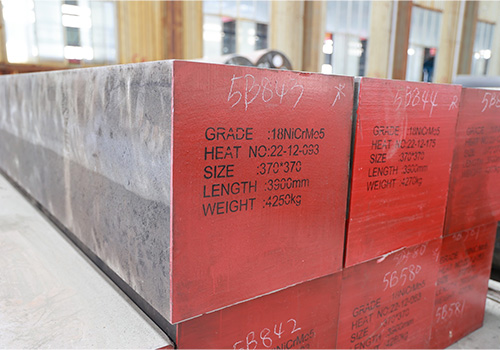
A billet’s outside hides its center. Looking at its long outer faces cannot provide the same view as looking at a section cut across its width. A transverse section exposes the journey from one side, through the middle, to the opposite side. That is often the useful direction when the question concerns how the billet solidified.
Cutting alone may not make that history obvious. A new section can look like a largely featureless field of silver-gray metal. Saw marks may dominate the image, while contamination or uneven surface roughness may create their own patches. Those features belong to the preparation of the specimen rather than necessarily to the billet’s internal structure.
Preparation therefore has a clear purpose: make the steel’s response visible without letting the preparation marks overwhelm it. It is comparable to cleaning a window before looking through it, except that the metal remains opaque and the evidence is on the exposed face itself. The face must be suitable for the chosen method before the resulting pattern can mean much.
This is why a photograph of an unprepared saw-cut end and a photograph of an etched section can look so different even when they come from the same billet. The material did not acquire a new casting history between photographs. The preparation and contrast changed which parts of that history could be observed.
The acid makes a contrast, not a colored label
An etchant reacts with the exposed metal. Regions with different composition or structure may respond differently, producing variations in attack, surface relief, and appearance. Light then reflects from that altered face in a way that reveals patterns which were faint or invisible before treatment.
It is tempting to imagine the acid as a dye that paints carbon one color and iron another. That picture is misleading. The visible result comes from a chemical interaction with the prepared surface, not from each element carrying a simple identifying color. A dark area is an observation that needs interpretation, not a direct percentage written by the acid.
ASTM E381 covers macroetch testing of steel bars, billets, blooms, and forgings. Its public scope places this examination within a defined testing method. That matters because a meaningful image depends on how the specimen was prepared and treated as well as on the material being examined.
Think of a relief map: small changes in height create shadows that make a landscape easier to read. An etched metal face can also contain relief and contrast, but its pattern is generated by selective reaction rather than by drawing a map on top. The visible pattern is evidence about the specimen, mediated by the method used to reveal it.
There is no need to treat this explanation as a home experiment. The useful knowledge is how a laboratory image is created and what questions it can answer. The chemicals and preparation belong to a controlled metallographic process; an attractive photograph by itself does not disclose all of those conditions.
Why casting leaves something worth revealing
Continuous casting removes heat from molten steel while a strand is being formed. An outer shell develops first, while the interior remains hotter and can remain liquid for longer. The center and the outside therefore do not experience the same solidification history at the same moment.
The Continuous Casting Consortium’s process explanation describes the developing shell and the liquid interior. This moving boundary between liquid and solid is the background to many large-scale patterns seen in cast sections. A billet is not simply a container of liquid that becomes uniformly solid everywhere at once.
As solidification proceeds, the arrangement of solidifying regions and the redistribution of dissolved elements can leave patterns across the section. Some features relate to structure; others relate to local compositional differences or discontinuities. An etched cross-section can make aspects of those differences easier to distinguish.
A cavity is a separate idea. Porosity means an empty region within the material. When a section intersects it, that opening can become visible. Segregation, by contrast, refers to an uneven distribution of composition; it need not be an empty space. Confusing the two turns every dark mark into a “hole,” even though dark contrast can have several causes.
Likewise, a line on an etched image is not automatically a crack. Some lines may reflect structural patterns, while others may be discontinuities. The image needs the context of the specimen and the examination method. Giving every visible feature the same alarming name discards the very distinctions the examination is intended to reveal.
A slice has a direction and a position
Imagine a long loaf containing a narrow tunnel that runs partway along it. A slice through the tunnel shows an opening. A slice beyond the tunnel does not. Neither slice is dishonest; each describes a different position. A section through a steel billet has the same fundamental limitation: it displays only the features that intersect that plane.
Orientation changes the view as well. A cross-section cuts across the length. A longitudinal section follows it. A long narrow feature might appear as a small mark in the first view and as an extended streak in the second. The two images can describe the same three-dimensional feature without resembling each other closely.
Even a spherical pore offers a simple example. A plane through its center produces the largest circular opening. A plane near its edge produces a smaller circle. A plane that misses it produces none. The measured size of an opening on one cut therefore does not automatically give the maximum size of the entire feature.
This is not a defect in sectioning; it is the geometry of observing three dimensions through two. A useful image record includes the specimen’s location and orientation so that a reader knows which part of the billet the picture represents. A detached close-up without a scale or location can be visually striking yet difficult to interpret.
A series of sections can provide more information about variation along a billet, but it still consists of sampled locations. Increasing the number of views changes the amount of evidence. It does not turn a single view into a complete picture of every cubic millimeter.
Large patterns and tiny structures answer different questions

Macroetching and microscopy operate at different scales. The overall shape of a central pattern may fit within a picture of the whole section. A tiny carbide particle or the fine arrangement of phases calls for another level of preparation and magnification. Enlarging a low-resolution photograph is not equivalent to performing microscopic examination.
An everyday comparison is a map of a city versus a photograph of the bricks in one wall. The city map explains where districts lie relative to one another; the wall image explains local detail. Neither is a defective version of the other. Their usefulness depends on the size of the question.
The same applies to chemistry. An etched pattern may suggest where composition varies, but the darkness of a region is not a calibrated carbon meter. A numerical composition result comes from an appropriate chemical measurement. A macrograph and a chemistry result can support one another while remaining different types of evidence.
Nor does one pattern create a universal pass-or-fail rule for all steel. A billet intended for one processing route may be evaluated under requirements different from those for another product. The public existence of a macroetch method does not mean that every visible mark has one universal acceptance limit.
Jiyuan’s billet offering includes cast square, rectangular, and large round forms. That variety gives a practical context to these images: the cross-section being discussed may be a square, a rectangle, or a circle, while the underlying questions about the center, exterior, and casting history remain meaningful. The billet is starting material whose internal and external form both matter to later processing.
The most revealing detail in a macrograph may be its caption: where the section came from, how it is oriented, and what scale it shows. Those few facts turn an abstract pattern into an observation about a definite place inside a definite piece of steel.
Interpreting an Etched Billet Section
Does a dark macroetched region give an exact carbon percentage?
No. Etching creates contrast through differences in how the prepared surface reacts. Darkness can reflect several aspects of the material and preparation. A numerical chemical concentration requires an appropriate chemical measurement; the etched image is not a calibrated carbon map.
Can one etched section show every feature inside a billet?
No. It shows a two-dimensional plane through a three-dimensional object. A feature must intersect that plane to appear, and section orientation changes its apparent shape. Location, direction, and scale are essential context for understanding what the image represents.
If an etched image has prompted a material inquiry, share the billet form, section size, intended processing route, and the specific feature you want to discuss. Including the image scale and whether it is a transverse or longitudinal section makes the question much clearer than sending an unexplained dark patch. Testing arrangements can then be discussed in the context of that particular material request.