AISI 4140 Technical Guide: Properties, Heat Treatment, and Sourcing
In the world of industrial production, reliability is the only currency that matters. Among all low-alloy grades, AISI 4140 has earned its reputation as the “workhorse” of the mechanical engineering industry. Known for its exceptional balance of toughness, fatigue strength, and abrasion resistance, this chromium-molybdenum alloy is the go-to solution for components that must survive high-stress environments.
Choosing AISI 4140 is not just about picking a metal; it is about selecting a versatile metallurgical platform that can be tailored through precise heat treatment to meet specific structural demands.
Table of Contents
What Exactly is 4140 Alloy Steel?
Technically classified as a low-alloy steel, 4140 Alloy Steel contains chromium and molybdenum as strengthening agents. The “41” in its name signifies its alloy family (Chromium-Molybdenum), while the “40” denotes a nominal carbon content of 0.40%. This specific carbon level is the “sweet spot” that allows the material to achieve high hardness without becoming overly brittle.
According to the ASTM A29/A29M Standards, this grade is recognized for its excellent atmospheric corrosion resistance and good strength-to-weight ratio. The structural integrity of AISI 4140 makes it indispensable for critical parts like gears and shafts.
Breaking Down the 4140 Chemical Composition
The performance of 4140 Steel is a direct result of its elemental makeup. Each element plays a calculated role in the final mechanical behavior of the metal.
Chemical Matrix (Typical Values)
| Element | Percentage (%) | Role |
| Carbon (C) | 0.38 – 0.43 | Increases hardness and strength. |
| Chromium (Cr) | 0.80 – 1.10 | Enhances hardenability and corrosion resistance. |
| Molybdenum (Mo) | 0.15 – 0.25 | Increases toughness and strength at high temperatures. |
| Manganese (Mn) | 0.75 – 1.00 | Improves tensile strength and hardenability. |
| Silicon (Si) | 0.15 – 0.35 | Acts as a deoxidizer and strengthens the ferrite. |
High-Performance 4140 Material Properties
Understanding the 4140 material properties is critical for safe engineering design. While the exact values vary based on the heat treatment process, the following are standard benchmarks for the material in a Quenched and Tempered (Q&T) state.
- Tensile Strength: 850 – 1000 MPa (Typical).
- Yield Strength: 650 – 850 MPa (Typical).
- Elongation: 12% – 20%.
- Hardness: Usually ranges between 28 – 34 HRC (Pre-hardened) but can reach higher levels after specialized heat treatment.
For a deeper dive into verified data, engineers often reference databases like MatWeb to analyze the mechanical iterations of AISI 4140.
Heat Treatment: Unlocking Potential
The versatility of 4140 Steel lies in its response to heat. Depending on the desired outcome, manufacturers typically use one of the following two states when processing AISI 4140:
Annealed State
Annealing involves heating the steel to a critical temperature and cooling it slowly. This results in a softer material with improved machinability, making it easier to mill or turn before final hardening.
Quenched and Tempered (Q&T)
This is where the material shines. By heating the steel and then rapidly cooling it in oil (Quenching), followed by re-heating (Tempering), we achieve a superior combination of high strength and ductility. Most users prefer to buy 4140 steel online in a pre-hardened (Q&T) condition to save on production time and costs.
Major Specifications: Round Bars and Forgings
AISI 4140 is available in various forms to suit different manufacturing methods. Choosing the right form can significantly impact the final performance of the component.
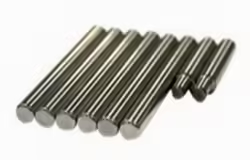
1.Round Bars: The most common form, used for axles, bolts, and shafts.
2.Forgings: Forged parts offer superior grain flow and internal strength. The properties of 4140 forged steel make it indispensable for high-impact applications where cast parts would fail. Using AISI 4140 in its forged state provides maximum resistance to structural fatigue.
4140 Steel Equivalent Table
Global sourcing often requires finding a 4140 steel equivalent. Use this quick reference:
- Germany (DIN): 42CrMo4 (1.7225)
- Japan (JIS): SCM440
- China (GB): 42CrMo
Common 4140 Steel Applications in Manufacturing
Due to its high fatigue strength, 4140 Alloy Steel is utilized across nearly every heavy industry. Here are the primary 4140 steel applications in manufacturing:
- Oil & Gas: Drill collars, tool joints, and valve bodies.
- Automotive: Crankshafts, steering knuckles, and axle shafts.
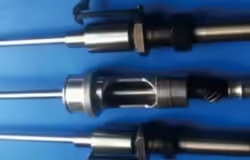
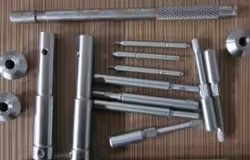
- Heavy Machinery: Transmission gears, conveyor rollers, and hydraulic cylinders.
The reliability of AISI 4140 ensures that these components can withstand cyclic loading without catastrophic failure in harsh environments.
Procurement: How to Buy 4140 Steel Online
In the digital age, sourcing industrial materials has shifted. To successfully buy 4140 steel online, procurement officers must verify three key things:
1.MTC Verification: Ensure the batch matches the required chemical composition.
2.Delivery Condition: Clearly specify if you need Annealed or Q&T (Pre-hardened).
3.Dimensional Tolerance: Check if the supplier adheres to ASTM or ISO tolerances.
Reliable suppliers of AISI 4140 will provide full traceability and documentation for every batch, ensuring the material meets international standards.
Final Expert Conclusion
The enduring popularity of 4140 Alloy Steel stems from its predictability. It responds consistently to heat treatment, machines well in the annealed state, and offers a level of toughness that few materials can match at this price point. By understanding the 4140 material properties and applying the correct processing standards, manufacturers can ensure their products stand the test of time.
FAQ
Can AISI 4140 be welded?
Yes, but it requires care. You must pre-heat the material and perform a post-weld heat treatment (PWHT) to prevent cracking in the Heat Affected Zone (HAZ).
Is 4140 better than 1045 steel?
4140 Steel is superior in terms of hardenability and strength. Use 1045 for light-duty parts and 4140 for critical, high-load components.
What is the maximum hardness 4140 can achieve?
After oil quenching, it can reach approximately 54-59 HRC, though it is almost always tempered back to a lower range (28-50 HRC) to regain toughness.