Medium Carbon Steel Equivalents — How 1045, C45 and EN8 Compare for Engineering Use
When engineers need a reliable service steel that balances strength, machinability and heat-treat response, medium carbon grades are often the first choice. This guide to Medium Carbon Steel Equivalents explains how common grades (AISI 1045, C45, EN8 / S45C) line up chemically and mechanically, outlines practical steel substitution rules, and gives actionable advice for selection in design and manufacturing.
Table of Contents
Why grade equivalence matters
Manufacturers frequently source equivalent grades across regions: an American drawing may call out AISI 1045, a European supplier lists CK45 / EN8, and Asian mills use JIS S45C. Understanding Medium Carbon Steel Equivalents avoids specification mismatches that cause welding, heat-treatment or performance problems on final parts. Authoritative material datasheets are a good first check: for example, the properties of AISI 1045 are well documented in material databases like MatWeb.
Chemical composition and mechanical baseline
Typical chemistry for these medium carbon steels centres on ~0.43–0.50% carbon and moderate manganese (≈0.6–0.9%). That composition delivers tensile strengths commonly between 570–700 MPa in normalized or hot-rolled condition and Brinell hardness around 170–210 HB for many suppliers. These numbers are consistent across respected references and review articles.
| Common name / spec | Typical designation | Carbon (approx.) | Typical tensile (MPa) |
|---|---|---|---|
| AISI 1045 | SAE/AISI 1045 | 0.43–0.50% | 570–700. (MatWeb) |
| C45 / CK45 | DIN / EN / 1.1191 | 0.42–0.50% | ~570–700. (Australian Steel Institute) |
| EN8 / 080M40 | BS / EN (UK) | ~0.40–0.50% | Similar range; may vary with thermomechanical processing. (Solitaire Overseas) |
Key selection and substitution rules
1.Match the application, not just the name. When substituting one of the Medium Carbon Steel Equivalents, ensure heat-treatment capability, section size and surface condition match the original spec. For example, S45C can have slightly different hardenability than AISI 1045 depending on section thickness — don’t substitute blindly.
2.Check mechanical spec limits. If the drawing lists specific tensile or yield values, use those numbers to pick an equivalent, not just the grade name. Refer to datasheets for exact treatment-condition values (normalized, annealed, quenched+tempered).
3.Welding and preheat. Medium carbon steels with ~0.45% C often require preheat/interpass control for thick sections to avoid cracking. That welding guidance applies across most Medium Carbon Steel Equivalents.
4.Surface finish and supply condition. Bright-finished EN8 vs hot-rolled AISI 1045 may machine differently; always note the supply condition when substituting.
Heat treatment and machinability notes
All three commonly substituted grades respond well to normalization and induction or flame hardening. Carburizing is generally not recommended for plain 1045 because of limited hardenability; if surface hardening is essential, consider an alloyed higher-hardenability grade. These practical heat-treatment cautions are part of why precise Medium Carbon Steel Equivalents selection matters.
Real-world examples and use cases
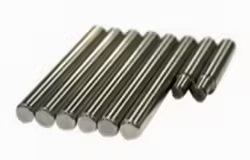
- Shafts and axles: AISI 1045 (or C45) in normalized condition is a common economical choice for medium-stressed shafts due to its combination of strength and toughness.
- Gears and bushes: If case hardening is required, consider alternative alloyed grades or adjust design—plain 1045 equivalents are not ideal for heavy surface fatigue without suitable treatment.
- Prototype to production: When moving from prototype (3D-printed or soft metal) to production, make sure your CAD/BOM uses the correct equivalent grade for your supplier’s region to avoid supply delays.
Final checklist before substituting
- Verify chemical limits and tensile/yield ranges on the supplier datasheet.
- Confirm section thickness and heat-treatment route will deliver required properties.
- Check weldability and required preheat for thicker sections.
- If surface hardness or wear resistance is critical, consider an alloyed alternative rather than direct substitution among Medium Carbon Steel Equivalents.
Conclusion
Knowing the subtle differences between AISI 1045, C45 and EN8 helps you make safe substitutions and avoid downstream problems. Treat the grade name as a starting point — validate the mechanical spec, supply condition and heat-treatment plan before committing to any Medium Carbon Steel Equivalents in production.
FAQ
Is 1045 steel the same as C45?
Yes, AISI 1045 and C45 are generally considered equivalent medium carbon steels under different international standards. Both contain about 0.43–0.50% carbon and provide similar strength, hardness, and machinability for engineering applications.
Is 1045 steel the same as C45 in mechanical properties?
In most cases, 1045 and C45 have very similar mechanical properties. Their typical tensile strength ranges from 570–700 MPa, depending on heat treatment and supply condition.
Where can I find an international carbon steel conversion chart?
An international carbon steel conversion chart compares grades across standards such as AISI, DIN/EN, JIS, and BS. These charts help engineers identify equivalent materials when sourcing steel globally.
What are the mechanical properties of C45 vs EN8?
C45 and EN8 have comparable mechanical properties as medium carbon steels. Typical tensile strength ranges from 550–700 MPa, with good machinability and moderate wear resistance.
How can engineers verify steel grade equivalence before substitution?
Engineers should check chemical composition, mechanical properties, heat-treatment condition, and hardenability to ensure the substitute material meets the original specification.
What is the European equivalent of 1045 steel?
The European equivalent of AISI 1045 steel is C45, defined under the EN and DIN standards. Both are medium carbon steels with similar carbon content (around 0.45%) and comparable mechanical properties.
Is EN8 stronger than 1045 steel?
EN8 and 1045 steels have very similar strength levels. Their typical tensile strength ranges from 550–700 MPa, depending on the heat treatment and supply condition.
What is the JIS equivalent of C45 steel?
The JIS equivalent of C45 steel is S45C, specified in the Japanese Industrial Standards. Like 1045 and C45, S45C is a medium carbon steel commonly used for shafts, gears, and mechanical components.