Why Can a Steel Billet Crack as It Cools?
Table of Contents
During continuous casting cooling, regions of a billet shrink and develop strength at different times, creating stresses between connected material.
A steel billet can crack while cooling because its different regions do not cool, shrink, and gain strength at the same time. The outside may already be solid while the center is still liquid. As temperatures change, neighboring regions pull on one another, and the developing metal must also withstand the forces of the casting process. Cooling turns liquid steel into a useful solid, but doing it unevenly can create stresses along the way.
A billet is a relatively compact length of semi-finished steel that can later be rolled into products such as bars or wire rod. In continuous casting, it begins as part of a moving strand of steel. The strand is formed and cooled continuously before being cut into shorter lengths.
Solid on the outside does not mean solid all the way through
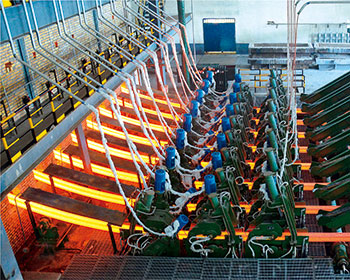
When liquid steel enters a cooled mold, a solid shell forms against the mold walls. More material freezes onto that shell as heat leaves. For part of its journey, the strand is therefore a container made of its own solidifying metal, surrounding a much hotter interior.
The Continuous Casting Center at the Colorado School of Mines describes this shell-and-liquid-core stage and the spray-cooling region below the mold. The shell is not merely an outer coating. It has to contain the liquid steel while continuing to grow.
A loaf of bread can have a firm crust before its center is ready, which helps visualize an outside-in process. Steel is obviously undergoing very different changes, but the useful point is the same: looking at an object’s exterior cannot tell you that its center has reached the same condition.
Neighboring regions cannot shrink independently
Most of us have seen the small gaps left in structures that must expand in warm weather. Cooling produces the opposite tendency: material generally contracts. In a newly cast billet, however, a cooler region is connected to a hotter region that has not yet contracted by the same amount.
Imagine two neighboring strips joined along their length. One tries to become shorter while the other remains longer. Their connection prevents each strip from freely taking the shape it wants. Forces develop inside them. In steel, these internal forces are called stresses.
The real situation is more complicated because the metal’s strength and ability to stretch also change with temperature. Its microscopic structure changes as it cools. A temperature difference is therefore acting on material whose response is changing during the journey.
This is why “more water” is not automatically a complete answer. A strong local spray may cool one patch quickly while nearby steel remains hotter. The important question is how the whole temperature pattern develops, including what happens between spray zones.
Heat has to travel out of the center
Spraying water on the outside does not put cold water in direct contact with every part of the billet. Heat from deeper inside must travel through steel before it can leave at the surface. That transport through the material is conduction. The outside can respond quickly to its surroundings while the interior responds more slowly.
The cooling system therefore acts on a moving body with a temperature distribution, not on a single temperature number. Two locations on the same cross-section can be at different temperatures, and the same surface location can experience different cooling conditions as it moves down the machine.
The Continuous Casting Center’s process explanation describes secondary cooling through water sprays together with radiation as the strand travels onward. Radiation is heat transfer through emitted electromagnetic energy; it continues without water physically touching every exposed point.
Solidification also involves removing the energy associated with changing liquid into solid. A region does not finish freezing merely because its exterior looks dark enough or because steam has appeared nearby. The internal thermal history determines the progress of the solidification front.
A surface can warm again while the whole billet is losing heat
At first this sounds contradictory. Imagine a surface patch passing through a strong spray. Its temperature drops while hotter material remains beneath it. When that patch moves into a region with less cooling, heat continuing to conduct outward from the interior can make the surface temperature rise again.
The billet as a whole can still be losing energy. The local rise means that energy is being redistributed inside the object faster than it is leaving that particular patch at that moment. The center is the heat source for this reheating; no new furnace has appeared between the sprays.
A familiar comparison is a hot dish cooled briefly on the outside. Its exterior can become warmer again after the strongest cooling stops because heat stored inside keeps moving outward. For cast steel, these local rises and falls matter because they change expansion, contraction, and the material’s response to strain.
A study of nozzle spray distance and billet secondary-cooling uniformity measured water-flux distributions and examined their thermal consequences. Its results connect spray arrangement with reheating and corner temperature in the studied system. They do not establish one spray arrangement or water quantity that is correct for every billet caster.
This is the physical reason that the path through cooling zones matters as much as one snapshot of the water spray. The shell has a memory in the form of its temperature and structure when it reaches the next location.
Corners have a different neighborhood
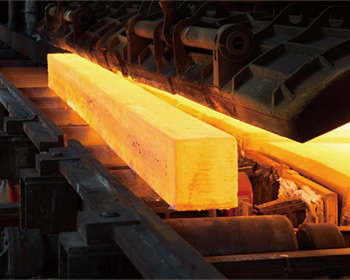
A corner sits beside two exposed faces. The center of a broad face has a different path for losing heat. That difference can make the corner’s temperature history distinct from the rest of the surface, rather than simply making every part of the billet cool at one shared rate.
Some casting machines also guide the strand along a curved path and then straighten it. Bending and straightening impose deformation on steel that is still hot. If a region is poorly able to accommodate that deformation at that moment, cracking becomes more likely. The thermal story and the mechanical story overlap.
None of this means that every corner crack has the same cause. Steel composition, shell growth, surface condition, cooling distribution, and the machine’s physical action can interact. A visible crack is the outcome of that history, not a label identifying one universal mistake.
Temperature and cooling rate describe different things
Temperature describes the state of a region at a particular moment. Cooling rate describes how quickly that temperature is changing. A temperature reading by itself cannot tell you whether the surface arrived there gradually, fell rapidly, or cooled farther and then warmed again.
Imagine two surface patches reaching the same temperature. One has cooled steadily; the other has recently reheated from a colder condition. Their present readings match, but the changes in dimension and the interaction with neighboring metal have followed different paths. A single final reading cannot reconstruct those paths.
The timing of mechanical movement adds another coordinate. A region may be relatively able to accommodate strain at one point in its temperature history and less able at another. Bending or straightening acts on the material in that particular condition, rather than on a timeless property called “hot steel.” This is why the sequence of cooling and deformation matters.
A crack is a result, not a complete history
A visible line on a cooled billet might invite the explanation “it cooled too fast,” but that phrase leaves several different possibilities unresolved. Was the cooling uneven across the section? Did a surface region cool and then reheat? Did the shell encounter a mechanical strain while its local condition made it vulnerable? These questions concern different parts of the same journey.
Some apparent lines may also be surface patterns or breaks in scale rather than the same kind of crack in the steel. A photograph can show location and appearance, but it cannot reveal the complete temperature distribution or reconstruct every force that acted during casting.
This is why a clear description of billet form helps anchor a discussion. Jiyuan’s steel billet category includes cast square or rectangular forms and large round forms. Shape changes the relationship between faces, corners, and heat-flow distances; an explanation tied to one form should not silently become a claim about every other form.
Cooling a Billet Without Oversimplifying Cracks
Can a billet surface warm while the whole billet is losing heat?
Yes. Heat can move from the hotter interior toward an exterior that has already cooled. If that inward supply exceeds the heat leaving a local surface region for a time, the surface can warm even as the billet continues losing thermal energy overall.
Does every crack in a cast billet prove that cooling was too fast?
No. Uneven contraction, temperature-dependent deformation, geometry, and casting forces can contribute to cracking. A crack records a result rather than its complete history. Its appearance alone cannot establish one cooling cause or one universally correct adjustment.
If you are exploring billet material for a downstream process, share the section shape and dimensions with Jiyuan, along with the intended rolling or forging route. Where a surface concern prompted the inquiry, noting its location and supplying a clear image gives the discussion useful context. It is a starting description of the material, not a substitute for reconstructing the casting process that produced a particular defect.