How Much Does a Round Steel Bar Weigh?
Table of Contents
The round steel bar weight formula is mass = density × π × diameter² × length ÷ 4, with consistent units.
A solid round steel bar weighs as much as the volume of steel it contains multiplied by the steel’s density. That sounds abstract, but it takes only two measurements to make a useful estimate: the bar’s diameter and its length. For an illustrative carbon steel rod 20 millimeters across and 1 meter long, using a density of 7,850 kilograms per cubic meter, the result is about 2.47 kilograms.
The surprising part is what happens when the bar gets thicker. A rod twice as long weighs twice as much. A rod twice as wide weighs four times as much, even though its length has not changed. The reason is hidden in the circular end.
Imagine a stack of very thin steel coins
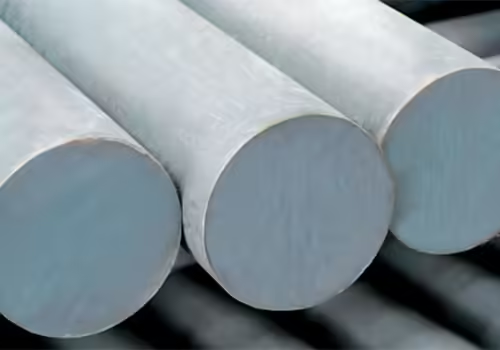
Looking at the end of a round bar, you see a circle. Imagine slicing the whole bar into thin coins of equal thickness. Each coin contains the same amount of steel, so putting twice as many coins in the stack doubles the total. This is why weight rises directly with length.
The area of each circular coin is π × radius × radius. The radius is the distance from the center to the edge; it is half the diameter. Multiplying that area by the stack’s length gives the volume. Multiplying volume by density turns an amount of space into an amount of material.
Written with the diameter, the round steel bar weight formula is:
Mass = density × π × diameter² × length ÷ 4.
The squared diameter simply means diameter multiplied by itself. The division by four comes from halving the diameter twice to turn it into the two radii in the circle-area formula.
A 20-millimeter rod, one step at a time
For our example, first convert 20 millimeters to 0.020 meters. The radius is therefore 0.010 meters. Its circular area is approximately 3.14159 × 0.010 × 0.010, or 0.00031416 square meters. Multiply by the 1-meter length and the volume becomes 0.00031416 cubic meters.
Now multiply by the assumed density: 0.00031416 × 7,850 = approximately 2.466 kilograms. Rounding sensibly gives 2.47 kilograms. This is an illustrative estimate for a solid cylinder, not a measurement of a particular bar.
There is a convenient shortcut when diameter is in millimeters and length is in meters: mass in kilograms is approximately 0.006165 × diameter² × length. That small number contains π, the density assumption, and the conversion from square millimeters to square meters. It is useful precisely because the units have already been worked out; mixing inches into it would break the calculation.
Why twice as thick means four times as heavy
Keep the rod 1 meter long, but increase its diameter from 20 to 40 millimeters. Both dimensions across its circular end have doubled. The circle now covers four times the area, so the estimated mass rises from about 2.47 to 9.86 kilograms.
By contrast, keeping the original 20-millimeter diameter and increasing the length to 2 meters gives about 4.93 kilograms. No new area has been added to each imaginary coin; there are simply twice as many coins.
This helps explain why a modest-looking increase in the thickness of a steel rod can make it unexpectedly difficult to lift. Our eyes notice a change in width, while our hands experience the change in cross-sectional area.
Three easy mistakes can change the answer dramatically
The first is mixing millimeters and meters. A diameter of 20 millimeters is 0.020 meters, not 20 meters. Because diameter is squared, that conversion appears twice. In a formula using kilograms per cubic meter, leaving the diameter in millimeters makes the area one million times too large. This is why a unit error can produce a wildly unrealistic result rather than a small discrepancy.
The second is mixing radius and diameter. If you put the diameter into a formula that expects the radius, you double each of the two radius factors. The result becomes four times too large. A useful check is to write the measured dimension in words before calculating: “20 mm across the whole circle” means diameter, while “10 mm from the center to the edge” means radius.
The third is treating centimeters as millimeters. A two-centimeter rod and a twenty-millimeter rod describe the same diameter. Putting the number 2 into the millimeter shortcut describes a much thinner rod. Its calculated mass would be one-hundredth as much, because the diameter has become one-tenth and its square one-hundredth.
These errors are easier to catch with a rough comparison than with more decimal places. A one-meter steel rod about as thick as a finger should not emerge from the calculation weighing a few milligrams or thousands of kilograms. The formula is exact for its geometric model, but it cannot recognize that its inputs use incompatible units.
What if you know the weight and want the length?
The same relationship can work backward. At a fixed diameter and assumed density, divide the total mass by the mass per meter. Using our 20 mm example, 10 kilograms corresponds to about 10 ÷ 2.46615, or 4.055 meters of ideal solid rod. It does not matter whether that total length is one piece or several pieces, provided they all have the same cross-section and there is no material lost between them.
Now compare a 40 mm rod. Its mass per meter is about 9.8646 kilograms, so the same 10 kilograms corresponds to only about 1.014 meters. Both piles contain the same amount of steel, but the thicker rod uses that material across a larger area and therefore has much less length.
This is a useful antidote to judging material quantity from length alone. Four meters of a slender rod and one meter of a rod twice its diameter can contain essentially the same mass. Laid side by side, they tell very different visual stories even though the scale would give similar readings.
Pieces introduce counting, not a new density formula. Ten ideal pieces that are each 0.4 meters long have a total length of 4 meters. Calculate one piece and multiply by ten, or calculate the full 4 meters at once; the result is the same. If the pieces are actually cut from a longer bar, the metal removed by the saw belongs to the original stock but not to the finished pieces. Geometry must describe the object whose mass you are estimating.
Why a scale might give a different answer
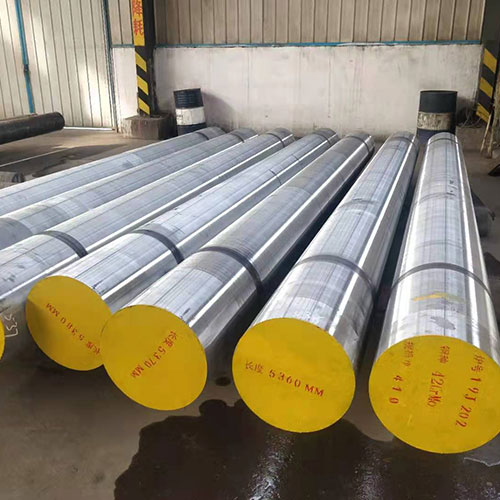
The calculation assumes a perfectly cylindrical, solid bar with the stated measurements. Real rods can be slightly larger or smaller, have rounded or cut ends, or carry a surface layer of oxide. Different steel compositions also have slightly different densities. A hollow tube needs a different volume calculation because the empty middle contributes no steel.
Strictly speaking, kilograms describe mass, while weight is a force measured in newtons. Everyday speech often calls a kilogram reading “weight”; the NIST guide to SI units explains the underlying unit system. For comparing the amounts of steel in ordinary rods, the kilogram calculation is the familiar and useful one. The formula tells you why a bar should be roughly that heavy; the scale tells you what the actual object measures.
A tube needs its empty center subtracted
A round outline does not prove that the object is solid. A tube with a 20 mm outside diameter and a 10 mm inside diameter has the outer circular area minus the inner circular area. Its metal area is proportional to 20² − 10², or 300, compared with 400 for a solid 20 mm rod. At the same length and density, that illustrative tube contains 75 percent as much steel.
It would therefore have a calculated mass of about 1.85 kilograms per meter under the same density assumption. Using only the outside diameter would overestimate its mass because the formula would count the hole as steel. A tapered rod presents another difference: its cross-section changes along its length, so one diameter cannot represent every slice.
The products discussed on Jiyuan’s round bar page are steel bar forms, including carbon and alloy steel categories. Keeping “solid bar” distinct from “tube” is useful even before discussing the exact grade. The shape decides which volume formula belongs to the calculation.
How precise should the final number look?
A calculator may produce 2.466150233 kilograms for the one-meter example, but that long decimal does not mean the real rod has been measured to a millionth of a kilogram. The diameter, length, and density were assumptions or measurements with their own limits. The result inherits those limits.
A small diameter difference is especially influential because of the square. If the diameter were 20.1 mm instead of 20.0 mm, the area ratio would be 20.1² ÷ 20² = 1.010025. That is roughly a 1 percent increase in mass, even though the diameter rose by only half a percent. A 1 percent increase in length, by contrast, produces exactly a 1 percent increase in mass in this model.
Writing “about 2.47 kg” is therefore more honest than displaying a string of digits unsupported by the inputs. Extra precision in arithmetic is useful while calculating, but the final wording should reflect what is actually known about the object.
Round-Bar Weight: Two Common Calculation Traps
Why does doubling a round bar diameter quadruple its weight?
The area of a circle depends on diameter squared. At the same length and density, doubling the diameter gives four times the cross-sectional area, four times the volume, and approximately four times the mass. Doubling only the length would instead double the mass.
Can the solid-bar formula be used for a steel tube?
A tube needs the empty center subtracted. Calculate the outer circular area, subtract the inner circular area, then multiply by length and density. Using only the outside diameter treats the hole as steel and overestimates the tube’s mass.
If you are moving from this calculation to a real round-bar project, the most helpful starting details are the diameter, length, quantity, and steel grade if one has already been established. You can send those dimensions to Jiyuan with a note saying whether you need material information or an indicative mass discussion. A clear description of the solid section lets the conversation begin with the right geometry, rather than with a weight that accidentally includes an imaginary hole or uses the wrong unit.