Open Die Forging vs. Closed Die Forging: Which is Cost-Effective?
Feeding a 150mm piece of metal into a roughing mill designed for a 300mm block doesn’t just waste your equipment’s mechanical capacity—it actively destroys the tensile strength of your final product. When you set out to compare steel billet and steel bloom for your next procurement contract, you are not just checking spot market prices. You are matching semi-finished steel geometry to your rolling mill’s maximum reduction ratio.
Procuring the wrong format means your facility will struggle with roll gap adjustments, or worse, end up with structural cracks in the finished beams due to insufficient core compression. This guide breaks down the physical, metallurgical, and logistical thresholds you must evaluate before finalizing your import volume.
Table of Contents
Where is the Line? Steel Billet Size vs Bloom Size Chart
The fundamental difference between these two semi-finished steel products is strictly dimensional, yet those dimensions dictate the entire downstream workflow.
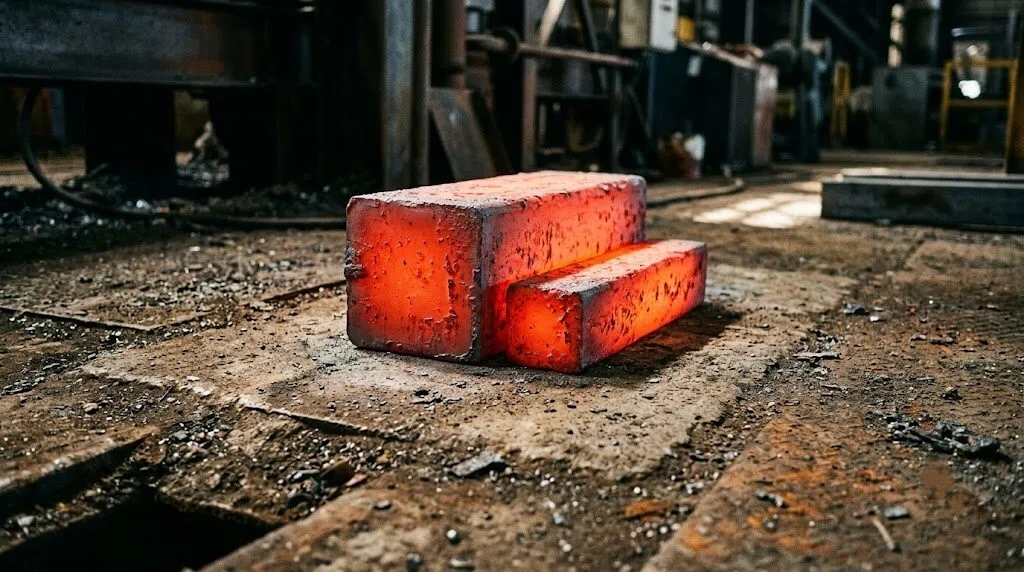
A billet is generally smaller, usually square, with a cross-section less than 150mm x 150mm (or 36,000 mm²). A bloom is massive, typically rectangular, and exceeds those measurements. According to the foundational classifications of semi-finished casting products detailed on Wikipedia, if the cross-section drops below this strict threshold, the thermal dynamics during rolling change completely, categorizing the metal as a billet.
Before jumping into procurement, review how these dimensions impact your mill capabilities:
| Parameter | Steel Billet | Steel Bloom | Procurement Verdict |
| Cross-Section | Under 150mm x 150mm | Over 150mm x 150mm | Defines reheating furnace opening requirements. |
| Shape | Almost always square | Square or rectangular | Rectangular blooms require specific roughing pass designs. |
| Weight per Meter | Light to medium | Extremely heavy | Dictates port handling fees and factory crane load limits. |
| Primary Output | Wire rod, rebar, light sections | Heavy rail, H-beams, forging | Mismatching input to output guarantees yield loss. |
How Does Casting Method Affect Steel Bloom Quality?
You cannot assess steel billet vs bloom without looking at what happens inside the continuous casting machine. The larger the cross-section, the slower the cooling rate at the absolute center of the steel.
Because a bloom is thick, its core stays liquid significantly longer than its surface. As it solidifies, impurities like carbon, sulfur, and phosphorus are pushed toward the center. This creates centerline segregation. As noted by metallurgical engineers dissecting centerline segregation issues in continuous casting on Reddit, if your steel mill does not apply soft reduction (mechanical pressing) during the final solidification stage, that bloom will arrive at your port with a brittle core.
Billets, having a smaller cross-section, cool much faster. This rapid cooling creates a finer, more uniform grain structure with minimal segregation. However, because they are already small, they cannot provide the massive deformation (reduction ratio) required to forge heavy-duty industrial components. You rely on the immense pressure of rolling a large bloom down to size to “knead” out internal porosities.
Downstream Processing: When to Choose Steel Bloom Over Billet
Purchasing decisions must trace backward from your final product catalog.
Focusing on steel billet sizing:
If your plant primarily outputs standard construction materials—such as wire rods, coiled rebar, or light merchant bars—billets are your mandatory input. The reheating furnaces in these specific rolling mills are dimensionally restricted. Forcing a larger format into a mill designed for billets causes severe jamming and uneven heating profiles.
Defining steel bloom applications:
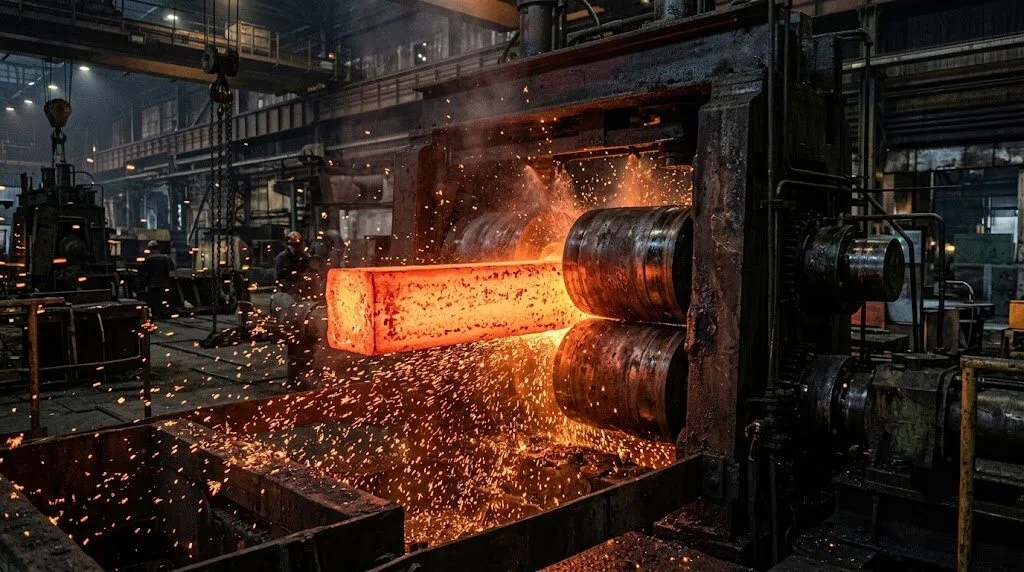
If you are supplying tier-1 infrastructure projects, blooms are non-negotiable. You need them for heavy rail tracks, large seamless pipes, and wide-flange H-beams. When evaluating rolling structural steel mechanics as published by The Fabricator, the mechanical integrity of heavy structural beams relies entirely on the roughing mill squeezing a massive bloom down into a complex web-and-flange shape. You cannot achieve this structural density starting from a small billet.
How to Compare Steel Billet and Steel Bloom for B2B Import
Do not send an RFQ (Request for Quotation) to a foreign steel mill based solely on the chemical grade. Your purchasing team must audit the supplier against these four structural constraints:
1.Calculate Your Mill’s Reduction Ratio:
The industry standard dictates a minimum reduction ratio of 6:1 (cross-section of the semi compared to the finished product) to consolidate internal casting voids. If you buy a bloom that is too large, your mill will run out of passes before hitting the final dimension.
2.Verify NDT (Non-Destructive Testing) Standards:
Because blooms are prone to internal defects, visual inspection is useless. Before authorizing the shipment, demand an audit of their subsurface integrity. Heavy industrial components must undergo strict ultrasonic testing for internal flaws, a baseline verification standard established by structural engineering authorities like TWI Global.
3.Logistics and Crane Capacity:
A standard billet might weigh 1 to 2 tons. A heavy bloom can easily exceed 5 to 10 tons per piece. Are your inland freight contractors and factory overhead cranes rated to lift massive blooms safely off the flatbed?
4.Surface Defect Conditioning:
Are the semis cast and shipped “as-is”, or are they scarfed? Large sections often require scarfing or grinding to remove surface oscillation marks before you reheat them. According to detailed technical papers on the continuous casting process published on ScienceDirect, surface cracks on the raw material will elongate and deepen during your rolling process, leading to rejected final batches.
The difference between a profitable production run and a factory floor piled with rejected scrap comes down to material geometry. Stop sourcing semi-finished goods blindly based on tonnage pricing. Analyze your crane limits, calculate your exact mill reduction passes, and then strictly compare steel billet and steel bloom to secure the precise structural foundation your equipment demands.
FAQ
Can I roll standard rebar using a steel bloom?
Mechanically, yes, but financially, it is a disaster. Rolling a heavy section down to a 12mm rebar requires excessive reheating time and drastically increases the electrical consumption of your mill motors. Use billets for rebar.
Why do steel blooms often cost more per ton than steel billets?
Even though both are unfinished, blooms require longer, controlled cooling processes in the steel plant to prevent thermal cracking. The necessity of soft-reduction technology and stricter internal NDT requirements for heavy-duty applications drives up their baseline manufacturing cost.
How do I verify if a batch of semis has surface cracks before shipping?
Never rely on photos of stacked steel. Contract a third-party inspector at the origin port to perform Magnetic Particle Inspection (MPI) or review the mill’s acid macro-etching reports.