Why Is a Square Steel Bar Wider from Corner to Corner?
Table of Contents
Steel square bar dimensions differ by direction: for an ideal square, the corner-to-corner span is about 1.414 times the width across flats.
A square steel bar is wider across its opposite corners because that measurement crosses the square diagonally. For an ideal square with sharp corners, the diagonal is about 1.414 times the distance between opposite flat faces. A bar that is 40 millimeters wide from flat to flat is therefore about 56.57 millimeters across the corners. Both measurements describe the same piece of steel.
The apparent contradiction comes from the word “width.” With a circle, every straight line through the center reaches the same distance between opposite edges. A square changes its apparent width as you turn it. Its dimensions need a direction as well as a number.
A paper square reveals the difference
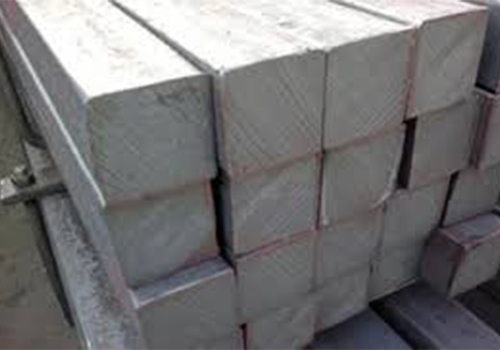
Imagine drawing a square on paper. Put one ruler straight across it, from the middle of the left edge to the middle of the right edge. That is the side length of the square, also called the distance across flats when describing a square bar.
Now move the ruler so that it joins the lower-left corner to the upper-right corner. This longer line is the diagonal. It travels sideways and upward at the same time. Although it is the shortest route between those two corners, the corners themselves are farther apart than the opposite flat faces.
The diagonal divides the square into two right-angled triangles. Each triangle has two equal short sides. The Pythagorean theorem says that the square of the long side equals the sum of the squares of the two short sides. For a 40-millimeter square, that means 40² + 40² = 3,200. The square root of 3,200 is approximately 56.57.
This calculation is about shape, so it works for a steel bar, a wooden stick, or the square you drew on paper. The material does not change the geometry.
Turning a square changes the space it occupies
Picture the end of that bar between two parallel walls. When a pair of its faces runs parallel to the walls, it occupies 40 millimeters of the gap. Turn it by 45 degrees and its opposite corners point toward the walls. It now occupies about 56.57 millimeters.
The steel has not expanded. Its orientation has changed. This is similar to moving a square box through a doorway: the space needed depends on how the box is turned, not just on the length printed beside one edge.
The width changes smoothly between the two positions
The square does not jump straight from a 40 mm width to a 56.57 mm width as soon as it begins turning. Its projected width changes continuously. At a small angle, part of the measured span comes from one side’s horizontal contribution and part from the neighboring side’s contribution.
For an ideal square of side b turned through an angle θ between zero and 90 degrees, the horizontal span is b × (cos θ + sin θ). The sine and cosine describe how much of each side projects horizontally. You do not need this formula to recognize the effect, but it explains the intermediate positions that a two-picture sketch leaves out.
At zero degrees, the two factors are 1 and 0, giving a span of b. At 45 degrees, they are equal, each about 0.7071, so the span is 1.4142b. At 90 degrees, their roles reverse and the span returns to b. The square has made a quarter-turn and presents an equivalent flat-facing outline again.
For the same illustrative 40 mm square, a 30-degree turn produces a span of about 40 × (0.8660 + 0.5), or 54.64 mm. That is already close to the maximum diagonal span. A shape can therefore need substantially more room before it reaches the familiar diamond-looking position.
This observation belongs to the shape’s envelope: the smallest space bounded by parallel lines that contains the turned outline in that direction. The amount of steel in the bar has not changed. The enclosing space changes because the same material is pointing in a different direction.
Real corners are not always sharp
An actual steel bar may have rounded corners. The flat faces can still be 40 millimeters apart while the outermost corner points sit slightly inside the sharp square we drew. In that case, the maximum corner-to-corner distance is smaller than 56.57 millimeters.
One way to visualize this is to erase just the tips of the four corners on your drawing. You have changed the greatest span without moving the middle of any flat face. Rounding also removes a little cross-sectional area, so a rounded square contains slightly less material than a perfectly sharp square with the same distance across flats.
That does not mean every rounded bar has the same reduction. A gentle curve and a broad rounded corner leave different outlines. The ideal diagonal formula describes the sharp mathematical square; the real shape determines the actual extreme points.
So when reading steel square bar dimensions, a number such as “40 millimeters square” normally draws attention to the sides. The larger diagonal is still there, waiting to become visible when the bar turns. Once you imagine the end as a rotating paper square, the two measurements stop competing: one describes the flats, and the other describes the corners.
Three different circles can describe the same square
One circle can sit inside the square and touch the middle of all four sides. Its diameter equals the square’s side length. For our example, that is 40 mm. It leaves the four corner regions of the square outside the circle.
A second circle can surround the square and pass through all four corners. Its diameter equals the diagonal, about 56.57 mm. This circle contains the entire square, but also includes empty curved regions outside each flat face.
A third circle can have exactly the same area as the square. Set πd²/4 equal to b² and solve for its diameter: d = 2b/√π. For a 40 mm square, the answer is about 45.14 mm. This circle has the same area, but it neither fits entirely inside the square nor contains the entire square.
These circles answer different questions. The first describes the largest circle that fits inside. The second describes a circle large enough to surround the sharp-cornered square. The third compares amounts of area. Mixing them up can make a correct number look useful for the wrong geometric problem.
If the circle and square were solid steel bars of equal length and density, the equal-area pair would contain equal calculated masses. That would not make their outside dimensions interchangeable. Equal material quantity and equal space requirement are separate ideas.
Across flats, across corners, and along the bar
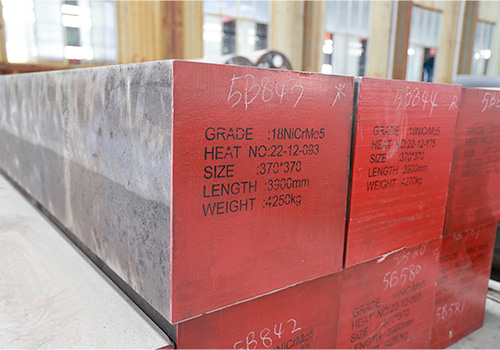
So far, every measurement has stayed within the two-dimensional end face. The bar’s length runs perpendicular to that face and adds a third dimension. Making the bar longer increases its volume but does not change the side-to-diagonal ratio at an unchanged cross-section.
This separation helps when looking at a drawing or photograph. A long perspective view can make the visible end look like a parallelogram because of the viewing angle. That visual effect is not evidence that the actual cross-section has stopped being square. A view looking directly at the end removes much of the perspective confusion.
Measurements between opposite parallel faces also differ from measuring from an arbitrary surface point to another point with a ruler held at an angle. The longest straight distance within the ideal square is corner to opposite corner. A line that misses either corner is not the full diagonal, even if it looks slanted.
A quick paper demonstration makes the relationships concrete. Draw a square with a side of 4 centimeters, measure its diagonal, then rotate the paper while keeping two parallel guide lines fixed. The square’s widest projected span appears near the position where a diagonal runs between the guides. The paper can model a steel end because the geometry does not depend on the material.
Use the shape’s name and its measurement together
Jiyuan’s square steel bar category describes carbon and alloy square sections, with listed dimensions in a substantially larger range than the 40 mm teaching example used here. The example is deliberately easy to calculate; it is not a statement that this size is offered in that category.
The same relationships scale up. For an ideal 200 mm square, the sharp-corner diagonal is 200√2, or about 282.84 mm. Every linear dimension is five times that of the 40 mm square, so the diagonal is five times larger too. Its cross-sectional area, however, is twenty-five times larger. The geometry separates changes in linear size from changes in the amount of material.
Understanding the Space Around a Square Bar
Will a 40 mm square bar fit inside a 40 mm circular opening?
An ideal sharp-cornered square measuring 40 mm across its flats needs a surrounding circle about 56.57 mm in diameter. Its corners extend beyond a 40 mm circle. Rounded corners change the outline, so an actual fit depends on the complete section geometry.
Is an equal-area circle the same as a circle surrounding a square?
No. An equal-area circle contains the same area, but it does not necessarily enclose the square. The enclosing circle must reach the corners. For an ideal 40 mm square, the equal-area diameter is about 45.14 mm, while the enclosing diameter is about 56.57 mm.
If a square-section project has led you to this question, a simple end-view sketch is often more informative than a number labeled only “width.” Mark whether the number refers to opposite flats or corners, and indicate any relevant corner curve. You can share that sketch with Jiyuan together with the required length and grade if known. It gives a material inquiry an unambiguous starting point without expecting one size number to describe several different distances.