Why Can Steel Split When It Is Squeezed?
Table of Contents
Cold heading steel wire can split while being squeezed because its expanding circumference stretches locally as the blank becomes shorter.
Cold heading steel wire can split during squeezing because the metal forced outward may stretch locally, even while the overall operation is compressive. The direction of the machine’s force does not describe the stress and strain at every point inside the workpiece. A compressed cylinder can grow wider, stretching its outer circumference until a surface region cracks.
This is particularly useful for understanding upsetting, the forming operation that makes a short piece of wire or bar shorter and wider.
Watch the circumference grow
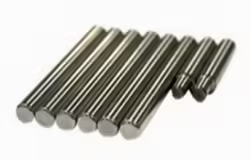
Imagine a short steel cylinder between two flat pressing faces. As the faces move toward one another, the cylinder’s height decreases. Its volume changes relatively little, so material spreads sideways.
Draw a ring around the cylinder’s middle before compression. As the diameter grows, that ring must become longer. The machine pushes vertically, but the marked surface is stretching around the circumference.
For an ideal cylinder whose volume stays constant, reducing its height to half would double its cross-sectional area. Its diameter would increase by the square root of two, approximately 1.414. Its circumference would increase in the same proportion, about 41.4 percent.
That is an illustrative uniform-deformation model. A real piece does not necessarily expand evenly, but the arithmetic shows why compressing in one direction can demand considerable extension in another.
Compression has a direction
The word “compressed” can describe the overall action of a machine without describing every local deformation. A cylinder between two approaching platens is shortening in the loading direction. That fact says nothing by itself about whether a small line drawn around its side becomes shorter or longer.
Use a grid rather than a single ring to picture the difference. Draw several lines around the circumference and several along the length. During an ideal uniform upset, the longitudinal spacing between neighboring rings decreases. At the same time, each ring grows longer as the radius increases. The grid is squeezed in one direction and expanded in another.
Choose simple numbers: a cylinder starts 10 millimeters in diameter and 20 millimeters high. Its volume is 500π cubic millimeters. If the height falls to 10 millimeters at unchanged volume, the new cross-sectional area is 50π square millimeters and the diameter becomes approximately 14.14 millimeters.
The original circumference is 10π, about 31.42 millimeters. The new circumference is approximately 44.43 millimeters. A marked ring has gained about 13.01 millimeters of length even though the cylinder has lost 10 millimeters of height. There is no contradiction because the measurements run in different directions.
Reducing height by another half would not add another fixed amount to the diameter. At one-quarter of the original height, the area would be four times the original area and the diameter twice the original diameter. The relationship follows area and volume, not a simple rule that each millimeter of height becomes one millimeter of width.
This model does not supply a fracture limit. It describes a shape change a perfectly uniform, volume-preserving cylinder would require. A real steel and forming route may behave differently well before that ideal shape is reached. Its value is showing the stretching demand hidden inside the phrase “squeezed shorter.”
Friction changes where the metal moves
The steel touching the pressing faces does not always slide outward as freely as the steel farther from them. Friction can restrain the ends while the middle spreads more, producing a barrel-like profile.
This uneven movement changes the local strain and stress pattern. Some surface regions experience a different deformation history from others, even within one short piece.
Nippon Steel’s research on fracture behavior during forging discusses the influence of deformation mode and lubrication. It illustrates why the material’s response cannot be predicted from the simple phrase “under compression.”
Imagine that the material touching the tools is restrained while a region at mid-height is freer to move sideways. The outside no longer remains the straight side of an ideal cylinder. Its middle bulges. A photograph of the final profile can show that the deformation was not distributed uniformly along the height.
This barrel-like shape matters because average dimensional change does not describe the most heavily deformed patch. Dividing the total height reduction by the original height gives an overall measure. It does not reveal the strain history at every point on the bulging surface.
Lubrication changes the contact conditions; it does not make the steel stop needing to deform. Tool shape, initial shape, material condition, and friction together influence the path. The same nominal height reduction can therefore correspond to different local deformation patterns in different tests.
The distinction between stress and strain is useful here. Stress describes internal force intensity; strain describes deformation relative to the starting state. A surface patch may undergo extension even while the machine force is compressive overall. Understanding cracking requires attention to the local state, not merely the direction of the machine’s travel.
An existing line and a new crack are not the same history
A seam or another surface discontinuity can act as a starting point for damage. As the surface extends, that feature may open further. In another case, a crack may develop from the deformation itself without an obvious pre-existing surface seam.
These possibilities are physically different. Seeing the final split does not, by itself, show whether the earliest separation existed before the press began moving.
Picture two blanks that look similar after forming because both have a split along the bulged side. One began with a small surface discontinuity that opened as the surface extended. In the other, separation developed during deformation in material that had no comparable visible feature beforehand. The final appearance can be similar even though the starting histories differ.
A photograph taken only after the stroke cannot recover all the earlier events. Images of the starting surface, the shape before and after forming, and the location where separation appeared provide different pieces of evidence. They help distinguish the observation “there is a split” from the stronger claim “this particular mechanism caused it.”
Orientation can add information without solving the entire problem. A feature parallel to the axis has a different relation to circumferential extension than a feature running around the cylinder. Watching how a marked or visible feature changes during deformation helps explain why its direction matters.
A split also need not start at exactly the place where it ends up most obvious. Once separation begins, further deformation can open and extend it. The largest visible opening in the finished part may represent an advanced stage of the damage rather than the original initiation site.
Why cold-heading steel is judged through a forming journey

The steel’s ability to accommodate deformation matters too. Its composition, internal condition, and prior working history influence how much and what kind of strain it can sustain. A hardness number alone cannot reconstruct that entire history or describe every forming path.
A simple shape may demand relatively modest redistribution, while a more complex fastener head can require metal to travel through several intermediate shapes. Splitting risk belongs to the combination of material and deformation route. It cannot be assigned solely from the broad fact that the operation is performed cold.
Jiyuan’s downstream steel applications include cold-heading steel. The relevance is the ability to start with steel intended for a process that redistributes solid material into a new shape. It places the feedstock in the context of making headed parts rather than treating it as an anonymous cylinder.
What the split teaches about force and shape
The outside of the cylinder is not being compressed in the same way as its height. To become wider, the circumference must increase. If a surface region cannot accommodate the local deformation imposed on it, separation can develop even while the total press load points inward.
This is why “steel is strong in compression” is an incomplete explanation of an upsetting operation. It refers broadly to a loading mode, while the actual part experiences a spatial pattern of deformation and stress. The relevant question is what happens at the region where damage begins.
The ring drawn around the initial 10-millimeter cylinder provides a concrete way to remember that distinction. Its original 31.42-millimeter circumference would have to reach about 44.43 millimeters in the ideal half-height example. The machine shortened the object, but the surface ring had to become longer.
Why Compression Can Open a Surface Split
How can the surface stretch while a steel cylinder is being squeezed?
The cylinder shortens axially while material spreads sideways. Its circumference must become longer as its diameter increases. In the article’s ideal constant-volume example, halving height increases diameter and circumference by about 41.4 percent, even though the overall machine motion is compressive.
Does a split after upsetting prove there was already a seam?
No. A pre-existing feature can open during deformation, but separation can also develop during the forming event. The final split alone does not establish its starting condition. Before-and-after observations and the feature’s location provide additional context.
If your interest comes from a real forming task, describe the starting section, material condition, and intended part geometry. For a question prompted by an observed split, before-and-after images and the location of the feature make the discussion more concrete. They document the event without turning a single photograph into a definitive diagnosis.