Can a Square Steel Bar Be Straight and Twisted at the Same Time?
Table of Contents
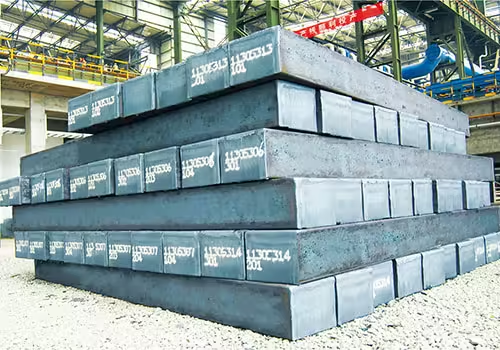
An HR steel square bar, meaning hot-rolled square stock, can have a straight centerline while its faces rotate along the length.
Yes. A square steel bar can have a straight centerline while its cross-section rotates along its length. Straightness describes where the bar’s center travels. Twist describes how its faces turn around that center. They are independent aspects of shape.
A long twisted ribbon makes the distinction easy to see. Hold the two ends along the same straight line and rotate one end. The ribbon’s broad surface turns, even though the imaginary line through its center can remain straight.
Follow the center, then follow a corner
Imagine looking through a transparent square bar. Draw a dot at the center of every cross-section and connect the dots. That line describes the path of the bar’s center.
Now draw a second line along one corner. In a straight, untwisted bar, the corner line runs parallel to the centerline. In a straight but twisted bar, it winds around the centerline instead.
The corner has changed direction without requiring the center to wander sideways. If you look only at the centerline, you miss the rotation. If you look only at a single end, you cannot tell what orientation the other end has.
For an illustrative picture, imagine the near end with one face horizontal. Farther along, that face has rotated by 10 degrees. A little farther, it has rotated by 20 degrees. The local square shape can remain square throughout; its orientation is what changes.
A square can hide a quarter-turn
An unlabeled square has rotational symmetry. Turn it through 90 degrees and its outline looks the same again. A face that was on top has moved to the side, but another identical face now occupies the top position.
This creates a subtle trap when comparing only the ends of a bar. If the section has rotated by a complete quarter-turn along the length, the two unmarked end outlines can look aligned even though the material between them is twisted.
Label the faces A, B, C, and D around the section. At the near end, face A is on top. After a quarter-turn, face A has moved to a side. The geometric outline repeats, but the identity of the face reveals what changed.
A stripe drawn along one face or corner serves the same conceptual purpose. It supplies a reference feature that an otherwise symmetric outline does not provide. The stripe is not measuring stress; it is making orientation visible.
A round bar takes the symmetry further. An ideal circle has the same outline after any rotation about its center. Material within it can twist, while an unlabeled end circle gives no unique direction to follow. Square faces make the same kind of rotation easier to see because they provide natural references.
Bending makes a different change
Bend the entire bar into a shallow arc without twisting it. The centerline is now curved. Its cross-sections can keep a consistent orientation relative to that bending path, rather than progressively winding around it.
A real piece can combine both effects. Its center may bow while its faces also rotate. Describing only one does not eliminate the other, just as describing a road’s uphill slope does not tell you whether it also curves left.
Square bars make twist particularly visible because their flat faces and corners provide reference directions. A perfectly circular cross-section has no unique corner to track. Rotating an ideal circle about its center leaves the outline looking the same, although the material itself can still undergo torsional deformation.
Why a flat surface can reveal a surprise
Imagine placing one face of a square bar on a perfectly flat plane. If that face rotates progressively along the length, different parts of it try to touch the plane at different angles. The bar may rock or make contact near different edges even though its centerline is straight.
This is a geometric consequence, not proof of one particular manufacturing cause. Uneven deformation, cooling, or subsequent handling can influence a bar’s shape, and the visible result does not identify the whole history.
The same end rotation can be distributed differently
Imagine a three-meter paper model whose square cross-section turns through a total of 90 degrees. In one drawing, the turn is distributed evenly: 30 degrees after one meter, 60 degrees after two, and 90 degrees at the far end.
In another drawing, most of the length keeps the original orientation and the turn is concentrated near one region. Both drawings can end at 90 degrees, yet the local changes are clearly different.
These are geometric models, not proposed deformation amounts for a particular steel. Their purpose is to separate total twist from how twist is distributed along length. Knowing the orientation at the two ends does not uniquely describe all the intermediate sections.
The same limitation applies to bow. A centerline can depart from a straight line and return, leaving the two ends apparently aligned. Looking only at the endpoints misses the intermediate path.
This is why the phrase over the full length adds real information. It asks about the whole shape rather than assuming that two endpoints represent every section between them.
Side views and end views reveal different features
A side view can show a bowed centerline clearly when the bow lies in the viewing plane. Rotate the object or change the viewing direction, and the same bow may become harder to see. The shape has not changed; its projection has.
End views taken at several locations reveal how the section is oriented. In a drawing, placing those views in sequence lets you follow one face as it turns. They supplement the side view instead of replacing it.
A perspective photograph combines these effects and can be deceptive. Nearer features look larger, parallel edges can appear to converge, and light can emphasize one face while hiding another. A slanted reflection on a bright face is not by itself a measurement of twist.
Imagine looking down a corridor with square doorframes. If each frame gradually turns around the same central line, the corridor can keep a straight center while the visible square outlines rotate. If the corridor itself bends, the centers of the doorframes change direction. The two changes can be imagined separately and then combined.
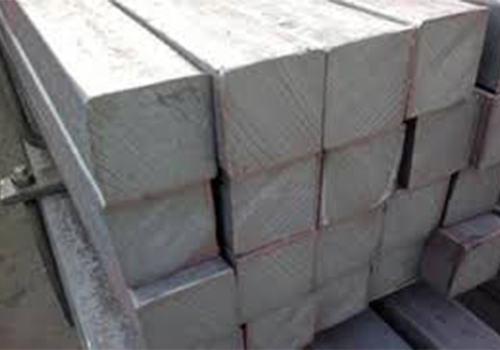
Jiyuan’s carbon and alloy square bar range includes large sections whose faces provide clear geometric references. For a project involving such stock, distinguishing side dimensions, centerline shape, and face orientation helps describe the material requirement without compressing everything into the single word straight.
A twisted shape does not reveal the torque acting now
Twist as a geometric observation and torque as a mechanical action are related but different. Torque is a twisting moment applied to an object. A current shape can reflect elastic loading, permanent deformation from earlier work, or a combination of histories.
If a part twists elastically under a load and the load is removed, it can recover toward its previous orientation. If deformation has become permanent, the shape can retain a twist after the external action ends. Seeing the final geometry alone does not tell the whole loading history.
This also separates twist from simple rotation of the entire bar. Pick an ideal straight, untwisted bar in a drawing and rotate the whole object rigidly by 30 degrees. Every section turns by the same amount, so there is no new relative rotation from one section to the next.
Twist requires a change of orientation along the length. Rigidly rotating the whole object changes its orientation in the room, but not the orientation of one section relative to another.
That final distinction completes the picture: straightness follows the centerline, twist follows the relative orientation of sections, and rigid rotation moves the entire object together. A bar can be straight and twisted because the first two descriptions track different features of the same piece of steel.
Separating Bow from Twist in Square Bar
Can both ends of a twisted square bar appear similarly oriented?
Yes. A square’s outline repeats after a quarter-turn. An end-to-end comparison can therefore conceal a 90-degree rotation unless individual faces are followed along the length. Matching end outlines alone do not prove that each face kept the same orientation throughout.
Is rotating an entire straight bar the same as twisting it?
No. A rigid rotation turns all sections together without changing their relative orientation. Twist means that sections at different positions are rotated relative to one another. A bar can also bow, changing its centerline, without having the same kind of sectional rotation.
If a drawing already includes straightness or twist requirements, you can share the section, length, and relevant drawing views with Jiyuan. An end view and a side view communicate different parts of the intended shape, making the material inquiry more concrete.