Why Are Some Steel Billets Round Instead of Square?
Table of Contents
Round steel billets and square billets provide different starting geometries, while later forming can change either into another section.
Steel billets can be round or square because they are intermediate shapes made for later processing, and different casting arrangements and downstream routes use different starting geometry. A round section has the same outline in every rotational direction. A square section has flat faces and corners. Those differences influence how the material is handled and deformed on its next journey.
A billet is not usually the final object. Its shape makes more sense when you imagine the rolling, forging, or other processing that follows.
A starting shape is not a final shape
A square billet can eventually become round bar or wire rod. Passing through successive shaped rolls redistributes the steel, changing the cross-section while increasing its length. The final round outline does not require the cast starting piece to have been round.
Likewise, a round billet can be deformed into another shape. Solid steel at a suitable working temperature can flow under compressive forces. Its starting cross-section influences that flow, but does not lock the material into one final product forever.
The Continuous Casting Center’s process overview places cast shapes within this larger production chain: casting produces a solid strand that becomes feedstock for subsequent operations.
The casting mold helps establish the strand’s initial external form. Subsequent processing changes that form. These are two separate moments in the production chain, so there is no requirement that the cast outline match the final product outline.
Consider the word “billet” as a statement about stage rather than a promise of one final shape. A billet carries a quantity of steel forward into later manufacturing. Its shape is selected in the context of equipment, handling, heating, and deformation. The circle or square is useful because of what comes next, not because one outline is inherently a higher grade of steel.
Rolling illustrates this clearly. A sequence of shaped roll contacts can progressively redistribute a cross-section. The material becomes longer as its cross-sectional area is reduced. It is not necessary to cut a small round rod from the center of a large square and discard all four corners.
Instead, plastic deformation moves the corner and face regions into the evolving section. The metal remains part of the worked product, apart from the material losses associated with the actual production route. Shape change through forming differs fundamentally from carving a final outline out of an unchanged block.
Two kinds of symmetry
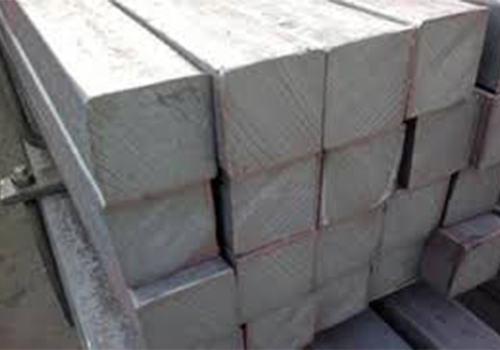
Rotate a perfect circle about its center and its outline looks unchanged. Rotate a square by a small angle and its faces and corners change position. A quarter-turn brings the square back to an equivalent orientation, but intermediate angles do not.
This difference matters whenever material enters shaped tooling or rests against supporting surfaces. Flat faces provide one kind of contact; curved surfaces provide another. It also influences how heat travels through the section because corners have a different relationship to exposed surfaces than the middle of a face.
Neither geometry is automatically better for every process. A production route is a connected sequence, and its starting shape is one part of that sequence.
That rotational difference gives a simple visual test. Place an ideal square end on paper and trace its outline. Turn it through 45 degrees and trace it again. Its corners now occupy directions that used to point toward the middles of the faces. Perform the same turn with a perfect circle and the outline remains coincident.
Contact changes with orientation for the square. A flat face resting against a flat surface is different from a corner approaching that surface. A round section presents a curved exterior at every rotational position. The supporting equipment therefore has to work with the geometry actually present, rather than merely with a size number.
A square’s corner also has two nearby exposed faces, whereas the center of a face has a different local relationship to the rest of the section. This is a geometric reason temperature distributions can differ around a square exterior. It does not establish a universal cooling-rate comparison between every round and square billet, because size and process conditions also matter.
Jiyuan’s steel billet range includes cast square, rectangular, and large round forms. Those alternatives make sense as different starting geometries for later work. A reader considering a manufacturing route can therefore discuss the initial form directly instead of assuming that all billets must look like square blocks.
The size number needs its shape
A 100-millimeter round section has an area of approximately 7,854 square millimeters. A sharp 100-millimeter square has an area of 10,000 square millimeters. The shared number “100” therefore does not mean equal amounts of steel per unit length.
For equal lengths and density, the round section contains about 78.5 percent as much steel as that square. Conversely, matching their areas would require different diameter and side-length numbers.
This geometric point helps explain why a billet description needs both size and shape. A diameter is not interchangeable with a distance across square faces.
For an equal-area comparison, begin with the 100-millimeter square. Set the circle area πd² ÷ 4 equal to 10,000 square millimeters. The equivalent diameter is 200 divided by the square root of π, approximately 112.84 millimeters. An equal-area round section needs a diameter larger than the square’s side length.
Reverse the exercise: the square with the same area as a 100-millimeter-diameter circle has a side length of 50 times the square root of π, approximately 88.62 millimeters. Equal area is the useful relationship when comparing the ideal volume of equal lengths. Equal numerical dimensions are a different comparison.
These dimensions are illustrative geometry, not a list of offered billet sizes. They also describe perfect circles and sharp-cornered squares. Actual corner shape changes the exact area of a real square section, so a precise physical volume would use the actual geometry.
Follow a fixed volume into a longer product
Imagine an ideal 100-by-100-millimeter square billet one meter long. Its volume is 10,000,000 cubic millimeters. Suppose that volume is reshaped into a uniform round section 50 millimeters in diameter, with no material loss in this simplified calculation.
The new cross-sectional area is 625π square millimeters, approximately 1,963.50. Dividing the original volume by that area gives a length of approximately 5,092.96 millimeters, or 5.09 meters. The section has become smaller and round, while the piece has become more than five times as long.
The example accounts for steel that a carving picture would mistakenly throw away. The original corners have not simply been sliced off to produce a 50-millimeter cylinder one meter long. The material is redistributed into extra length as the section changes.
In real production, scale formation, cropping, and other losses mean that the ideal no-loss length is not the actual finished yield. Temperature also affects dimensions. The calculation is a volume-conservation model for understanding the direction of change, not a forecast of a mill’s output.
The same method can start with a round billet and end with another section. Divide the retained volume by the final cross-sectional area to understand the corresponding length. Nothing in that arithmetic says that the starting circle is obliged to remain a circle.
Round billet and finished round bar are different descriptions
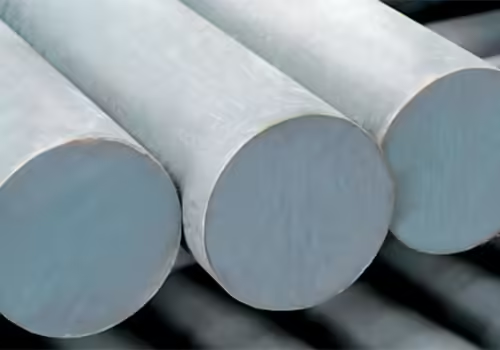
The billet’s surface condition and internal solidification history also differ from those of a finished, dimensionally refined bar. A round cast billet should not be imagined as a bright finished rod simply because both have a circular end.
A circular end view hides this distinction particularly well. Two products can have the same basic outline while belonging to very different stages of manufacture. A cast round starting form and a later machined or otherwise finished round bar need not have the same surface, dimensional condition, or processing history.
That is why the noun matters alongside the shape adjective. “Round” describes the section. “Billet” locates the material within a manufacturing route. “Bright bar” describes a different product condition. Replacing one noun with another because the objects share a circular outline loses information.
Rectangular billets add a further reminder that the choice is not only circle versus square. A rectangle has two different side dimensions, allowing its form to relate to a different subsequent deformation route. Its area is the product of those dimensions, while its orientation determines which broad and narrow faces meet the equipment.
On a drawing or inquiry, diameter identifies a round section and two side dimensions identify a rectangle. Those small differences in notation preserve the starting geometry that the next machine will actually encounter.
Round and Square Billets as Starting Shapes
Must a round bar begin as a round billet?
No. Rolling can redistribute a square billet into a smaller round section while increasing its length. The starting corners are not necessarily cut off and discarded. A billet’s initial outline influences processing but does not permanently determine the final product shape.
Do a 100 mm round billet and a 100 mm square billet contain equal steel per meter?
No. An ideal 100 mm circle has about 7,854 square millimeters of area, while a sharp 100 mm square has 10,000. At equal length and density, the round section contains about 78.5 percent as much material. Shape must accompany the dimension.
To connect that choice with an actual application, describe the required section, grade, and intended rolling or forging route. The next operation gives the shape question its context. A request for “round billet” becomes much more informative when it includes what that billet is expected to become.