Does Carbon Leave a Hot Steel Bar All at Once?
Table of Contents
A high carbon steel round bar can lose carbon first near its surface, with diffusion developing a concentration profile inward over time.
No. When a high-carbon steel round bar loses carbon during heating, the change usually begins at an exposed surface and develops inward. Carbon near the surface reacts with the surrounding atmosphere, while carbon deeper inside moves toward the depleted region by diffusion. The result can be a gradual change with depth rather than the whole bar losing carbon at once.
This process is decarburization. It can alter the chemistry near the outside even when the bar still looks like a solid, unchanged cylinder.
Begin with one carbon atom near the outside
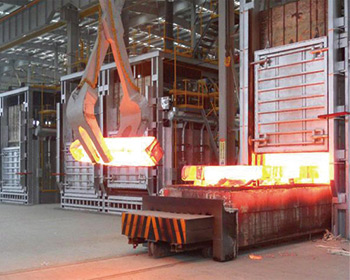
At an elevated temperature, reactions at the surface can remove carbon in gaseous compounds. The exact reaction depends on the atmosphere around the steel. Once carbon leaves that region, the distribution of carbon near the surface differs from the distribution farther inside.
Atoms in a solid are not permanently locked into one unchanging arrangement. At sufficient temperature, carbon can move through the steel. Diffusion describes this atomic movement and its tendency to redistribute concentration differences.
The surface reaction and internal diffusion are connected. Removing carbon at the boundary creates a depleted region; diffusion can supply more carbon from within. Both must be considered to understand how the changed layer develops.
Diffusion should not be pictured as a neat procession in which every atom walks straight toward the outside. Individual atomic movements occur in many directions. A concentration difference can produce a net redistribution, even though the underlying movements are not all aligned.
Nor does the steel have to become liquid for carbon to move. The word “solid” describes the material’s overall state, not a complete ban on atomic motion. At elevated temperature, diffusion can change the local composition while the bar retains its recognizable shape.
Two connected processes therefore set the scene. The atmosphere supplies conditions for a surface reaction, and the solid supplies a path for redistribution below the surface. If one changes, the overall behavior can change. Describing only the furnace temperature leaves out the chemical boundary condition; describing only the atmosphere leaves out the steel’s thermal history.
A gradient is not a peeled-off skin
Imagine drawing carbon concentration on one axis and depth below the surface on the other. A decarburized bar can show low carbon near the outside, rising progressively toward the original interior level.
There need not be a single sharp boundary that can be peeled away like a label. The phrase “decarburized layer” is a convenient description of a region, not proof that the region has one uniform composition.
In more severe conditions, the outermost portion can be much more depleted than the region below it. The distinctions between complete and partial decarburization describe different parts of that changed structure.
ASTM E1077 addresses estimating decarburization depth, while Buehler’s discussion of metallographic examination illustrates the distinction between surface and deeper changes. A polished cross-section can reveal information that the outside color cannot.
Reading a profile from the edge inward

Suppose a graph begins at the current metal surface and moves horizontally toward the center. The vertical axis represents carbon concentration. A low starting value followed by a gradual rise describes a depleted exterior merging into less affected material below it.
There are two dimensions to keep separate on this graph. The height of the curve describes how much carbon is present locally. The horizontal extent describes how far the compositional change reaches. A very strongly depleted thin region and a more mildly depleted deeper region are not the same profile.
This distinction helps explain why a single average number cannot fully describe a surface effect. If a chemical sample includes both the depleted exterior and a much larger amount of less affected interior, the reported average combines them. A small surface region may have changed more than that whole-sample average suggests.
A microscopic cross-section provides another kind of evidence by exposing the region from edge inward. Changes in the observed structure or response can help estimate the affected depth through an appropriate method. The outer color alone does not provide the same information because it does not show the carbon distribution beneath the visible surface.
The depth also needs a reference surface. If some metal is later machined away, the new exterior lies below the former one. A statement about depth from the original outside and a statement about depth from the newly machined outside refer to different positions.
Time, temperature, and atmosphere do different jobs
Diffusion over a longer distance takes more time under otherwise comparable conditions. The center of a thick bar is far from the reacting outer boundary, so a surface change does not instantly reproduce itself throughout the section.
Temperature strongly influences atomic mobility. A bar’s exposure time and temperature history therefore matter alongside the surrounding atmosphere. The same steel can experience different depths of change after different heating histories.
Time provides an opportunity for the processes to proceed, but it is not a complete description. The same exposure duration at two different temperatures need not produce the same result. Likewise, two atmospheres at the same temperature need not impose the same tendency for carbon to leave the steel.
“The bar was heated for an hour” therefore leaves important questions unanswered. Was the temperature constant? How did the material warm up and cool down? What surrounded the surface during the relevant exposure? These details describe the physical history rather than a universally fixed decarburization rate.
A thick bar’s center also reaches and leaves elevated temperature on a different schedule from its exterior. The carbon-loss question still begins at the boundary, but the temperature distribution helps determine how quickly internal movement can occur. Heat flow and carbon diffusion are linked through temperature without being the same transport process.
It is useful to separate a heating history that promotes surface carbon loss from the later cooling history that establishes hardness. The changed chemistry can influence the response to hardening, yet carbon loss and quench transformation are different events. A softer exterior after treatment does not mean carbon suddenly escaped during the final hardness test.
A thin region can be small in volume and important at the surface
Consider a purely geometric example of a 20-millimeter-diameter bar with an outer region 0.1 millimeter deep. The inner radius is 9.9 millimeters instead of 10. The fraction of cross-sectional area in the outer ring is 1 − 9.9²/10², which equals 1.99 percent.
For a 100-millimeter-diameter bar with the same hypothetical 0.1-millimeter region, the corresponding fraction is 1 − 49.9²/50², or about 0.400 percent. The layer occupies a smaller share of the larger bar’s cross-section, even though its depth from the surface is the same.
Those examples treat the affected region as a geometric ring only to compare volumes. They do not assume carbon is uniform inside the ring or absent from it. An actual concentration gradient contains more information than the simplified boundary used in this area calculation.
The small overall fraction does not automatically make the surface change unimportant. The outside may later become a working surface or experience demanding loading. Its role depends on the part, whereas the volume percentage describes only how much material is in the chosen geometric region.
Jiyuan’s round-bar range includes carbon and alloy steels across a published φ12–300 millimeter diameter family. For a high-carbon bar that will be heated and later machined, the starting section and the amount of surface retained in the final part help connect the material choice to its thermal journey.
Removing scale and removing depleted steel are separate actions
Oxide scale may form at the same time, but scale and decarburization are different features. Scale is an oxide layer; decarburization is a carbon change in the steel. Removing visible scale does not necessarily remove all the carbon-depleted metal underneath it.
A surface can look bright after cleaning and still retain a compositional change below it. Conversely, removing enough underlying metal can move the final surface into a different part of the carbon profile. Appearance and depth are different observations.
That distinction is particularly easy to miss because scale is visible and carbon concentration is not. A dark oxide layer draws the eye. A depleted region can remain metallic in appearance, so removing the visible feature may feel like removing the entire effect of heating even when the chemistry beneath has also changed.
On the concentration-versus-depth graph, cleaning away only the oxide does not simply flatten the carbon curve. The curve describes the steel underneath. To understand what remains on the final bar, locate the final metal surface on that profile rather than judging the result from its color.
How Surface Carbon Loss Develops
Does carbon loss require the steel to melt?
No. Carbon can diffuse through solid steel at elevated temperature. Surface reactions and internal redistribution work together, allowing near-surface chemistry to change while the bar remains a solid object. Its unchanged external shape does not prove unchanged composition.
Is a decarburized layer always uniform with a sharp inner boundary?
No. Carbon concentration can rise gradually with depth from a depleted exterior toward less affected material. The term layer describes a region, not necessarily a separate skin. Its depth and degree of depletion provide different information about the carbon profile.
For a related inquiry, describe the grade, bar diameter, planned heating route, and whether the original outside remains on the finished part. Those details make a surface-carbon question specific without treating a generic depth estimate as a property of every delivered bar.