Green Steel Billet & CBAM: The Strategic Guide to Low-Carbon Production and Global Trade Compliance
The global steel industry is no longer just about melting iron; it is about managing molecules and carbon math. As we move deeper into 2026, the transition toward decarbonized manufacturing has shifted from a corporate social responsibility (CSR) goal to a hard-line trade requirement. Central to this transformation is the Green Steel Billet, a semi-finished product that has become the benchmark for sustainable industrial supply chains. For manufacturers and exporters, understanding how these billets are produced and how they interact with emerging trade barriers like the EU’s Carbon Border Adjustment Mechanism (CBAM) is now a matter of economic survival.
Table of Contents
Defining the Green Steel Billet and the Hydrogen Revolution
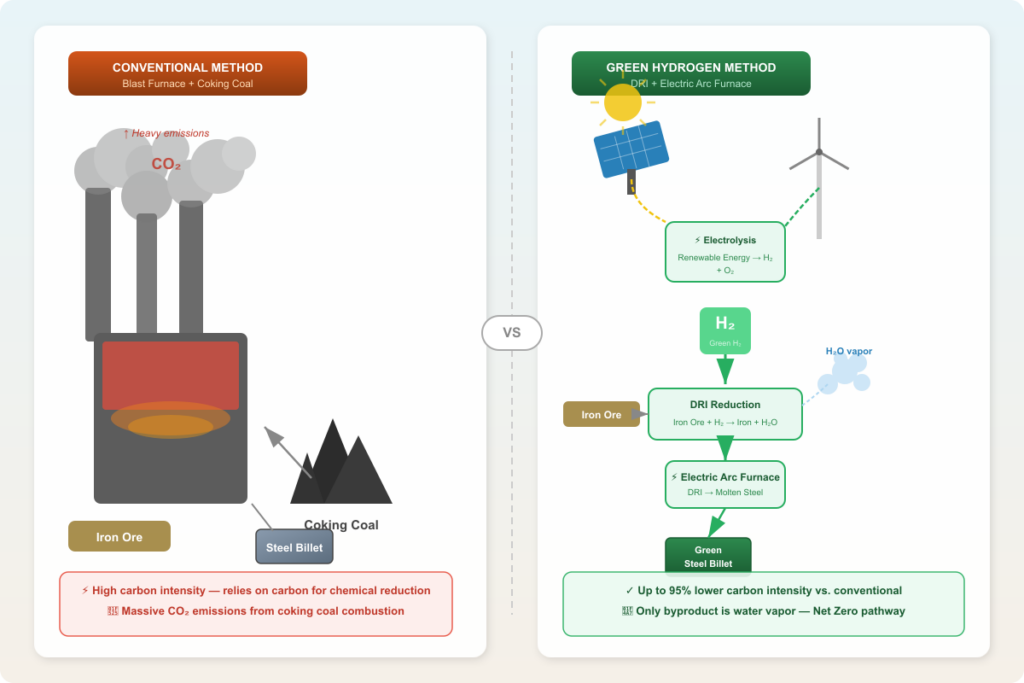
The shift away from traditional coal-fired blast furnaces is primarily driven by the need toeliminate the carbon-heavy chemical reduction of iron ore. Conventional methods rely oncoking coal, which releases massive amounts of C’O2. In contrast, a Green Steel BilletSdefined by its low-carbon production pathway, often utilizing Direct Reduced Iron (DRI) pairedwith an Electric Arc Furnace (EAF).
The most promising technology in this space is Hydrogen-based steelmaking. By using green hydrogen (produced via electrolysis powered by renewable energy) instead of carbon-rich gases or coal, the only byproduct of the reduction process is water vapor. According to the International Energy Agency (IEA), hydrogen-based DRI is a critical pillar for achieving the Net Zero Emissions by 2050 Scenario. This technology allows for the production of a Green Steel Billet with a carbon intensity that is up to 95% lower than traditional methods.
Calculating the True Carbon Footprint of Billets
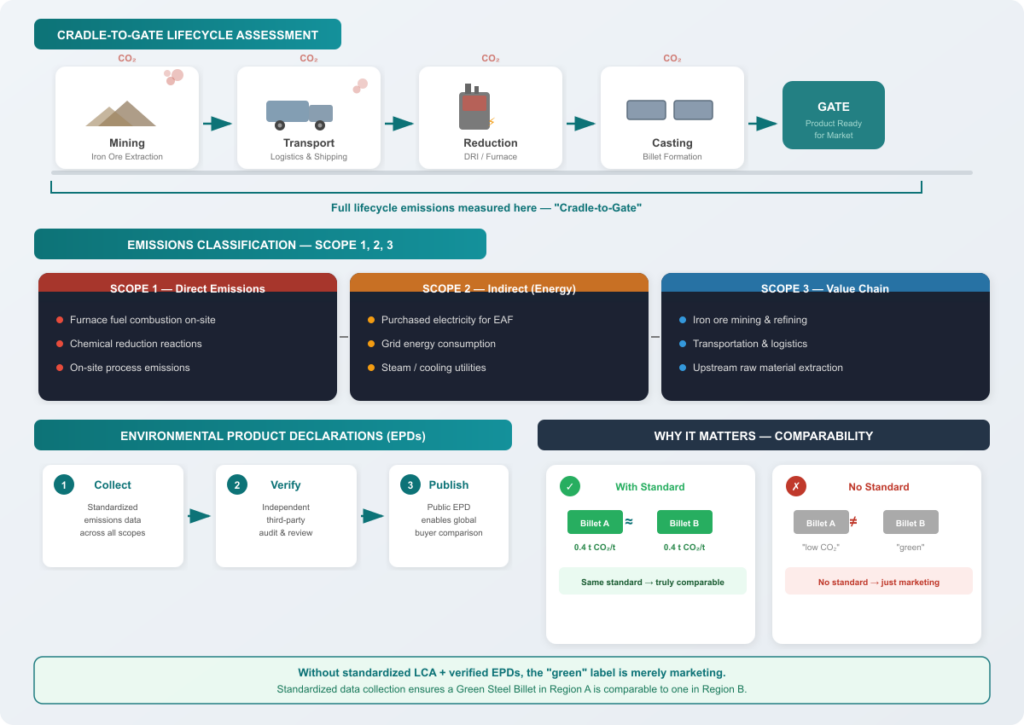
For a product to be labeled “green,” transparency is paramount. The industry has moved toward rigorous Lifecycle Assessment (LCA) standards to quantify the Carbon footprint of billets. This measurement typically follows a “Cradle-to-Gate” approach, accounting for emissions from iron ore mining, transportation, and the energy consumed during the melting and casting stages.
Determining the Carbon footprint of billets is not just an academic exercise; it is a reporting requirement. Global buyers now demand Environmental Product Declarations (EPDs) that verify the Scope 1, 2, and 3 emissions associated with each ton of steel. As the World Steel Association
notes, standardized data collection is the only way to ensure that a Green Steel Billet produced in one region is comparable to one produced elsewhere. Without these metrics, the “green” label is merely marketing fluff.
Navigating the CBAM for Steel Exports
The most significant policy disruptor in the current landscape is the European Union’s Carbon Border Adjustment Mechanism. CBAM for steel exports effectively places a carbon price on certain goods imported into the EU, ensuring that European manufacturers—who are subject to the EU Emissions Trading System (ETS)—are not at a competitive disadvantage against imports from regions with laxer environmental laws.
For international producers, the Green Steel Billet is the ultimate hedge against these costs. If a producer can prove that their Green Steel Billet was manufactured using low-carbon energy, they can significantly reduce or even eliminate the CBAM certificates they are required to purchase. This creates a powerful financial incentive to invest in decarbonization. As detailed by the European Commission, the transition to full CBAM implementation in 2026 marks a turning point where carbon intensity becomes as important as price and quality in global trade.
Technological & Economic Comparison: The Billet Landscape
To understand the competitive positioning of different production routes, we must look at the energy consumption and carbon output across the major pathways currently in play.
| Production Pathway | Energy Source | CO2 Intensity (t/t Steel) | CBAM Risk Level |
| BF-BOF (Traditional) | Coking Coal | 1.8 – 2.2 | Critical |
| Natural Gas DRI-EAF | Methane / Grid Power | 0.8 – 1.2 | High |
| Scrap-EAF (Recycled) | Renewable Electricity | 0.1 – 0.4 | Low |
| Hydrogen DRI-EAF | Green Hydrogen | < 0.1 | Minimal |
This data confirms that the Green Steel Billet produced via green hydrogen is the only long-term “future-proof” asset for exporters. While the initial capital expenditure for Hydrogen-based steelmaking is high, the reduction in carbon taxes and the ability to capture “green premiums” make it economically viable.
Can the Market Support the Green Premium?
The transition to a low-carbon economy is not free. Producing a Green Steel Billet involves higher costs for green hydrogen and renewable energy infrastructure. However, we are seeing a shift in the downstream market. Industries such as automotive manufacturing and offshore wind energy are increasingly willing to pay a “green premium” to satisfy their own Scope 3 emission targets.
The impact of CBAM for steel exports further levels the playing field. When carbon costs are factored in, the price gap between “dirty” steel and a Green Steel Billet begins to close. In some scenarios, a low-carbon billet may actually become the cheaper option once the carbon levies on high-emission alternatives are applied at the border.
Preparing for a Net-Zero Future
For steel mills and trading houses, the roadmap is clear. First, companies must conduct a thorough audit of their current Carbon footprint of billets. This baseline is essential for any future decarbonization strategy. Second, firms must evaluate their local energy grid—is there enough renewable capacity to transition to EAF-based production?
Finally, players must master the regulatory landscape of CBAM for steel exports. This involves not just technical upgrades, but also administrative excellence in tracking and reporting emissions. The Green Steel Billet is no longer a niche product for “eco-conscious” brands; it is the new global standard. Companies that move first to secure hydrogen supply chains and certify their production will own the high-value markets of the next decade.
In summary, the Green Steel Billet represents more than just a cleaner product; it represents a more resilient and transparent global trade system. As carbon becomes a global currency, the ability to produce and export low-carbon steel will be the primary differentiator between industry leaders and those left behind by the green transition.
FAQ
Does every Green Steel Billet require hydrogen?
Not necessarily. While hydrogen is the cleanest method, billets made from 100% recycled scrap in a renewably powered EAF are also considered “green” due to their low carbon footprint.
How does CBAM affect non-European exporters?
Any exporter to the EU must report the embedded emissions of their products. If those emissions exceed EU standards, the importer must buy certificates to cover the difference, effectively acting as a tax on high-carbon steel.
What is the biggest hurdle for Hydrogen-based steelmaking?
The primary challenges are the cost and availability of green hydrogen at a massive industrial scale, along with the high capital investment required to build DRI plants.
Why is the Carbon footprint of billets measured “Cradle-to-Gate”?
This ensures that all emissions generated up to the point the product leaves the factory are accounted for, providing a standardized metric for international trade and comparison.
Will a Green Steel Billet always be more expensive?
Initially, yes. However, as renewable energy costs drop and carbon taxes on traditional steel increase, the price difference is expected to vanish by 2030.