1045 vs 4140 Steel: Choosing Between Carbon and Alloy Steel Billets
For procurement managers and mechanical engineers, selecting the right material is rarely about finding the “strongest” steel in existence; it is about finding the most cost-effective steel that meets the specific performance threshold of the project. The ongoing debate between 1045 vs 4140 steel is a cornerstone of industrial metallurgy. While AISI 4140 is a legendary alloy steel known for its toughness, AISI 1045 remains the high-performance workhorse of the carbon steel world.
Over-specifying material is a common hidden cost in manufacturing. Choosing a chrome-moly alloy when a medium-carbon steel would suffice can inflate production budgets by 30% to 50% without adding functional value. This guide provides a technical deep-dive into the mechanical, chemical, and economic factors when analyzing 1045 vs 4140 steel for precision components.
Table of Contents
Breaking Down the Chemical Profile: Carbon vs. Alloy
The primary distinction in the 1045 vs 4140 steel comparison is the presence of specialized alloying elements. AISI 1045 is a medium-carbon steel, containing approximately 0.43–0.50% carbon. Its strength is derived primarily from its carbon and manganese content. It is simple, predictable, and lacks the expensive elements found in higher-grade steels.
In contrast, AISI 4140 is a “Chromoly” steel. It contains chromium (0.80–1.10%) and molybdenum (0.15–0.25%). These elements are not just additives; they fundamentally change the steel’s “hardenability”—the depth to which the steel can be hardened during heat treatment. According to the ASTM A29/A29M standard, which governs the general requirements for hot-wrought carbon and alloy steel bars, the addition of chromium significantly enhances corrosion resistance and toughness compared to plain carbon varieties.
While 1045 relies on a straightforward chemistry to provide reliable strength, 4140 uses its alloy complexity to offer superior performance in environments where high stress and fatigue are constant factors.
Mechanical Limits: Strength vs. Toughness
When comparing the performance metrics of 1045 vs 4140 steel in high-stress scenarios, 4140 is the clear technical winner. AISI 4140 in a “Quenched and Tempered” (Q&T) state can easily reach a tensile strength of over 100,000 PSI (690 MPa). More importantly, its yield strength—the point at which the steel permanently deforms—remains exceptionally high even under heavy, oscillating loads.
AISI 1045 generally offers a tensile strength around 85,000 PSI (585 MPa). While this is sufficient for many applications, 1045 lacks the “impact toughness” of 4140. If your part is subject to sudden shocks or sub-zero temperatures, 1045 may become brittle and fail. 4140, thanks to its molybdenum content, maintains its structural integrity under these harsh conditions.
However, the question for the decision-maker is: Does your part actually experience those extremes? For many industrial pins, simple shafts, and fasteners, the 85,000 PSI provided by 1045 is more than adequate. Buying the extra toughness of 4140 for a part that never sees more than 40,000 PSI of stress is a significant waste of capital.
The Real-World Cost of Machinability
Another major factor in the 1045 vs 4140 steel debate is how the material interacts with your CNC machinery. AISI 1045 has a machinability rating of approximately 70% of B1112 (the industry standard). AISI 4140, particularly in its annealed state, usually hovers around 55% to 60%.
What does this mean for your bottom line?
1.Lower Tooling Costs: 1045 is much “softer” on CNC inserts and drill bits. You will replace your consumables less frequently.
2.Faster Cycle Times: You can run your lathes and mills at higher speeds and feed rates when processing 1045. In a high-volume production run of 10,000 units, saving 30 seconds per part results in hundreds of hours of saved machine time.
3.Superior Surface Finish: Because 1045 is less “gummy” than some alloy steels, it often achieves a cleaner surface finish right off the machine, potentially eliminating the need for secondary grinding or polishing.
If your project involves complex geometries or massive production volumes, the processing costs can quickly overshadow the raw material price. This makes the hidden cost drivers within the 1045 vs 4140 steel landscape a primary concern for procurement teams.
Strategic Heat Treatment: Surface vs. Core
The way these steels respond to heat treatment is at the core of the 1045 vs 4140 steel technical choice. Each material requires a different strategy to achieve its peak performance.
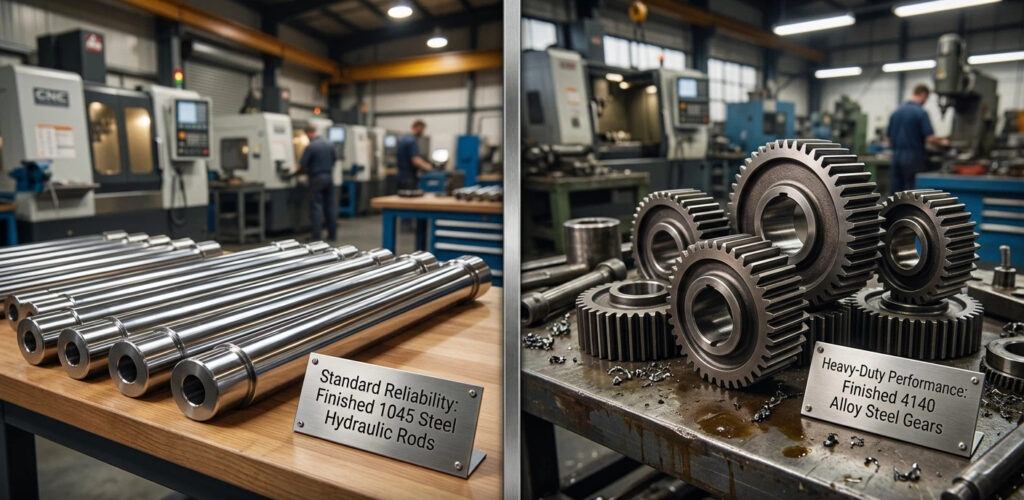
AISI 1045 is the preferred choice for Induction Hardening or Flame Hardening. Because it is a carbon steel, you can harden the “skin” of the part to reach HRC 50-55 while leaving the core soft and ductile. This is perfect for components like hydraulic cylinder rods or conveyor rolls that need a wear-resistant surface but must remain flexible enough to resist snapping under side-loads.
AISI 4140, however, is designed for Through-Hardening. Because of its alloy content, when you quench a 4140 billet, the hardness penetrates deep into the center of the material. This results in a part that is consistently strong from the surface to the core. According to ASM International, the increased depth of hardening in 1045 vs 4140 steel bars is the defining factor for heavy-section parts where uniform strength is mandatory.
Procurement Strategy
The final assessment of 1045 vs 4140 steel depends on the specific engineering intent. To simplify the decision-making process, we can use a simplified matrix for the 1045 vs 4140 steel decision based on common industrial use cases.
Select AISI 1045 for:
- Transmission shafts, axles, and pins that operate under stable, medium loads.
- Projects requiring high-volume production where low material and machining costs are essential.
- Parts that need a hard surface but a flexible core (Induction hardening).
- Standard fasteners and structural components that do not face extreme fatigue.
Select AISI 4140 for:
- Heavy-duty gears, crankshafts, and drill collars for the oil and gas or mining sectors.
- Environments involving extreme temperatures or constant high-impact forces.
- Components requiring high fatigue strength to prevent failure over millions of cycles.
- Parts that must be through-hardened for uniform strength across large cross-sections.
Maximizing ROI Through Material Selection
In the industrial supply chain, the goal is maximizing ROI through a clear 1045 vs 4140 steel strategy. AISI 4140 is technically the “better” steel in terms of absolute strength and toughness, but it comes with a premium price and significantly higher processing costs.
For a majority of general engineering applications, AISI 1045 provides a superior return on investment. Its ease of machining and excellent response to surface hardening make it the optimized choice for “everyday” industrial components. However, when the safety of the machine or the environment depends on the steel’s ability to withstand extreme torque and impact, the investment in 4140 is a necessary insurance policy.
By matching the steel’s properties to the actual stress of the application, procurement teams can significantly reduce waste and ensure long-term mechanical reliability without blowing the budget.
Now that you understand the critical differences in the 1045 vs 4140 steel debate, it’s time to put that knowledge into action. From precision-ground shafts to heavy-duty industrial gears, [Your Company Name] provides the premium billets that power global industries. High inventory levels, competitive B2B pricing, and expert material selection—all in one place. [Click here to request your 2026 Price List] or speak with a steel specialist now.
FAQ
Can I replace 4140 with 1045 to save money?
Yes, but only if the part is not subject to high impact or through-hardening requirements. If the part primarily needs surface hardness and moderate tensile strength, 1045 is a viable, more profitable alternative.
Which steel is easier to weld?
AISI 1045 has moderate weldability but often requires pre-heating to prevent cracking. AISI 4140 is more difficult to weld due to its alloy content and almost always requires pre-heat and post-weld stress relief to maintain its mechanical properties.
Is 4140 always more expensive than 1045?
Generally, yes. Because 4140 contains chromium and molybdenum—which are traded on global commodity markets—the raw material cost is higher. Additionally, its lower machinability increases the total cost of the finished part.
What is the HRC range for these steels?
1045 can reach HRC 50-55 on the surface via induction hardening. 4140 is typically used in the HRC 28-32 range (pre-hardened) or can be through-hardened to HRC 45-50 for high-strength tools.
Does 1045 rust faster than 4140?
Both are prone to oxidation. However, 4140 has a very slight advantage in atmospheric corrosion resistance due to its chromium content, though neither should be used in corrosive environments without a protective coating.