Steel Billet Manufacturing Trends: How Global Production Has Changed in Recent Years
Steel billet manufacturing has changed significantly over the past decade. The industry has moved beyond simply increasing output capacity and has become more focused on production efficiency, energy consumption, environmental requirements, and regional supply chain changes.
For steel buyers and manufacturers, understanding steel billet manufacturing trends helps explain why production methods, supplier selection, and market conditions have changed.
The major changes are not happening in one area only. Asia has expanded its production influence, Europe has accelerated low-carbon steel initiatives, North America has continued developing electric arc furnace (EAF)-based production, and many manufacturers have invested in automation and continuous casting technology.
This article examines how global steel billet production has evolved in recent years, what technologies have shaped manufacturing changes, and what these developments mean for buyers evaluating steel billet suppliers.
Table of Contents
What Major Changes Have Shaped Steel Billet Manufacturing in Recent Years?
The biggest shift in steel billet manufacturing has been the transition from capacity-driven growth toward technology-driven production.
Several factors have influenced the industry:
- Increasing demand from construction and infrastructure projects
- Rising energy costs
- More strict environmental regulations
- Growth of recycled steel production
- Improvements in continuous casting technology
- Changes in regional steel supply chains
These changes have directly affected billet production because steel billets are the starting material for many downstream products, including:
- reinforcing bars
- wire rod
- structural sections
- specialty steel products
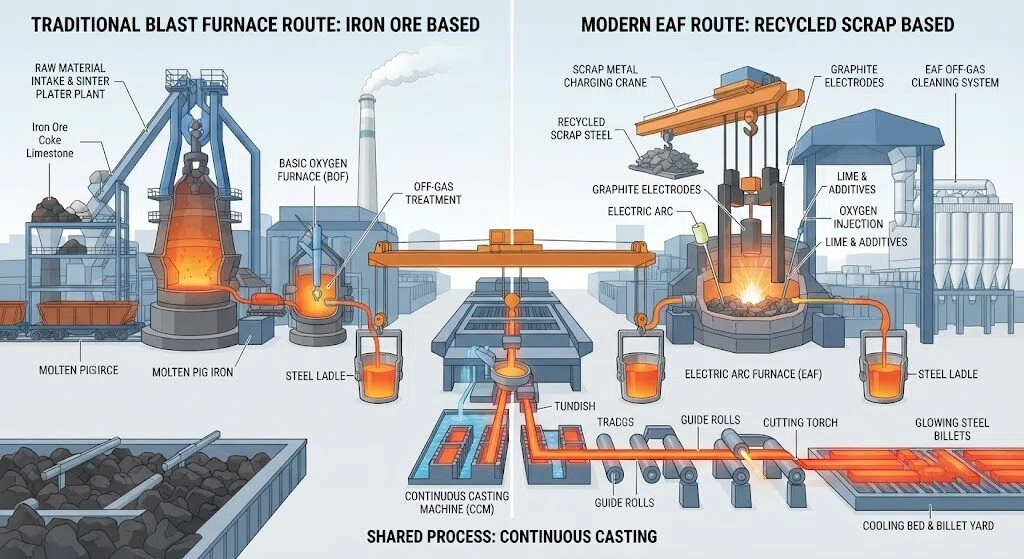
The Shift From Traditional Steelmaking to Electric Arc Furnace Production
One of the most important steel billet production trends in recent years has been the increased use of electric arc furnace technology.
Traditional steel production mainly relied on:
Iron ore → Blast Furnace → Basic Oxygen Furnace → Billet Production
However, many producers have increased the use of:
Scrap Steel → Electric Arc Furnace → Continuous Casting → Steel Billet
The growth of electric arc furnace steel billet production has been driven by several reasons:
Lower dependence on iron ore
EAF production can use recycled steel scrap as a major raw material source.
This provides manufacturers with more flexibility when raw material markets fluctuate.
More flexible production capacity
Compared with traditional integrated steel plants, EAF facilities can often adjust production levels faster according to market demand.
This is especially useful in regions where steel demand changes frequently.
Environmental pressure
Many countries have introduced policies aimed at reducing industrial carbon emissions.
This has encouraged more companies to evaluate lower-carbon approaches, including EAF production and improved energy management.
Continuous Casting Has Become a Standard Production Technology
Another important change in the steel billet manufacturing process is the wider adoption of continuous casting.
In the past, steel production often used ingot casting methods, where molten steel was poured into molds and processed through additional steps.
Continuous casting changed this process by allowing molten steel to be directly converted into semi-finished products such as billets.
The process generally includes:
1.Melting steel in a furnace
2.Refining molten steel composition
3.Casting steel through a continuous mold
4.Cooling and cutting billets into required lengths
The main advantages of continuous casting include:
- More consistent billet dimensions
- Reduced material loss
- Better production efficiency
- Improved process control
According to the technical explanation from Encyclopaedia Britannica, continuous casting became an important development in modern steel manufacturing because it improved productivity and reduced processing steps.
For steel billet manufacturers, this technology directly affects product consistency and downstream processing performance.
Why Has Low Carbon Steel Billet Production Become More Important?
Environmental requirements have become one of the biggest factors influencing recent steel billet manufacturing trends.
Steel production has historically been one of the largest industrial sources of carbon emissions.
As governments and customers increase sustainability requirements, manufacturers have started focusing on:
- reducing energy consumption
- increasing scrap utilization
- improving furnace efficiency
- tracking carbon emissions
Europe has been one of the most active regions in this transition.
For steel billet suppliers, this means production capability alone is no longer the only consideration.
Buyers increasingly evaluate:
- production method
- energy source
- carbon footprint information
- environmental compliance
How Has Asia Changed the Global Steel Billet Production Landscape?
Asia has played the largest role in recent changes within the global steel billet market.
The region has become the center of global steel production because of:
- large construction demand
- infrastructure development
- industrial expansion
- strong downstream steel processing capacity
According to World Steel Association data, Asian countries continue to account for the majority of global crude steel production.
However, the changes within Asia are not only about production volume.
Manufacturers have also focused on:
- improving energy efficiency
- upgrading production equipment
- reducing emissions
- increasing product consistency
How Has China Influenced Steel Billet Manufacturing Trends?
China has remained the largest steel-producing country in the world and plays a major role in the global steel billet market.
Over the past several years, China’s steel industry has experienced a transition from rapid capacity expansion toward quality improvement and production optimization.
Major changes include:
Capacity control and modernization
Earlier growth was mainly driven by increasing production capacity.
More recently, steel producers have focused on:
- replacing outdated production equipment
- improving energy efficiency
- increasing automation
- reducing emissions per ton of steel
Growth of cleaner production methods
China has increased investment in:
- ultra-low emission steel plants
- energy-saving technologies
- electric furnace production
For steel billet buyers, China’s changes have affected:
- supply availability
- export competition
- production standards
- pricing conditions
Why Is India Becoming an Important Steel Billet Production Region?
India has become one of the fastest-growing steel markets in recent years.
The main drivers include:
- infrastructure investment
- urban development
- construction growth
- increasing domestic steel consumption
Steel billets are especially important because they supply downstream products such as:
- rebar
- wire rod
- construction sections
India’s steel industry has a strong presence of both integrated steel plants and electric arc furnace producers.
The expansion of steel billet production using electric arc furnace technology has become increasingly important because it allows producers to use recycled steel and respond more flexibly to market demand.