Why Is the Middle of a Cast Steel Billet Different from Its Outside?
Table of Contents
Continuous cast billets solidify from outside inward, leaving the last liquid with a different thermal and compositional history.
The middle of a continuous cast steel billet can differ from its outside because it solidifies later. As steel freezes, some dissolved elements are redistributed between the growing solid and the remaining liquid. The last liquid can become enriched in certain elements, leaving a different composition near regions that freeze last. This uneven distribution is called segregation.
It does not require someone to pour a different steel into the middle. A single original melt can develop local differences during its transition from liquid to solid.
Follow the freezing front inward
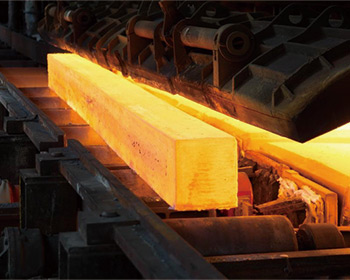
In continuous casting, heat leaves through the mold and later cooling regions. A solid shell forms at the outside and grows inward. For a time, the center remains much hotter and may still contain liquid.
The boundary is not necessarily a smooth wall separating a perfectly solid outside from a perfectly liquid inside. Growing crystals can extend into a region containing both solid and liquid. This mixed region is often called the mushy zone.
As crystals grow, their composition can differ from that of the liquid beside them. Some elements are preferentially left in the liquid. The remaining liquid therefore changes as solidification proceeds, rather than preserving the exact chemistry of the starting pool everywhere.
A simple counting model shows how the remainder becomes richer
Imagine a box containing 100 counters: 90 plain and 10 colored. The colored counters represent a dissolved ingredient, but this is a counting analogy rather than a chemical recipe for steel.
Suppose the first group removed from the box contains 50 counters, of which only two are colored. That first group contains 4 percent colored counters. The remaining box holds 50 counters with eight colored ones, so its colored fraction is now 16 percent.
No colored counters were added. The total is still ten. The difference arose because the first removed group took a smaller share of them than an exactly uniform split would have taken.
If both groups had taken five colored counters, each would have remained at 10 percent. The enrichment therefore depends on unequal partitioning, not merely on making two groups. Solidification can partition an element unequally between solid and liquid, creating the analogous change in the remaining liquid.
The example does not claim that a steel element follows these particular percentages. Actual partitioning depends on the element, phases, and conditions. It demonstrates conservation: local enrichment can develop even while the overall amount of each element stays the same.
The last liquid has its own history
Imagine repeatedly removing portions of a mixture while leaving more of one ingredient behind. The remainder gradually becomes richer in that ingredient. Solidification has its own thermodynamics, but this idea helps explain why the final liquid is not necessarily identical to the first solid.
Liquid movement and shrinkage also influence where that enriched material ends up. When steel solidifies, changes in volume and the feeding of liquid through partly solid regions can contribute to the large-scale pattern.
Research on centerline behavior in continuously cast steel examines these coupled solidification effects. The centerline is significant because it is associated with late stages of freezing, not because the geometric middle has a special attraction for impurities.
A composition difference can exist even where the material is fully solid and there is no visible cavity. That is why an ordinary photograph of a billet’s outside cannot reveal its entire chemical landscape.
The freezing region is a network, not always a smooth moving wall
The phrase freezing front can suggest a perfectly flat boundary. In steel, growing solid crystals can branch into the remaining liquid. The partly solid region contains channels and spaces through which liquid can still move until the solid network becomes sufficiently connected and restrictive.
This is the mushy zone introduced earlier. The word describes coexistence of solid and liquid, not soft room-temperature steel. The geometry of that mixed region influences how remaining liquid can feed regions that are still solidifying.
The Continuous Casting Center’s overview explains the development of the solid shell around a liquid interior. Within that broad picture, the final liquid pathways matter because they can carry enriched material to places that freeze late.
Shrinkage and movement of the strand can affect that flow. The result is more than a static concentration difference at a single crystal surface; liquid transport can organize differences over a larger part of the billet.
This distinction is often described as microscopic versus macroscopic segregation. Microscopic differences occur on the scale of local solidification structures. Macroscopic segregation refers to larger-scale variations, such as an enriched central region visible through analysis across the section. The names describe scale, not two completely unrelated causes.
The center is important because of timing
The geometric center is commonly associated with the last stages of freezing in a billet cooled from the outside. That makes it a natural place to look for the consequences of enriched remaining liquid. It is not a special location that attracts an element by gravity simply because it is the middle.
Nor does the explanation require every cross-section to contain a perfectly circular or perfectly square enriched patch. The thermal and flow histories can create more complicated distributions. A simple center-versus-outside description is a useful starting picture, not a complete map.
Different section sizes and shapes change heat-flow distances and the relationship between surface and interior. A round billet and a square billet can both solidify outside inward while having different local geometry. The timing of final solidification belongs to the actual casting conditions.
Jiyuan’s steel billet range includes square or rectangular cast forms and large round forms. That variety gives later rolling and forging routes different starting shapes; the section description also supplies context for questions about the billet’s internal history.
Three internal features that should not be combined into one word

A pore is a region not filled with solid metal. An inclusion is a distinct particle or phase, such as an oxide, within the material. Segregation is a variation in the distribution of elements. One describes empty space, one describes a separate feature, and one describes chemistry.
They can coexist or interact in a cast product, but discovering one does not automatically prove the presence or severity of the others. A chemical analysis can identify composition without showing the full shape of a pore. A cut surface can show a cavity without specifying the concentration of every nearby element.
This matters because the word clean is sometimes used loosely for several different ideas. A billet can look physically solid in one section while still having composition variation. Conversely, a local void does not mean that every surrounding region has the same chemical enrichment.
A clear explanation keeps each observation attached to the feature it actually describes. The internal condition is a combination of observations, not one visual impression expanded into a universal conclusion.
Later deformation changes shape faster than it mixes atoms
Rolling can elongate the billet and reduce its cross-section. It changes the spatial arrangement of the material and can affect internal physical features. But it does not instantly stir solid steel in the way a spoon stirs a liquid.
Diffusion can redistribute elements in solid steel over time, especially at elevated temperature. Its effectiveness depends on the element and the distance involved. A large-scale compositional variation cannot be assumed to disappear simply because the outside shape has changed substantially.
The final bar or rod can therefore carry a stretched and transformed version of part of the billet’s solidification history. The outside and center began their solid lives at different moments. That difference in timing can remain relevant after the original cast shape is no longer recognizable.
The Center of a Cast Billet
Why can elements concentrate in the last regions to solidify?
Growing solid and remaining liquid do not necessarily have the same composition. As freezing proceeds, some elements can become concentrated in the remaining liquid. Its movement and final solidification can leave larger-scale compositional variation, including near the billet’s center.
Does rolling automatically remove center segregation?
No. Rolling changes the section and length, but it does not generally erase an established large-scale compositional difference. It can change the geometry of the affected region. Segregation should also be distinguished from a cavity: uneven composition does not necessarily mean an empty space.
For a material inquiry, you can share the required billet form, section, and grade with Jiyuan, along with the intended downstream route. Those facts are useful because “the middle of the billet” has a physical scale and processing context, rather than being an abstract point shared by every product.