
Does a Higher Steel Grade Number Mean Stronger Steel?
Table of Contents
Round bar steel grades use different naming systems, so a higher number is not a universal sign of greater strength.
No. Round bar steel grades are not arranged in a universal strength ranking by their numbers. Depending on the naming system, a number may identify a composition family, indicate an approximate amount of an element, refer to a specified property, or simply act as part of an identifier. You cannot reliably compare two steels by treating their names as scores.
A bus numbered 400 is not necessarily larger or faster than bus 200. The number becomes useful only when you understand the system behind it. Steel names work in a similar way, although some of their digits carry technical information.
A code can describe ingredients

Traditional SAE designations for carbon and alloy steels use digits associated with chemical composition. SAE’s discussion of its steel designation system describes the older four- or five-number codes as identifying steels specified to composition ranges.
That makes the digits a way to organize materials. It does not make the whole number a measured strength. Reading a grade number as one large quantity would be like adding the house number and postal code to judge the size of a building.
Other naming systems can incorporate a property level. In that case, a particular number may have a direct meaning within that system, but it still does not create a ranking across every other kind of steel label. A number associated with chemistry and a number associated with a mechanical property are describing different things.
A grade number is not a strength value with its units missing

A designation such as 1045 is a name within a coding system. It should not be read as 1,045 units of strength. Its individual digits can have a defined role without the complete four-digit number acting like a measured physical quantity.
A strength result, by contrast, needs both a defined property and a unit. A reported yield strength and a reported tensile strength are not interchangeable merely because both use the same pressure-like units. The unit tells us the scale; the property name tells us what was measured.
For example, 400 and 600 could be meaningful comparative values if they describe the same property in the same units under comparable conditions. The second value would be 50 percent larger. But applying that arithmetic to two grade designations would be meaningless unless the naming system explicitly defined such a relationship.
The mistake is similar to comparing two model numbers as though they were horsepower ratings. A larger model number might happen to accompany greater power in one product family, but the number itself does not prove a general mathematical rule.
Letters in a steel name can matter just as much as digits. Removing them to create an easier-to-sort number can remove information about the designation. A suffix is not automatically a minor decoration, and two similar-looking names should not be assumed identical without understanding their system.
More carbon is not “more of every good property”
Carbon has a strong influence on steel’s heat-treatment response and the structures it can form. But an increase in carbon is not a simple increase in overall quality. Properties can move in different directions, and the result depends on the structure produced during processing.
For example, the ability to become hard is not the same as the ability to bend extensively without cracking. A material can be useful precisely because it balances those behaviors for a particular purpose. Calling one grade “higher” can hide the question of which behavior matters.
Alloying elements add more dimensions. Their effects depend on amount, combinations, and processing. A grade with a larger-looking identifier is not automatically the harder, tougher, more corrosion-resistant, and more easily machined option all at once.
Strength needs its own description
Even the word strength needs context. Yield strength concerns the onset of a defined amount of permanent deformation. Tensile strength concerns the maximum engineering stress reached in a tensile test. Neither is the same as hardness, which concerns resistance to indentation.
The material’s condition also matters. Heating, cooling, and cold working can change the structure inside a bar while its grade designation stays the same. That is why a material description can include a grade and a condition rather than asking one label to do both jobs.
The same steel can be called stronger in more than one sense
Imagine pulling two rods made from the same material condition, one thin and one thick. The thicker rod can carry a larger total force at the same average axial stress because it has more cross-sectional area. The object carries more force, but its material has not acquired a higher yield-strength value simply by becoming thicker.
Now imagine two rods with the same geometry but different material conditions. Their force response can differ because the material itself has changed. Geometry and material properties are two routes to changing how an object behaves, and everyday language often combines both under the word strong.
A grade label mainly helps identify the material within a defined system. It does not encode every dimension of the object, every processing step, or every load that the object might experience. A round bar’s diameter remains a separate description even when the grade is fully known.
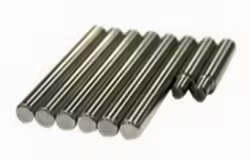
Jiyuan’s round bar range includes carbon and alloy steel families. That range is useful precisely because material requirements differ: an existing design may call for a particular composition and condition rather than simply the largest grade number available.
Harder, stiffer, and tougher are not alternative spellings of stronger
Hardness describes resistance to a specified kind of local indentation. It is associated with a small contact region. A hardness number does not automatically describe how far a long bar bends or how it behaves when a crack is present.
Stiffness concerns resistance to elastic deformation. At the material level, elastic modulus is important; at the object level, length and cross-sectional shape also matter. A slender rod and a thick rod of the same steel can feel very different when bent because their geometry differs.
Toughness concerns the ability to resist fracture while absorbing energy, with the exact meaning tied to the test or fracture situation. A material can be hard yet relatively vulnerable to cracking under a particular kind of loading. The everyday assumption that hard must mean unbreakable is therefore unreliable.
These properties can respond differently to heat treatment and cold working. Increasing resistance to permanent deformation does not necessarily increase every other useful behavior by the same proportion. This is why a material description often includes several properties rather than one overall score.
A tool edge, a repeatedly bent spring, and a component that must tolerate impact bring different questions to the same broad family called steel. Ranking grades on one unlabeled vertical ladder would hide those questions instead of answering them.
Names from different systems need translation, not numerical sorting
Different organizations and regions use different designation systems. A number can identify a composition family in one system and a specified property class in another. Similar digits do not establish a shared meaning, and different-looking names do not by themselves prove that the materials are unrelated.
A proper comparison has to look at what the designations require. Composition ranges, product form, treatment condition, and the properties being specified can all matter. The visual similarity of two names is only a clue about the names, not evidence that the steels can be substituted.
Document numbers create a further source of confusion. A standard identifier and a grade within that standard occupy different levels of the description. A bigger document number does not mean stronger steel any more than a later page number in a textbook means a harder material.
The most useful question to ask of a label is “What information does this system put into this part of the name?” Once that is answered, the grade code can be read on its own terms. Strength can then be discussed as a defined property of the material in a stated condition, rather than guessed from the numerical size of its name.
Steel Grade Numbers Are Not Scores
Can grades from different naming systems be ranked by their numbers?
No. The digits may describe composition, a property level, or an identifier depending on the system. A larger number in one system does not establish greater strength than a smaller number in another. The standard, material condition, and property being compared must remain attached to the designation.
Are stronger, harder, and stiffer interchangeable descriptions?
No. Strength concerns resistance to specified loading or permanent deformation, hardness concerns local indentation, and stiffness concerns elastic deformation. Toughness asks another question about fracture behavior. A material can improve in one response without improving by the same proportion in the others.
If you are exploring material for such a design, you can share the original grade designation with Jiyuan, together with its standard reference if known and the bar dimensions. Keeping the name intact gives the discussion a real material starting point instead of treating “higher grade” as a complete technical description.