What Is Negative Strip Time in Steel Casting?
Table of Contents
Negative strip time is the part of a casting mold’s oscillation cycle when the mold moves downward faster than the steel strand. The time itself is not negative. The name describes the relative movement between two objects that are both in motion.
This becomes much easier to picture once you stop imagining the mold as stationary. In continuous casting, the strand travels out of the mold while the mold repeatedly moves up and down. Their speeds change relative to one another throughout each cycle.
Ride beside the strand
Imagine descending on a moving platform beside the steel strand, traveling at exactly the same speed as the strand. From your viewpoint, the strand appears still. Now watch the mold.
When the mold moves downward more slowly than you do, it appears to move upward relative to your platform. When it descends faster than you, it appears to move downward. That second interval is the negative strip period.
The mold does not need to keep descending forever. It oscillates, so it later slows, reverses direction, and returns. Negative strip time is only one part of that repeating motion.
An everyday version is passing another car on a road. Both cars may be moving forward, yet the slower car appears to drift backward relative to yours. Absolute direction and relative direction are different descriptions.
Position, direction, and speed are three different observations
A mold can be near the top of its travel, near the bottom, or somewhere between. That is its position. It can be moving upward or downward. That is its direction. It can be moving slowly or quickly. That is its speed.
Negative strip is not defined by the mold merely being low down, nor by its moving downward at any speed. The defining comparison is whether its downward speed exceeds the strand’s downward speed.
At a smooth turning point, the mold momentarily stops before reversing. A stopped mold is not overtaking a strand that continues downward. As the mold accelerates downward, it may first move more slowly than the strand, then match its speed, and then move faster.
The relative motion changes when the two speeds match. At that instant, their relative speed is zero even though both can still be moving through the building. This is the same distinction seen when two cars travel side by side at equal speed.
Later, the mold slows before reaching the bottom of its travel. It can leave the negative strip interval before it actually starts moving upward, because its downward speed can fall below the strand speed while its direction is still downward.
Why let the mold overtake the steel?
Near the top of the mold, liquid steel is turning into a thin solid shell. That shell has to travel along the mold region without damaging sticking. Oscillation and lubrication help manage the interaction between the hot developing shell and its cooled surroundings.
The negative strip interval is part of this changing contact and lubrication behavior. Research on mold oscillation and the casting interface examines the relationship between these motions and the conditions where the shell forms. It is a dynamic interaction, rather than a mold simply stamping a fixed shape onto steel.
The interval can also be associated with the formation of oscillation marks on the strand’s surface. Those repeating marks are evidence that the surface was created while the mold was moving, though their detailed shape depends on more than a single time measurement.
Put simple numbers beside the moving picture
Suppose an imaginary strand travels downward at 20 mm per second. If the mold is also moving downward, but at 10 mm per second, the strand gains 10 mm per second relative to it. From an observer riding with the strand, the mold appears to rise at that relative speed.
If the mold instead descends at 30 mm per second, it gains 10 mm per second on the strand. This is negative strip motion. Both objects still travel downward relative to the factory floor, but the mold now overtakes the steel.
If the mold moves upward at 10 mm per second while the strand continues downward at 20 mm per second, they move apart in those directions at 30 mm per second. Subtracting signed velocities, or simply adding their speeds when directions oppose, gives the relative movement.
| Illustrative mold motion | Strand motion | Does the mold overtake the strand downward? |
|---|---|---|
| Stopped | 20 mm/s downward | No |
| 10 mm/s downward | 20 mm/s downward | No |
| 20 mm/s downward | 20 mm/s downward | Equal speed at that instant |
| 30 mm/s downward | 20 mm/s downward | Yes |
These values form a teaching example, not a casting recipe. They show that the word negative depends on a comparison. One speed number without the other cannot identify the interval.
How long does the overtaking last?
The mold’s speed changes through an actual oscillation cycle. Negative strip time begins when its downward speed passes above the strand speed and ends when it falls back below it. The duration between those crossings is a positive amount of time.
If an illustrative cycle lasts one second and the overtaking interval lasts one-quarter of a second, the negative strip time is 0.25 second. The negative strip fraction is 0.25 divided by 1, or 25 percent. Time and fraction describe related but different quantities.
Now imagine another cycle lasting half a second with the same 25 percent fraction. Its negative strip time would be 0.125 second. Equal fractions do not imply equal durations because the complete cycles have different lengths.
This distinction prevents a percentage from being mistaken for a time setting. A fraction is dimensionless; a duration has a time unit. Frequency, the number of cycles per second, is yet another way of describing the rhythm.
Changing strand speed while holding the mold’s motion unchanged can also change the overtaking interval. A faster strand may be harder for the mold to catch. The mold’s motion has not changed, but the threshold against which it is compared has moved.
Why the motion matters near the new shell
The relevant region is where the steel surface is still forming and interacting with the mold environment. A thin shell, liquid metal, and lubrication must coexist while the material is withdrawn. The relative movement affects that local interaction.
Sengupta and Thomas’s research on mold oscillation describes lubrication and shell-formation events through an oscillation cycle in the studied slab-casting conditions. It also shows why the motion cannot be reduced to a simple rubbing action on an already finished solid bar.
The presence of a negative strip interval is consequently one part of a coupled process. Its effect depends on the surrounding thermal, flow, and contact conditions. A longer interval is not automatically a universal improvement, just as a faster movement is not automatically a better movement.
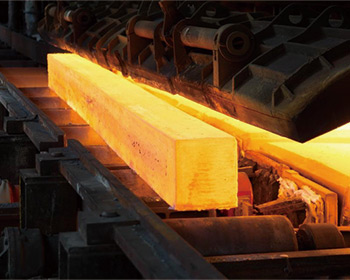
Jiyuan’s cast steel billet range includes square or rectangular sections and large round forms. These are tangible downstream results of a process in which material shape, solidification, and motion have to work together.
The name makes sense from the moving viewpoint
The mold returns to its starting position after a complete cycle, but the strand has moved onward. During one part of that cycle, the mold briefly moves downward faster than the strand. During other parts, it moves more slowly or reverses upward.
A graph of mold position shows where the mold is. A graph of mold velocity shows how quickly and in which direction it is moving. Negative strip time is identified through the velocity comparison, not merely by marking the low point on the position curve.
The apparently unusual term therefore describes an ordinary relative-motion event inside an unusual machine. The clock always runs forward. What changes sign is the direction in which the mold appears to move when you watch it from beside the traveling steel.
Understanding Negative Strip Motion
Is negative strip time a negative number of seconds?
No. It is a positive duration within a mold oscillation cycle. The name refers to the interval when the mold moves downward faster than the strand, so their relative movement reverses compared with other parts of the cycle.
Is downward mold motion always negative strip?
No. The mold must move downward faster than the strand. Moving downward more slowly still gives a different relative motion. Mold position, direction of travel, and speed are separate observations; the relative speed determines whether the interval meets the definition.
If a question about casting terminology has led to a billet-material inquiry, you can share the intended section and downstream route with Jiyuan. The material form helps keep the discussion concrete, while machine motion and control values remain matters for the actual casting process.