How Do Peeling and Grinding Reveal a Bright Steel Surface?
Table of Contents
The bright bar manufacturing process can use defined cutting edges in peeling or many abrasive points in grinding to expose a new metallic surface.
In bright bar manufacturing, peeling and grinding both remove material from the outside of steel, but they use different kinds of cutting contact. Peeling uses defined cutting edges to remove an outer layer. Grinding uses many abrasive grains, each acting as a small cutting point. Both can expose a bright metallic surface while leaving different traces of how it was made.
A bright surface is easy to recognize and surprisingly difficult to explain from appearance alone. Two bars may reflect the same workshop lights even though the machines that finished them worked in different ways. Following the removed metal helps distinguish those routes: what left the bar, how it was separated, and what surface remained?
Peeling makes a new outside
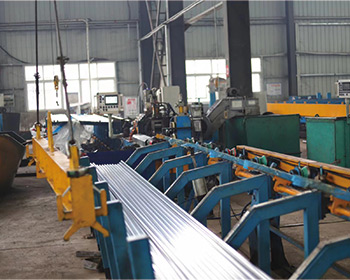
Imagine removing the outer layer of a cylindrical vegetable, but replace the hand tool with controlled cutting tools and the vegetable with steel. The useful part of the comparison is the geometry. Material around the outside is cut away, exposing metal that was previously below the surface.
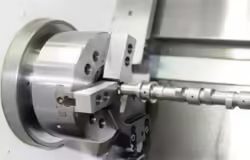
In bar peeling, a cutting arrangement works around the bar as material progresses through the operation. The tool edge is a deliberately shaped edge, much as a turning tool has a defined cutting tip. Contact between the tool and the workpiece separates metal as chips. The machine does not simply squeeze the existing outside into a shinier condition.
The removed layer may include dark scale and steel beneath it. Scale is an oxide layer; it is not the same substance as the metal underneath. Removing only loose oxide would clean the surface, but peeling can also remove a controlled thickness of the underlying metal. That distinction explains why a peeled bar has a smaller diameter than the material entering the operation.
It also explains the word “reveal.” A new surface was already present in the sense that the metal existed inside the original bar. Machining turns that interior material into the exposed exterior. A scratch on the old surface disappears only if the material containing the scratch is actually removed. Merely making the surrounding area shiny would not erase a deep groove.
Ovako’s description of peeled bars identifies peeling as a distinct further-processing route. The process name tells us something about how the surface was produced; it does not replace the steel grade or specify every feature of the finished bar.
A small diameter change can remove a substantial layer
Consider an illustrative one-meter length that starts at 52 millimeters in diameter and finishes at 50 millimeters. The amount removed from each side is one millimeter, not two. Diameter crosses the entire circle, so reducing it by two millimeters moves the surface inward by one millimeter all around.
The original cross-sectional area is π × 26², and the final area is π × 25². Subtracting them gives 51π, approximately 160.22 square millimeters. Over a one-meter length, that corresponds to about 160,221 cubic millimeters of removed material, or 160.22 cubic centimeters.
This is the volume of a thin cylindrical sleeve, although it leaves the machine as chips rather than as an intact sleeve. It represents about 7.54 percent of the original cross-sectional area. The example shows why a surface operation can remove appreciable material even when the change looks small beside the bar’s overall diameter.
There is a useful trap in the arithmetic. Multiplying the diameter reduction by the length does not calculate removed volume: it leaves out the circular geometry. Nor is the percentage change in diameter the same as the percentage change in area. The final area is proportional to 50 squared, while the starting area is proportional to 52 squared.
Those dimensions are a calculation example, not a recommended peeling allowance. The actual starting surface and required finished dimensions determine how much material an operation needs to remove. A shallow cosmetic mark and a deeper surface discontinuity are different geometric problems.
Grinding shares the cutting among thousands of points
A grinding wheel contains abrasive particles held in a bonded structure. Exposed particles meet the steel as the wheel moves. A grain that penetrates sufficiently can cut a very small chip; other grain contacts may rub or push material. The resulting surface is the accumulated effect of many tiny interactions.
In Norton’s explanation of grinding-wheel construction, the wheel is described as a cutting tool made from abrasive grains and a bond. The distinction from peeling is therefore not “cutting versus no cutting.” Both remove material. The distinction is a defined tool edge versus a population of abrasive cutting points.
The bond matters because the particles must be held in useful positions while they work. The spaces between them matter too: the wheel cannot be imagined as a perfectly solid block of grit. Its cutting face contains a changing landscape of grains, spaces, worn areas, and newly exposed edges.
That landscape changes during use. Grains can dull or fracture, and particles can be released as the wheel wears. Norton’s account of self-sharpening explains how fresh cutting points become available. The wheel’s useful cutting behavior depends on this controlled renewal, not on every original grain remaining sharp forever.
This makes grinding different from wiping steel with a cloth. A cloth may remove dirt without materially changing the underlying shape. A grinding operation can change dimensions because some of the metal is removed. The individual chips may be too small to resemble the recognizable curls produced by other machining methods, but their combined volume still comes out of the bar.
Why use both operations on one bar?
A manufacturing route can assign different tasks to successive operations. One stage can remove an outer layer; a later stage can refine the remaining surface and dimensions. There is no contradiction in describing a bar as peeled and then ground. Those words record a sequence rather than two mutually exclusive identities.
Imagine drawing a broad line with a marker and then trimming its edges carefully. The second action does not undo the first. It works on the result left behind. Similarly, grinding after peeling begins with the geometry and surface that the peeling stage has produced. It removes another amount of material and leaves its own texture.
That does not make a longer sequence automatically better for every use. An operation has value when it supplies something the next manufacturing step needs. If later machining will remove the entire finished outside, the significance of that outside differs from a case in which it becomes a working surface. The route and the final use must be understood together.
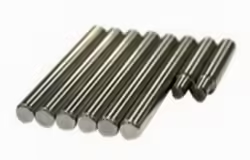
For readers exploring starting material, Jiyuan’s bright steel bar range provides a relevant place to look: the published diameter family is φ12–300 millimeters. Bright bar is an intermediate product that can bring an already finished exterior into a later machining route. The useful question is which surface and dimensional condition fits the next operation, rather than how shiny the catalog photograph looks.
What light can tell you about the result

A defined cutting edge and an abrasive wheel can leave different families of fine marks. Their direction, spacing, and depth affect how light reflects. One surface may show a pronounced directional pattern while another appears more uniform to the eye. Moving the light or rotating the bar can change the apparent pattern dramatically.
Reflection is not a chemical analysis. A bright carbon-steel surface does not become stainless steel when its scale is removed. Nor does brightness establish hardness. Those properties belong to the material and its condition; the visible finish records only part of its processing history.
It helps to separate three descriptions: the process that produced the surface, the measured texture of that surface, and the steel beneath it. “Ground” names a process. A roughness value describes an aspect of texture under specified measurement conditions. A grade identifies a material family. None of those labels alone substitutes for the other two.
Finally, look at where the removed material went. Peeling leaves chips from a shaped edge. Grinding leaves very small metal particles together with material worn from the abrasive system. Both routes create the bright exterior by removing part of the former exterior. The bar has not acquired a metallic-looking skin; its own metal has become the surface you can see.
Peeling and Grinding: What Actually Comes Off?
Can one bright bar be both peeled and ground?
Yes. Peeling can remove an outer layer, and a later grinding operation can refine the surface and dimensions that remain. These names can describe successive stages. They are not mutually exclusive material identities, and additional stages are useful only when they serve the intended result.
Does a 2 mm reduction in diameter remove 2 mm from every side?
No. For a centered round section, reducing diameter by 2 mm moves the outside inward by 1 mm on each side. Removed volume comes from the difference between the starting and final circular areas multiplied by length, not from diameter reduction alone.
If that is the question behind your project, describe the grade, finished diameter, and what will happen to the outside surface. For example, explain whether it will be turned away or remain on the part. Those details give a specific context for discussing a bright-bar option without assuming that every bar receives the same finishing sequence.
Ask about bright bar with the outside diameter and surface role your part needs.