Why Does Steel Spring Back Slightly After Cold Drawing?
Table of Contents
Cold drawn square steel bar can recover a small elastic part of its deformation after unloading while retaining the larger permanent shape change.
A cold drawn square steel bar can spring back slightly after drawing because some of the deformation under the die is elastic. That part recovers when the load is removed, even though the larger permanent change in shape remains. A bar can therefore leave the die with dimensions influenced by both plastic deformation and elastic recovery.
The two behaviors occur together. “Plastic” means the change stays; “elastic” means it tends to reverse after unloading. Cold drawing does not switch off the steel’s elastic response.
A permanent bend can still recover a little
Imagine gently flexing a thin metal strip. Under a small load, it returns almost entirely to its original shape. Press far enough and it can retain a bend, yet still move back slightly when released.
That final movement is not the strip undoing all its deformation. The permanent part remains while the elastic part recovers. This is the key distinction behind springback.
A drawing die imposes a different loading pattern from bending a strip, but the same coexistence matters. The steel is squeezed and pulled while being reshaped. Removing those loads lets some of the stored elastic strain relax.
One deformation can contain two parts
It helps to give the two parts separate names without imagining two separate pieces of steel. Elastic strain is the recoverable part of the deformation. Plastic strain is the part that remains after unloading. A region of steel can carry both while a forming load is acting.
Consider a deliberately simplified stretching example. A marked length begins at 100.00 millimeters, reaches 102.10 millimeters while loaded, and measures 102.00 millimeters after unloading. The loaded extension was 2.10 millimeters. Of that extension, 0.10 millimeter recovered and 2.00 millimeters remained.
Those numbers are invented to isolate the idea, not to predict the dimensions of a drawn bar. The piece did not return to its original 100.00 millimeters, so it underwent permanent deformation. Yet it did recover some length, so it also showed elasticity. Both statements are true of the same loading cycle.
Now reverse the mistaken interpretation. If somebody saw the 0.10-millimeter recovery and said “the forming operation failed because the steel sprang back,” they would be ignoring the much larger permanent change. If somebody saw only the 2.00-millimeter permanent extension and said “the steel no longer behaves elastically,” they would be ignoring the recovery.
Drawing is more complicated than that one-dimensional example because the bar is pulled along its length while the die acts on its cross-section. The local load includes several directions. The example supplies a vocabulary for separating recoverable and permanent deformation, not a formula for the die size.
The die opening is not the whole story
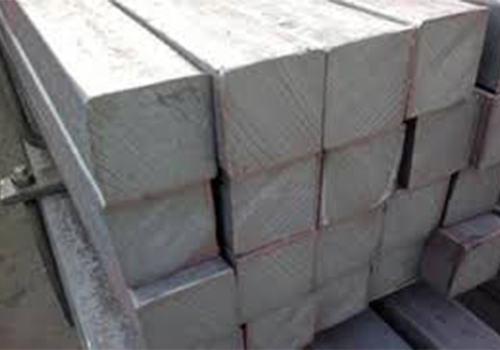
In a square-bar drawing operation, the die guides material through a shaped opening. The faces and corners are loaded as the metal passes. At the exit, the contact forces change, and the steel is no longer constrained in exactly the same way.
It is tempting to imagine the emerging section as a perfect frozen copy of the hole. That picture ignores the fact that the steel was under force inside the die. Unloading is another physical event after shaping.
The die itself can also deform elastically under load. The contact therefore involves two real materials, not an infinitely rigid outline surrounding an object with no springiness.
A square opening makes the difference between an outline and a material response especially visible. Faces and corners do not have identical surroundings. A point at the middle of a face and a point near a corner encounter different local geometry, even though both belong to the same cross-section.
As the section enters, passes through, and leaves the die, the contact conditions evolve. The region inside is constrained by tooling and transmitting the drawing force. The region beyond the exit is no longer held by that same contact. The dimensional state at one moment need not be identical to the free state after the drawing load has been removed.
A further subtlety is that “outside the die” and “fully unloaded” are not always the same observation. While drawing continues, the emerging material may still transmit a pulling force. A measurement of that loaded material and a measurement after the load is released concern different mechanical states.
This is why a die opening should not be treated as a perfect rubber stamp for the final unloaded section. The real outcome includes the geometry imposed under load and the recovery that follows. It is possible to understand that principle without assuming that every dimension changes by the same amount or even in the same simple direction.
Research on drawing SAE 1045 steel examines how drawing conditions relate to dimensions and residual stresses. Its broader lesson for understanding the process is that geometry, loading, and the material’s response are coupled.
Harder to deform permanently is not the same as unable to recover
Cold working can change the stress needed to continue permanent deformation. That does not eliminate the recoverable response associated with loading and unloading. A worked bar can be more resistant to further permanent shape change while still recovering a small elastic component when a force is removed.
Here the words “strong” and “springy” can confuse everyday intuition. A material may need a greater load to acquire a permanent set, yet still have a small elastic strain under load. The extent of recovery depends on the loaded state and the material’s response; it cannot be guessed solely from a shiny surface or the fact that the bar was drawn.
Nor does springback mean that atoms slowly remember the original shape and decide to return to it. Ordinary elastic unloading is a response to changed forces. It should not be confused with a special shape-memory effect or with a later heat treatment that changes the structure.
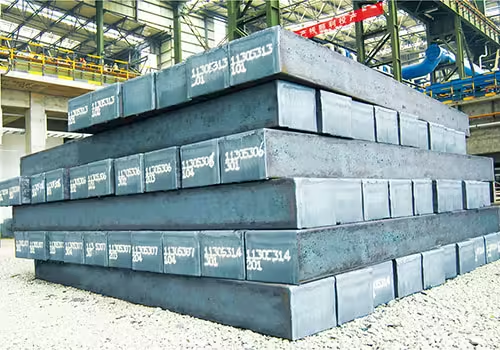
Jiyuan’s square-bar range includes carbon and alloy steel sections, with a published large-section family of 150 × 150 to 500 × 500 millimeters. The flat-sided form is useful when the next process starts from a square section, but a square outline alone does not tell the reader whether a particular bar has been cold drawn or what its final dimensional condition is.
Three changes that can happen at different times
Elastic recovery at the die exit concerns the release of drawing loads. Movement after a later machining cut can involve a different event: removal of material that had helped balance residual stresses inside the bar.
Residual stresses are internal stresses that remain without an external load. Their presence can influence later behavior, but they should not be used as a catch-all name for every small dimensional change.
Temperature change is another separate cause of size change. A warm bar can contract as it cools, even without additional cutting or drawing. Several mechanisms can affect dimensions while acting at different moments.
Put the events on a timeline. First, a bar passes through the die while forces are acting. Next, those forces are removed and elastic recovery occurs. Later, the bar may cool from its processing temperature. Still later, a machining cut may remove material and change the balance of internal stresses. A measured dimensional change at each stage can have a different cause.
The timeline is especially helpful when comparing two measurements. If the first was made on warm material during production and the second on a cool, unloaded piece, more than one condition changed. It would be too simple to assign the entire difference to springback just because the material was cold drawn.
Residual stress adds one final nuance. An unloaded object can contain internal stresses that balance one another. There is no contradiction between saying “the external pulling force has gone” and “some stresses remain inside.” Recovery after external unloading does not require every microscopic region to become completely stress-free.
A later cut can disturb that internal balance, but it is a new event, not the original die-exit springback happening again. Keeping the events separate avoids using one familiar term to explain every movement a piece of steel might make.
Return to the marked 100.00-millimeter length in the simple example. The 102.10-millimeter loaded dimension and 102.00-millimeter unloaded dimension are both correct observations. The difference between them describes elastic recovery; the difference between 102.00 and 100.00 describes permanent change. Drawing leaves a final shape because the permanent part remains after the recoverable part has relaxed.
What Recovers After Cold Drawing?
Does springback undo all the permanent change from drawing?
No. Recoverable elastic deformation relaxes when the load is removed, while the plastic part remains. A drawn bar can therefore retain a substantially changed section and length while recovering a smaller part of the deformation that existed under load.
Is every later dimensional change in drawn steel springback?
No. Cooling can cause thermal contraction, and later machining can disturb a balance of residual stresses. Those events occur at different stages from release of the drawing load. The time and conditions of each measurement help distinguish their causes.
For a material discussion, give the grade, square section, and required delivery condition. If the question involves a size change, distinguish a dimension measured under load from one measured after unloading. That distinction turns “the size changed” into a much more useful description of the observation.
Share when the size change was measured as you ask about square-bar material and delivery condition.