Is a Square Steel Bar the Same as a Square Tube?
Table of Contents
A solid square steel bar has a filled section; a square tube has a hollow center that changes its mass and the distribution of material.
No. A solid square steel bar is filled with steel across its cross-section. A square tube has a hollow center surrounded by walls. Their outside outlines can look almost identical, but the missing middle changes their weight and the way material is distributed through the section.
The easiest way to understand the difference is to look at the cut end. A solid bar shows a filled square. A tube shows a frame around an opening. Looking only along one long face hides this distinction.
Subtract one square from another
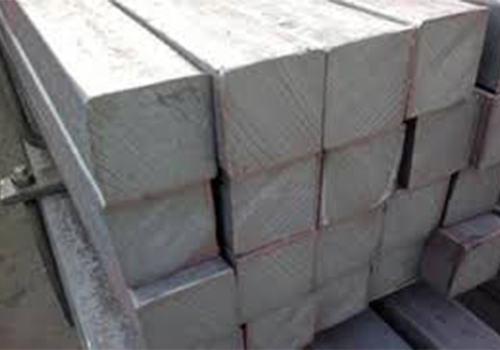
Consider an illustrative sharp-cornered square bar measuring 40 millimeters on each side. Its cross-sectional area is 40 × 40, or 1,600 square millimeters.
Now imagine removing a centered 30-millimeter square from it. The empty region has an area of 900 square millimeters, leaving 700 square millimeters of steel. The wall thickness in this idealized shape is 5 millimeters: the 10-millimeter difference is shared between the two opposite walls.
For equal lengths and equal steel density, that hollow section contains 700 ÷ 1,600, or 43.75 percent, as much steel as the solid bar. It would therefore have 43.75 percent of the solid bar’s mass in this model.
Real square tubes usually have rounded corners and other manufacturing details, so their exact areas differ from our sharp-square illustration. The subtraction still explains why identical outer width does not mean identical weight.
Wall thickness is a third piece of information
A tube’s outside side dimension does not determine its metal area on its own. The wall thickness controls the size of the opening. Two tubes can both measure 40 mm across the outside and still contain different quantities of steel if their walls differ.
In an ideal sharp-cornered square tube, the inside side dimension is b − 2t, where b is the outside side and t is the wall thickness. The factor of two counts the walls on opposite sides. Subtracting only one wall thickness would make the imaginary hole too large.
The steel area is b² − (b − 2t)². Expanding the brackets gives 4t(b − t), another way to write the same relationship. This formula describes the ideal geometry; actual tube corners and dimensional variation require a more faithful profile for a precise calculation.
Keep b at 40 mm. With a 5 mm wall, the opening is 30 mm square and the steel area is 700 mm². With a 3 mm wall, the opening is 34 mm square and the steel area is 444 mm². The outside silhouette stays the same while the quantity of material changes substantially.
The hollow center is therefore not a minor labeling detail. It is a geometric feature that continues along the length. Looking at one broad face cannot reveal its size, whereas a clear end view shows the difference immediately.
A hollow section has an inside surface too
The opening creates a second long surface around its inner boundary. In the ideal 40 mm tube with a 30 mm square opening, the outer perimeter is 160 mm and the inner perimeter is 120 mm. Both continue along the length.
Over one meter, those ideal surfaces total 0.28 square meter before counting the ends. The solid 40 mm square has only the 0.16 square meter of long outer surface. The tube can therefore contain less steel while having more total surface area exposed around its outer and inner boundaries.
Surface area and material volume are different quantities. Counting the faces that surround the opening does not count the opening as metal. It reveals another consequence of creating a hole: the same outside envelope now contains an additional boundary between steel and empty space.
The word tube describes a hollow form. The word bar commonly describes a solid form in this comparison. Neither tells you everything about the steel’s chemistry or processing history.
ASTM A500, for example, covers cold-formed structural tubing, including round and shaped sections. It is a tubing specification, not another way to say solid square bar. That distinction persists even when the two objects share an outside measurement.
Equal outside size and equal weight are different comparisons
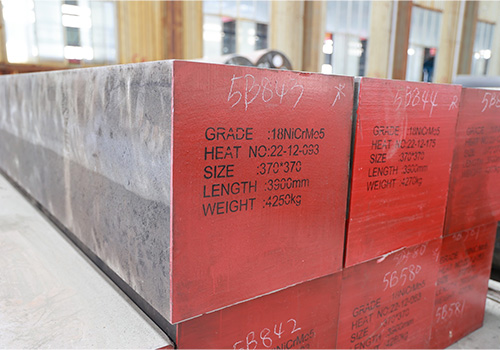
The earlier 40 mm comparison held the outside dimension fixed. Under that condition, the ideal solid bar contains more steel because it fills the space that is empty in the tube.
Now hold material area fixed instead. The ideal 40 mm square tube with 5 mm walls contains 700 mm² of steel. A solid square with the same area would have a side length equal to √700, approximately 26.46 mm.
At equal length and density, those two sections have the same calculated mass. But one spreads the material around a 40 mm outer outline, while the other gathers it into a smaller filled square. Their outside dimensions and material distribution differ even though their weights match.
Using an illustrative density of 7,850 kg/m³, each contains about 5.50 kg of steel per meter. The original solid 40 mm square contains 12.56 kg per meter. The calculation is comparing ideal shapes rather than quoting weights for a specific manufactured product.
This explains why seemingly contradictory statements about hollow and solid sections can both arise. Someone comparing equal outside dimensions asks one question. Someone comparing equal weight asks another. Neither comparison should silently replace the other.
Why distance from the middle affects bending
When a member bends, material on one side extends while material on the other side shortens. Material farther from the neutral region undergoes a larger change in length for a given curvature in a simple bending model.
Placing material farther outward can therefore make efficient use of a limited amount of steel for resisting overall bending. That is the geometric reason a hollow section can offer useful bending stiffness relative to its weight.
But efficiency per unit weight and total resistance within a fixed outside envelope are not the same measurement. A solid section with the same outside dimensions contains all the material in the hollow section plus the filled center. It has not lost that extra material’s contribution merely because the center is less geometrically efficient per unit area.
Nor does a statement about elastic bending settle every failure mode. A member may be limited by local contact, a joint, a thin wall, or another part of the load path. The shape comparison explains one mechanism rather than assigning a universal winner.
Pressing on a wall is different from bending the whole length
Imagine pressing a small object into the middle of one tube face. That face can bend locally between its neighboring walls. A solid bar backs the same outside region with steel extending inward, so the immediate supporting geometry is different.
A tube can consequently resist overall bending effectively while still allowing a local wall dent under a concentrated contact. There is no contradiction because the two actions deform different parts of the object in different ways.
Thin walls can also have local stability concerns when compressed. Their ability to retain their shape depends on wall dimensions and support, not only on the strength of the steel from which they are made.
The filled section and hollow section therefore direct forces through different paths. A useful physical description says where the load is applied and which deformation is being discussed. “Strong” by itself does not distinguish a whole-member bend from a small indentation in one wall.
Jiyuan’s square steel bar range offers the solid-section side of this distinction, with carbon and alloy material families and listed large square sections. When a project needs material throughout the center, the filled cross-section is a meaningful product feature rather than just a heavier version of tubing.
The quickest visual test remains the end face: a filled square describes material across the section, while a framed square surrounds a void. From that simple difference follow the changes in mass, wall behavior, and the way steel is distributed around the center.
Solid Square Bar and Hollow Tube
Can equal-width square bar and square tube have the same weight?
Not if they have equal length, density, and the same outside dimensions but one contains an empty center. The tube contains less steel. Equal-weight comparisons require changing another dimension, so they are different from comparisons based on identical outside size.
Why is wall thickness essential when describing a square tube?
The outside width does not reveal the size of the hollow center. Wall thickness helps determine the inner dimensions, remaining area, mass, and local wall behavior. A solid square bar has no internal wall or hollow section to subtract.
You can share a solid-square material requirement with Jiyuan using the side dimension, length, and grade if established. A small end-view sketch marked solid keeps the inquiry clear when other documents or photographs show similar-looking hollow sections.