Alloy Steel Billet for Heavy Machinery: Matching Grade, Strength, and Heat Treatment Before Failure Happens
An alloy steel billet for heavy machinery should not be chosen by grade name alone. A shaft, gear blank, pin, or forged connector may look fine after machining, but still fail later if the billet grade, section size, hardenability, and heat treatment route were not matched from the beginning.
This guide explains how buyers can match heavy machinery steel to real working loads, why heat treatment steel billet selection matters, and when grades such as 4140, 42CrMo, 4340, or 20CrMnTi make sense for forged machinery parts.
Table of Contents
Why Heavy Machinery Parts Cannot Choose Alloy Steel Billet by Grade Name Alone
The simple way to buy steel is to ask: “Do you have 4140?” or “Can you supply 42CrMo?”
That is not enough for heavy machinery parts.
A large shaft, gear blank, pin, or structural support part does not only need a chemical grade. It needs the right combination of strength, toughness, hardenability, internal soundness, and heat treatment response.
The NIST publication on heat treatment and properties of iron and steel explains how heat treatment changes steel properties through operations such as annealing, normalizing, hardening, and tempering. For buyers, this means the billet is only the starting point; the final part performance depends on what happens after forging and heat treatment.
For an alloy steel billet for heavy machinery parts, buyers should ask:
- What load will the part carry?
- Is the part exposed to impact, bending, torsion, or fatigue?
- How large is the final section size?
- Will the part be quenched and tempered, carburized, normalized, or annealed?
- Does the supplier provide chemistry, heat number, UT inspection, and surface quality records?
A grade name helps identify the steel family. It does not prove the final part will survive.
How Should Buyers Match Steel Billet to Load Type?
Different heavy machinery parts fail in different ways. A gear tooth may fail from surface wear or tooth-root fatigue. A shaft may fail from bending and torsion. A pin may fail from impact and shear. A large forged support part may fail because the internal section did not reach the required strength after heat treatment.
That is why structural alloy steel should be matched to the part function, not only the drawing name.
| Heavy Machinery Part | Main Risk | Steel Billet Selection Logic |
|---|---|---|
| Transmission shaft | Bending fatigue, torsion | Needs hardenability and core strength |
| Gear blank | Wear, tooth fatigue | May need carburizing or quench-temper route |
| Pin or connector | Impact, shear load | Needs toughness and controlled hardness |
| Hydraulic component | Pressure, fatigue | Needs clean steel and stable heat treatment |
| Large forged part | Section hardness variation | Needs internal soundness and suitable hardenability |
A heat treatable steel billet is most valuable when the buyer knows the final heat treatment target before placing the order. If the billet cannot respond consistently to heat treatment, the problem may appear only after forging, quenching, machining, or final inspection.
Why Hardenability Matters More Than Surface Hardness
Many buyers focus on final hardness. That is understandable, but for heavy machinery steel, surface hardness is only part of the story.
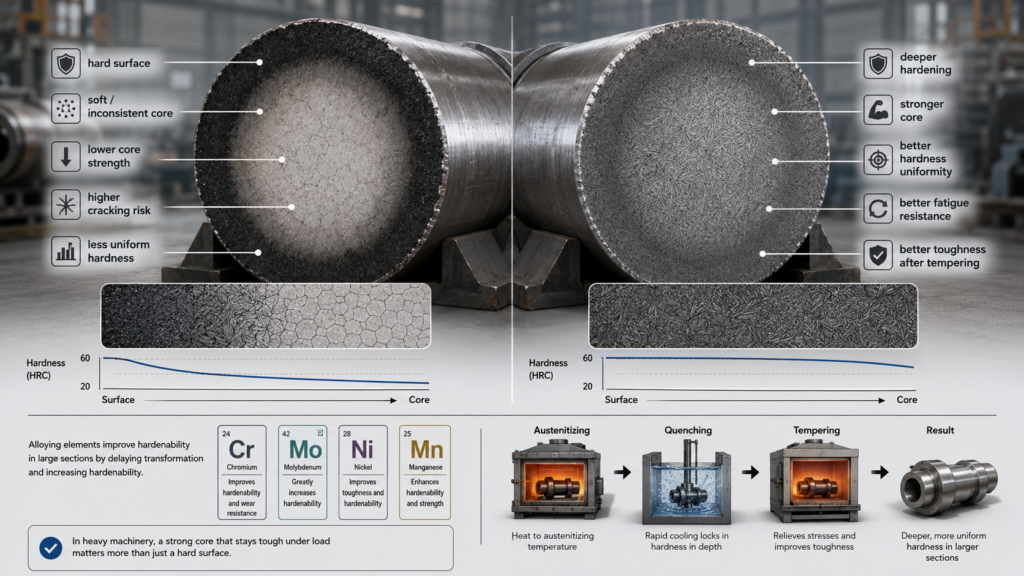
A large part also needs enough strength below the surface. If the steel has poor hardenability, the outside may reach the required hardness while the core remains too soft or inconsistent.
The ASM International video article on making metal stronger by heat treating, alloying, and strain hardening explains that processing and alloying change mechanical properties by modifying microstructure. That point is important for steel billets used in heavy-load applications because microstructure after heat treatment decides much of the final performance.
For a heavy shaft or forged connector, hardenability affects:
- core strength;
- hardness uniformity;
- fatigue resistance;
- toughness after tempering;
- risk of early cracking;
- machining behavior after heat treatment.
This is why alloying elements such as chromium, molybdenum, nickel, and manganese matter. They help the steel respond better in larger sections compared with plain carbon steel.
Which Alloy Steel Billet Grades Fit Shafts, Gears, and Heavy-Load Parts?
A buyer does not need a long grade list. They need a practical way to connect grade families with real parts.
| Grade Family | Common Grades | Best-Fit Parts | Selection Logic |
|---|---|---|---|
| Cr-Mo alloy steel | 4140 / 42CrMo / 42CrMo4 | Shafts, pins, machinery parts | Balanced strength, toughness, and quench-temper response |
| Ni-Cr-Mo alloy steel | 4340 / 34CrNiMo6 | Heavy shafts, high-impact parts | Better hardenability and toughness for demanding loads |
| Carburizing alloy steel | 8620 / 20CrMnTi | Gears, transmission parts | Hard surface with tougher core after carburizing |
| Medium carbon steel comparison | 1045 / C45 | Lower-load shafts and general parts | Lower cost, but limited hardenability |
A 4140 or 42CrMo alloy steel billet is often selected for forged machinery parts because it offers a practical balance between strength, toughness, availability, and heat treatment response.
For heavier sections or stronger fatigue requirements, 4340 or 34CrNiMo6 may be considered. For gears that require a hard wear surface and tougher core, carburizing grades such as 8620 or 20CrMnTi may be more suitable.
The point is not that one grade is “best.” The point is that the grade should follow the part duty.
When Should 4140 or 42CrMo Be the First Option?
4140 / 42CrMo is often a logical first option when the part needs a strong but still tough quench-and-temper steel.
It is commonly considered for:
- machinery shafts;
- forged pins;
- connecting rods;
- heavy-duty bolts;
- axle components;
- hydraulic machinery parts;
- general forged machinery components.
4140 / 42CrMo is not always the answer. If the part is very large, highly impact-loaded, or exposed to severe fatigue, the buyer may need a higher hardenability grade. If the part is a gear requiring case hardness, a carburizing steel may be better.
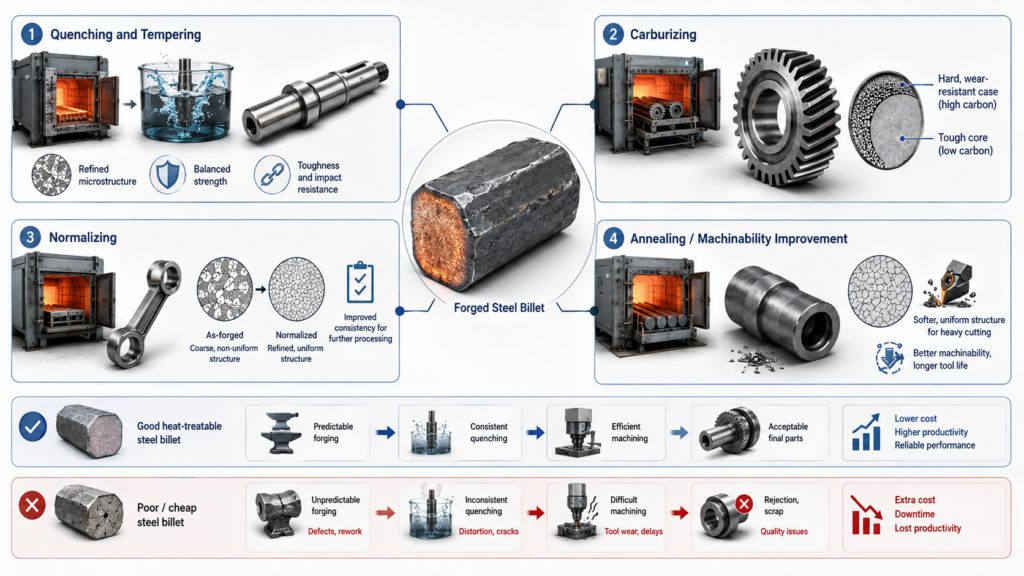
How Does Heat Treatment Change the Final Value of a Steel Billet?
A heat treatment steel billet becomes valuable only when it can deliver predictable results after the chosen thermal process.
Common routes include:
1.Quenching and tempering:Used when the part needs strength and toughness together. This is common for shafts, pins, and many forged machinery parts.
2.Carburizing:Used when the surface must be hard and wear-resistant while the core stays tougher. This is common for gears and transmission parts.
3.Normalizing:Used to refine structure and prepare steel for later processing.
4.Used to improve machinability before heavy cutting:Used to improve machinability before heavy cutting.
TWI’s article on heat treatment of welded joints explains that tempering can reduce hardness and tensile strength while improving ductility and toughness in steels. That same strength-toughness balance is central when choosing a heat treatable steel billet for heavy machinery.
A cheap billet that cannot respond consistently to heat treatment may become expensive after forging, quenching, machining, and rejection.
What Should Be Checked Before Forging Heavy Machinery Parts?
Before forging heavy-load parts, buyers should check more than billet size.
Important checks include:
- actual chemical composition;
- heat number and MTC;
- billet size tolerance;
- surface cracks or folds;
- internal soundness;
- ultrasonic testing requirements;
- end cutting condition;
- decarburization risk;
- forging temperature suitability;
- final heat treatment plan.
Before forging heavy machinery parts, buyers should confirm chemistry, internal soundness, surface condition, and billet size tolerance. This article on steel billet for forging quality checks explains what should be reviewed before production.
For heavy machinery steel, an inspection missed at the billet stage can become a much more expensive problem after forging and machining.
How Do Surface Defects Increase Machining Cost and Rejection Risk?
Surface defects are not just cosmetic. A crack, fold, scab, or deep surface mark can increase machining allowance or become a rejection point after forging.
This matters because heavy machinery parts often have high material cost and long processing routes. If a defect is found late, the buyer may lose forging time, heat treatment cost, machining cost, and delivery schedule.
Surface defects are not only cosmetic. They can increase machining allowance, rolling loss, and rejection risk. This guide to steel billet surface defects explains why early inspection matters.
For a large alloy steel billet, surface quality should be checked before the billet enters the forging furnace, not after the part has already consumed production time.
How Should Buyers Choose a Supplier for Heavy Machinery Steel Billets?
A supplier for heavy machinery steel billets should understand more than grade names.
Buyers should check whether the supplier can provide:
- stable grade supply;
- full MTC documents;
- heat number traceability;
- UT inspection when required;
- controlled billet cutting;
- surface inspection;
- size tolerance control;
- experience with forged machinery parts;
- communication on heat treatment requirements.
If the buyer is comparing mills, documentation, delivery consistency, and inspection capability, this guide on how to choose a steel billet supplier can help build the supplier checklist before ordering.
The supplier should also understand the downstream process. A billet for forging, heat treatment, rough machining, and final inspection is not the same as steel sold only by weight.
Alloy Steel Billet vs Carbon Steel Billet: When Is the Upgrade Worth It?
Carbon steel billets such as 1045 or C45 can be suitable for lower-load shafts, general machinery parts, and cost-sensitive components.
But carbon steel has limits. For larger sections, higher fatigue loads, impact conditions, or more demanding heat treatment targets, alloy steel may be the safer choice.
Choose alloy steel billet when the part needs:
- better hardenability;
- more uniform section properties;
- higher fatigue resistance;
- stronger quench-and-temper response;
- better toughness at higher strength levels;
- reduced failure risk in heavy-load service.
Choose carbon steel when the load is moderate, the section is not too large, and the final part does not require deep hardening or severe fatigue resistance.
The upgrade is worth it when the cost of field failure, downtime, or part rejection is much higher than the material price difference.
What Should Buyers Decide Before Ordering Alloy Steel Billet?
Before ordering, buyers should not only ask for a grade. They should define the final part.
What does the part do? How large is the section? Will it face impact, bending, torsion, wear, or fatigue? Will it be quenched and tempered, carburized, normalized, or annealed? What inspection will be required after forging and machining?
Once these questions are clear, it becomes easier to match 4140, 42CrMo, 4340, 34CrNiMo6, 8620, 20CrMnTi, or another steel family to the job.
A good alloy steel billet is not simply the billet with the highest strength on paper. It is the billet that can move through forging, heat treatment, machining, and heavy machinery service with fewer surprises.
FAQ
What is alloy steel billet used for in heavy machinery?
It is used for shafts, gears, pins, forged connectors, hydraulic parts, and structural alloy steel components that need strength, toughness, and heat treatment response.
Is 4140 alloy steel billet good for heavy machinery parts?
Yes. 4140 / 42CrMo is commonly used for shafts, pins, and forged machinery parts that need a balance of strength and toughness after quenching and tempering.
What is a heat treatable steel billet?
It is a steel billet designed to change final properties through heat treatment such as quenching, tempering, carburizing, normalizing, or annealing.
Why is hardenability important for heavy machinery steel?
Hardenability helps the steel achieve useful strength below the surface, especially in larger sections. Surface hardness alone does not prove core strength.
When should buyers choose 4340 instead of 4140?
4340 may be better when the part is larger, more impact-loaded, or needs higher hardenability and toughness than 4140 can provide.
Can carbon steel billet replace alloy steel billet?
Sometimes. Carbon steel can work for moderate-load parts, but heavy-load, fatigue-critical, or large-section parts often need alloy steel for more stable performance.
What should buyers check before ordering alloy steel billet?
Check chemistry, MTC, heat number, surface condition, internal soundness, billet size, forging route, heat treatment plan, and final mechanical property requirements.