What to Check Before Choosing Steel Billet for Forging
Choosing the right steel billet for forging is a critical step for manufacturers producing forged components. From automotive parts to heavy machinery, the wrong billet can cause cracking, internal defects, or inconsistent mechanical properties, leading to wasted materials, costly rework, and production delays.
Table of Contents
Why Steel Billet Selection Matters
Chemical Composition is the First Checkpoint
The elemental composition of a steel billet—carbon, manganese, chromium, molybdenum, nickel, vanadium—dictates hardenability, strength, toughness, and forging behavior. Even within the same steel grade, variation in chemical content can result in inconsistent heat treatment results.
For alloy steel billets intended for high-strength automotive components, consistent composition ensures uniform mechanical properties across multiple batches.
Internal Defects Can Become Forging Failures
Internal issues like shrinkage cavities, center porosity, segregation, non-metallic inclusions, or micro-cracks are critical. Ultrasonic testing (UT) or radiographic inspection is standard practice to detect hidden flaws that could compromise forging.
- Pro Tip: Request UT reports from suppliers before accepting steel billets.
- Ultrasonic testing standards detail proper evaluation methods.
Surface Quality Affects Heating and Deformation
Even minor surface cracks or folds can worsen during heating. Oxidized layers or deep scratches can lead to uneven expansion, resulting in distorted forged parts. A visual check combined with surface hardness testing ensures billets are ready for processing.
Heating Performance Should Match Forging Process
Different billets require precise heating profiles. Alloy steel billets are sensitive to overheating, decarburization, and oxidation. Uneven heating can cause internal stress, leading to micro-cracking. Large cross-section billets require extended uniform heating to minimize temperature gradients.
Forging Ratio and Billet Size Cannot Be Ignored
The billet-to-final-part volume ratio impacts densification and microstructure refinement. Undersized billets may not fully compensate for defects, while oversized billets may experience excessive stress during deformation. Axial shafts, rings, and flanges require specific forging ratios for optimal performance.
Continuous Cast vs Rolled Billets
Manufacturers must consider production route:
- Continuous cast steel billet: offers uniform quality, lower costs, but requires stricter control of segregation and internal defects.
- Rolled billets: suitable for high-integrity critical components but may be costlier.
How to Choose a Reliable Supplier
Selecting a trusted supplier ensures traceability and consistent quality. A credible supplier should provide:
- Mill test certificates (MTC)
- UT and surface inspection records
- Traceable heat numbers
- Stable chemical composition
- Customizable sizes and steel grades
Application Scenarios
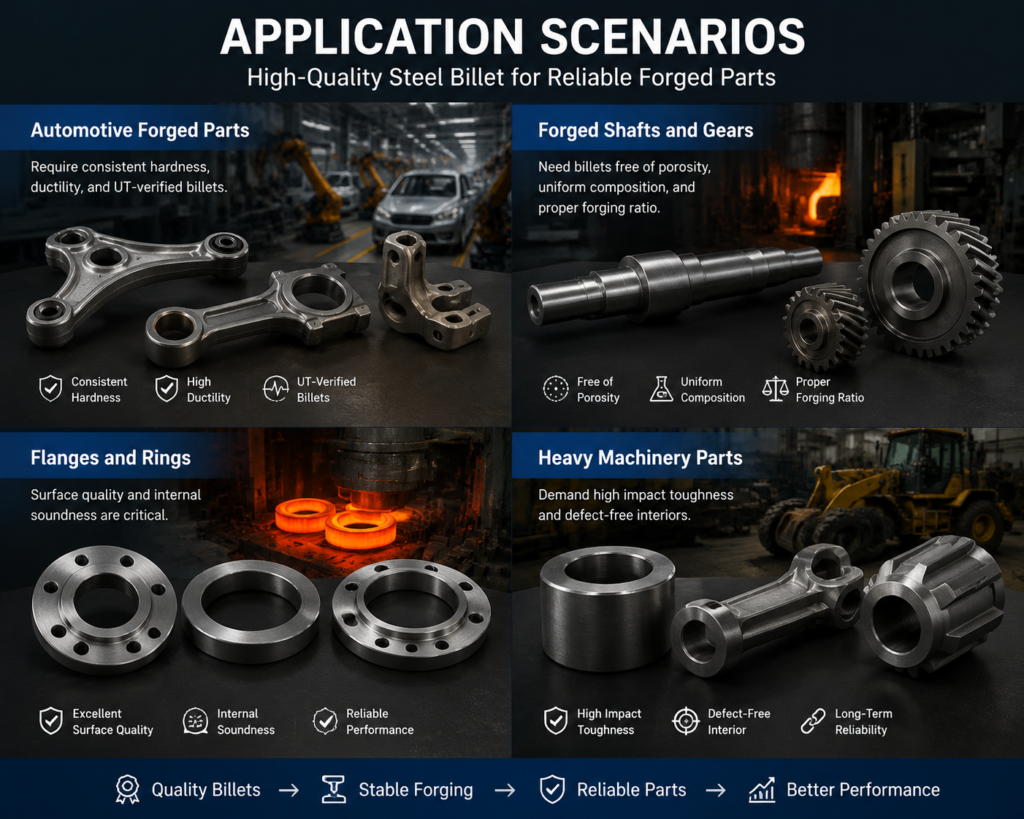
- Automotive forged parts: require consistent hardness, ductility, and UT-verified billets.
- Forged shafts and gears: need billets free of porosity, uniform composition, and proper forging ratio.
- Flanges and rings: surface quality and internal soundness are critical.
- Heavy machinery parts: demand high impact toughness and defect-free interiors.
Conclusion
FAQ
What is the best steel billet for forging?
Depends on forged part type, steel grade, heat treatment, and inspection requirements.
Why does steel billet crack during forging?
Internal defects, uneven heating, improper forging ratio, or unsuitable chemical composition are main causes.
How to check steel billets before forging?
Verify chemical composition, surface quality, UT results, billet size, heating profile, and supplier documentation.
Are alloy steel billets better for forged parts?
They offer higher strength and toughness but must match application and heat treatment.
Can continuous cast billets be used?
Yes, when internal quality, segregation control, and inspection certificates meet production requirements.