
Square Steel Billet vs Round Steel Billet for Different Production Lines
Choosing square steel billet vs round steel billet is not about which shape looks better. It is about which billet shape fits your rolling mill, forging route, piercing process, bar production, seamless tube line, machining plan, and final product geometry. This guide explains where square billet and round billet work best, what buyers should confirm before ordering, and how billet shape can affect processing stability, yield, and production cost.
Table of Contents
Why Square Steel Billet vs Round Steel Billet Is a Production Decision
The right answer to square steel billet vs round steel billet starts with the production line. A billet is only a semi-finished steel product. Its value comes from how efficiently it can be heated, moved, reduced, pierced, forged, or machined into the final shape.
The Wikipedia article on semi-finished casting products explains that billets, blooms, slabs, and ingots are intermediate products that need further processing before becoming finished goods. That is the key point: billet shape should match the next process, not just the available stock.
A square billet may be practical for many rolling and forging routes. A round billet may be more suitable for rotary processes, seamless tube production, and round-bar-focused processing.
The wrong billet shape can increase:
- reheating time
- deformation steps
- crop loss
- surface conditioning
- machining allowance
- handling difficulty
- process instability
So billet shape is a production planning choice, not a cosmetic detail.
What Is a Square Steel Billet and What Is a Round Steel Billet?
A square steel billet is a semi-finished steel product with a square cross-section. It is usually produced by continuous casting or hot rolling before being further processed into bars, wire rods, profiles, forged blocks, or other steel products.
The main advantage of a square billet is processing flexibility. Because of its flat sides and stable section, it is commonly used in rolling mills, forging operations, and general steel processing routes where the final product does not require a round starting shape.
A round steel billet is a semi-finished steel product with a circular cross-section. It is often selected when the downstream process involves rotation, piercing, round bar production, shaft forging, hollow tube forging, or seamless tube production.
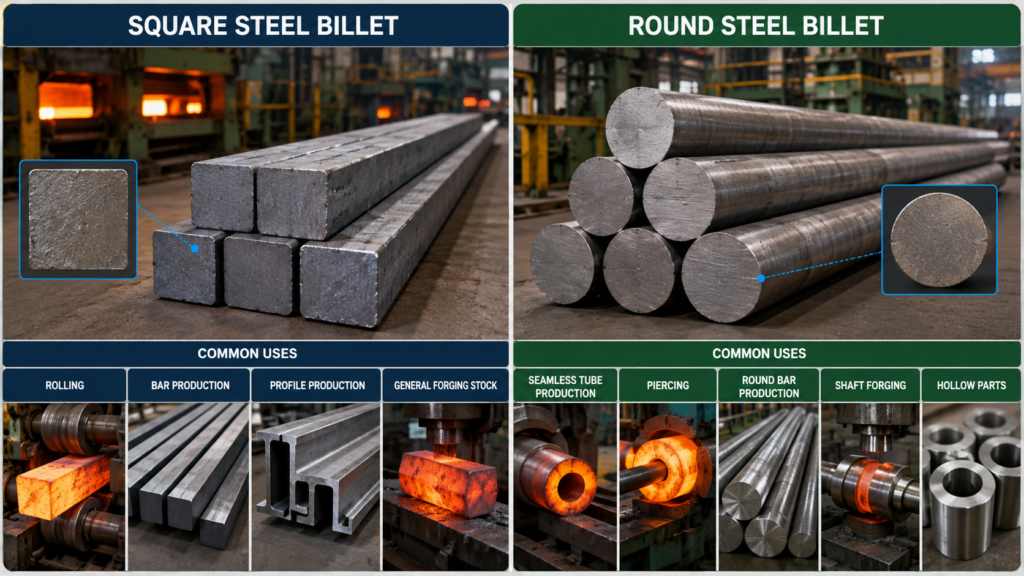
The main advantage of a round billet is shape compatibility. If the final product is round or hollow, starting with a circular billet can reduce unnecessary deformation, improve process stability, and lower material loss.
In a square steel billet vs round steel billet comparison, the key is not only the shape. The real question is whether the billet shape matches the production line.
You can understand it this way:
| Item | Square Steel Billet | Round Steel Billet |
|---|---|---|
| Cross-section | Square | Circular |
| Common production source | Continuous casting or rolling | Continuous casting or rolling |
| Common use | Bar rolling, wire rod, profiles, forging stock | Seamless tube, piercing, round bar, shafts, hollow parts |
| Processing advantage | Stable feeding and flexible rolling routes | Better rotation and round-shape compatibility |
| Best for | General rolling and many forging routes | Tube, pipe, round bar, and rotary processes |
A square billet is often chosen when the production line needs stable feeding and efficient reduction into bars, rods, or profiles. A round billet is often chosen when the line needs smoother rotation, easier piercing, or less shape conversion for round finished products.
What Is the Basic Difference Between Square Billet and Round Billet?
A square billet has a square cross-section. It is common in rolling routes, bar production, wire rod production, and many forging applications.
A round billet has a circular cross-section. It is often selected when the downstream process benefits from rotation, symmetry, or round starting geometry.
In a square steel billet vs round steel billet comparison, the basic difference is simple:
| Factor | Square Billet | Round Billet |
|---|---|---|
| Cross-section | Square | Circular |
| Typical processing fit | Rolling, bar routes, forging stock | Seamless tube, piercing, round bar, shaft routes |
| Handling | Stable stacking and furnace loading | Easier rotation in some processes |
| Shape transition | Good for many reduction routes | Better for round or hollow products |
| Main buyer question | Does it fit the rolling or forging route? | Does it reduce conversion loss for round products? |
Neither shape is automatically better. The best choice depends on the production route and final product.
Is Square or Round Steel Billet Better for Rolling?
For rolling, square steel billet vs round steel billet usually depends on mill design, pass schedule, reduction ratio, final product size, and product category.
Square billet is often practical for rolling because many mills are designed to reduce square or rectangular sections into bars, rods, or profiles. It can be easier to feed, reheat, and reduce through common rolling passes.
The Wikipedia article on rolling metalworking notes that rolling mill divisions convert semi-finished casting products into finished products. For billet buyers, that means the starting shape should support the rolling route, not fight against it.
Square billet may be suitable for:
- steel bar rolling
- wire rod production
- small section rolling
- profile production
- general hot rolling lines
- some forging stock routes
However, square billet is not always the answer. If the final product is a round bar with tight material yield requirements, or if the mill is designed around round starting stock, round billet may still be preferred.
For buyers who need more background on billet source and casting route, this guide to continuous cast steel billet can be used as a practical follow-up without repeating the full casting process here.
Why Is Round Billet Used for Seamless Tube Production?
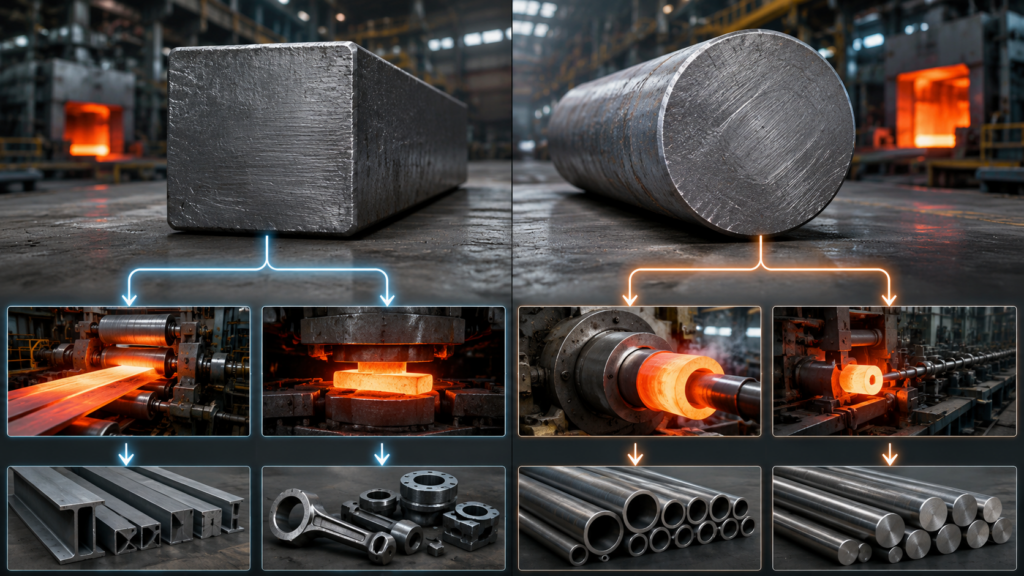
For seamless tube production, square steel billet vs round steel billet is usually easier to answer. Round billet is commonly preferred because seamless tube manufacturing often involves rotary piercing, plug mill processing, elongation, and sizing operations.
A round billet fits the logic of the process. It rotates more naturally, supports more symmetrical deformation, and reduces the need to convert a square section into a round mass before piercing.
The Mannesmann plug mill process video on YouTube visually shows how heated steel is pierced and processed into seamless pipe. This kind of process helps explain why round billet for seamless tube production is a strong long-tail search intent: the starting shape must support rotation, piercing stability, and hollow shell formation.
Round billet is often selected for:
- seamless tube production
- pipe billet preparation
- piercing mill routes
- hollow bar processing
- round bar production
- shaft stock
- rotary forming routes
If the final product is a tube, pipe, or hollow section, using round billet can reduce unnecessary shape conversion and improve processing fit.
How Square Steel Billet vs Round Steel Billet Affects Forging
In forging, square steel billet vs round steel billet should be selected by the final shape and deformation route.
Square billet can be suitable for forged blocks, rectangular sections, general open die forging stock, and parts that need flattening or section reduction. It can also be convenient when the final forged shape has a non-round geometry.
Round billet may be better for shafts, rings, hollow tube forgings, stepped round parts, and components that need rotation or symmetric deformation. It can reduce unnecessary corner deformation when the final part is mostly round.
The Wikipedia article on forging explains that forging uses localized compressive forces to shape metal. In real production, the starting section matters because metal flow, deformation route, and heating behavior all affect forging stability.
For forging buyers, billet shape is not the only issue. Steel grade, surface quality, internal soundness, length, diameter or side size, and heat number traceability still matter. When the buyer is unsure, it is safer to choose a steel billet supplier that can review the final product, processing route, and inspection needs before quotation.
Does Billet Shape Affect Defects and Yield?
The wrong answer to square steel billet vs round steel billet can create extra processing work. Billet shape itself does not automatically create defects, but a poor shape match can increase yield loss, handling difficulty, heating inefficiency, and deformation risk.
Examples:
- Using square billet for a round or hollow product may require more shape conversion.
- Using round billet for a profile route may require a less efficient rolling schedule.
- Poor shape matching can increase crop loss.
- Extra deformation steps can expose surface defects.
- More machining allowance may be needed when the starting shape is far from the final part.
Billet defects are still controlled by casting quality, surface inspection, chemical composition, internal soundness, and handling. Britannica’s article on steel continuous casting explains that continuous casting feeds liquid steel into a water-cooled mold while withdrawing the solidifying shell. This kind of process control affects the quality of the semi-finished product before it enters rolling or forging.
The practical point is simple: shape selection and billet quality control should be considered together.
Square Steel Billet vs Round Steel Billet Selection Table
Use this square steel billet vs round steel billet table as a quick production-line reference.
| Production Target | Usually Better Starting Shape | Why |
|---|---|---|
| Bar rolling | Square billet or mill-dependent | Common hot rolling route |
| Wire rod production | Square billet | Efficient reduction path |
| Seamless tube production | Round billet | Better for piercing and rotation |
| Round bar production | Round billet or mill-dependent | Less shape conversion |
| Forged shaft | Round billet or square billet | Depends on forging route |
| Forged block | Square billet | Easier section matching |
| Hollow tube forging | Round billet | Better starting geometry |
| General machining stock | Depends on final part | Match machining allowance and yield |
| Profile production | Square billet | Often fits pass design better |
This table is not a universal rule. It is a starting point. The final decision should depend on mill design, forging method, reduction schedule, final product shape, steel grade, and inspection requirements.
How Does Continuous Casting Affect Billet Shape Choice?
Continuous casting can produce different semi-finished shapes depending on caster design, mold size, and production plan. The Wikipedia article on continuous casting describes the process as solidifying molten metal into semi-finished billet, bloom, or slab for later rolling in finishing mills.
This does not mean all continuous cast billets are the same. Shape consistency, surface quality, corner condition, center soundness, and cut length control still affect downstream processing.
When buyers compare square billet and round billet, they should ask whether the producer can supply the required shape consistently across batches. If a rolling line needs square billet, inconsistent side dimensions may create feeding or rolling problems. If a seamless tube line needs round billet, diameter control and internal quality become even more important.
A buyer comparing square steel billet vs round steel billet should therefore check both shape and process reliability.
Buyer Takeaway for Rolling Forging and Tube Lines
The real question is not “which billet shape is better?” The real question is “which billet shape reduces unnecessary processing for my line?”
Use square billet when it fits the rolling pass design, bar route, profile route, or block-style forging plan.
Use round billet when the final product is round, hollow, or processed through rotary deformation, piercing, or tube production.
If the final product is complex, ask the supplier to review billet size, shape, grade, tolerance, cut length, inspection plan, and delivery consistency before the order is confirmed.
Conclusion
The best square steel billet vs round steel billet choice depends on the production line, not a general rule. Square billet often fits many rolling and forging routes, while round billet is usually better for seamless tube production, piercing, round bar processing, and rotary deformation. Buyers should match billet shape with final product geometry, mill design, forging route, inspection needs, and yield expectations. A clear square steel billet vs round steel billet decision can reduce unnecessary processing, improve production stability, and help the finished steel match its intended application.
FAQ
What is the main difference in square steel billet vs round steel billet?
The main difference in square steel billet vs round steel billet is cross-section shape. Square billet has a square section, while round billet has a circular section. The better choice depends on the production process.
Is square billet better for rolling?
Often, yes. Square billet is widely used for bar, rod, and profile rolling. However, the final answer depends on the rolling mill design and product size.
Why is round billet used for seamless tube production?
Round billet is better suited for rotary piercing and seamless tube production because its circular shape supports more stable rotation and symmetrical deformation.
Can square billet be used for forging?
Yes. Square billet can be used for many forging routes, especially forged blocks, rectangular components, and open die forging stock. Round billet may be better for shafts, rings, and hollow parts.
Does billet shape affect final product quality?
Yes, indirectly. Billet shape affects processing fit, deformation route, yield, and machining allowance. Final quality also depends on steel grade, surface quality, internal soundness, and process control.
How should buyers choose billet shape?
Buyers should choose billet shape by final product, production route, equipment requirement, yield target, inspection needs, and supplier capability.