Continuous Cast Steel Billet: Why Rolling and Forging Quality Starts Here
A continuous cast steel billet is not just a semi-finished steel product waiting for rolling or forging. For downstream processors, it is the starting point of dimensional stability, internal soundness, heating behavior, deformation consistency, and final product reliability.
If a continuous cast steel billet has unstable structure, surface cracks, internal segregation, or poor size control, the problem may not appear at purchase. It often appears later during reheating, rolling, forging, machining, or heat treatment. This guide explains why billet casting quality matters before you buy, especially when the billet will be used for rolling and forging.
Table of Contents
Why Continuous Cast Steel Billet Quality Matters After Delivery
Many buyers compare steel grade, billet size, price, and delivery time. Those points are important, but they do not tell the full story. The quality of a continuous cast steel billet depends on how molten steel solidifies, how cooling is controlled, how defects are prevented, and how the billet is inspected before shipment.
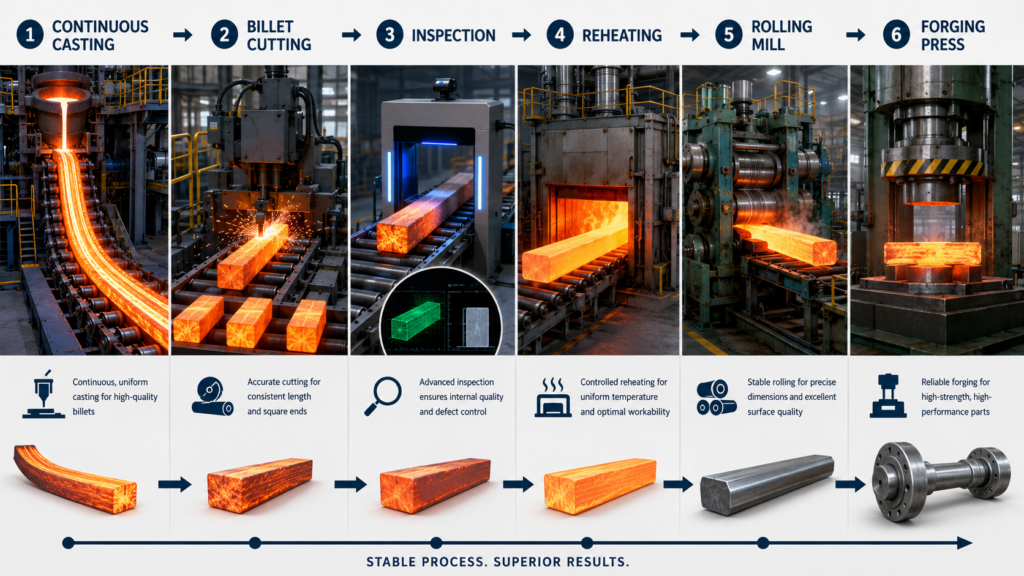
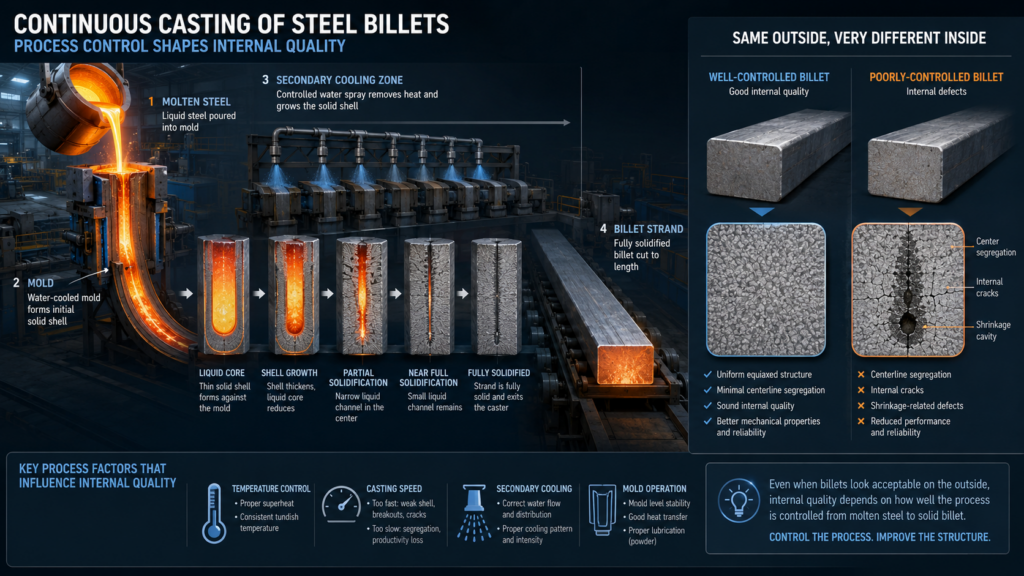
Britannica’s article on continuous casting explains that the process feeds liquid steel into a water-cooled copper mold while the solidified shell is continuously withdrawn. This sounds simple, but the real challenge is controlling solidification, heat transfer, surface condition, and internal quality at production speed.
For rolling mills, poor billet quality can reduce rolling efficiency. For forging plants, internal defects can increase crack risk. For machining users, uneven structure or inclusions may affect tool life and final part consistency. That is why continuous cast steel billet selection should be treated as a processing decision, not only a purchasing decision.
How Billet Casting Affects Internal Structure
During billet casting, steel changes from liquid to solid. This solidification stage forms the internal structure of the billet. If temperature, casting speed, secondary cooling, and mold operation are not controlled well, problems may develop inside the billet.
Steeluniversity’s continuous casting module describes continuous casting as the critical step that transforms molten steel into a solid shape and covers plant equipment, metallurgy, operation, and simulation. For buyers, the important point is practical: billet casting is where internal quality begins.
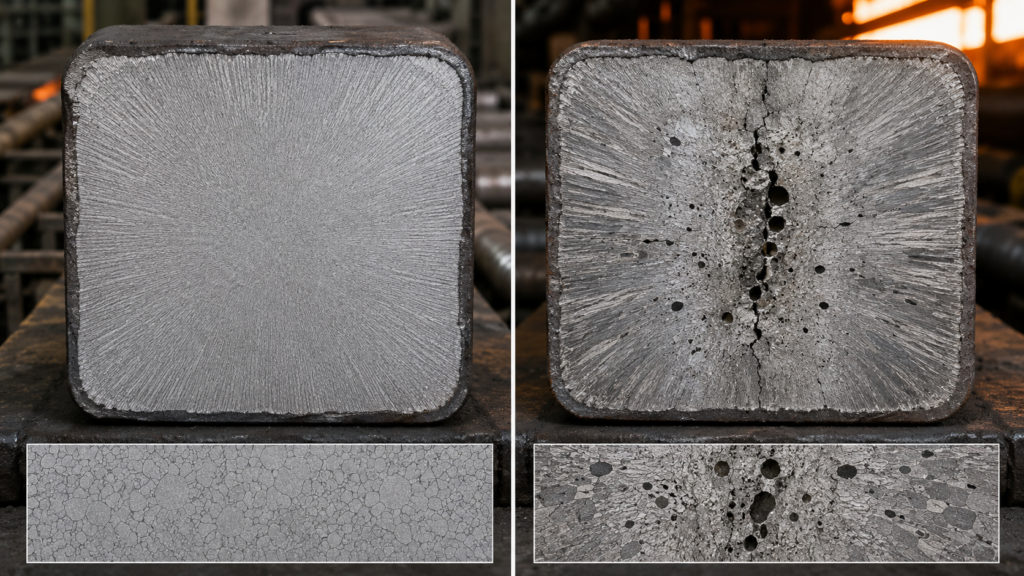
A continuous cast steel billet with more uniform internal structure is easier to reheat, roll, forge, and machine consistently. A billet with center segregation, internal cracks, or shrinkage-related defects may still look acceptable on the outside, but it can create quality problems later.
This is why steel billet quality cannot be judged by surface appearance alone.
Continuous Casting Billet Advantages for Rolling Mills
One major reason buyers choose a continuous cast steel billet is processing stability. Compared with older ingot-based routes, continuous casting can provide better yield, more consistent semi-finished shapes, and more efficient downstream processing.
ScienceDirect’s overview of continuous casting notes that continuous casting improves efficiency for bulk steel by reducing top and tail discard and by providing a semi-finished shape for further rolling.
For rolling mills, continuous casting billet advantages include:
- more consistent billet dimensions;
- more stable reheating behavior;
- better rolling schedule control;
- reduced interruption from billet defects;
- improved material utilization;
- better production planning.
A continuous cast steel billet for rolling should have stable cross-section size, controlled surface condition, and predictable hot deformation behavior. If billet dimensions vary too much, rolling setup becomes harder. If surface cracks are present, defects may extend during rolling.
For this reason, cast steel billet procurement should include tolerance review, surface inspection requirements, and heat number traceability.
Why Continuous Cast Billet Matters for Forging
Forging places heavy stress on steel. During hot deformation, internal weaknesses can open, extend, or become visible as cracks. This makes the continuous cast steel billet especially important for forging applications.
A continuous cast billet for rolling and forging must provide more than chemical composition compliance. It should offer internal soundness, controlled segregation, and stable response during heating and deformation.
A study in MDPI’s Metals journal on internal crack prediction of continuous casting billet states that internal cracks in steel billets are difficult to detect during continuous casting and may pass on to rolled materials. That point matters for forging as well, because hidden internal defects can become serious failures during heavy deformation.
For forged shafts, rings, blocks, and mechanical parts, billet quality affects:
- forging crack risk;
- deformation consistency;
- final grain structure;
- heat treatment response;
- machining stability;
- finished part reliability.
A continuous cast steel billet used for forging should be matched to the forging route, reduction ratio, steel grade, and final part requirement.
Steel Billet Quality Problems That Affect Downstream Processing
A continuous cast steel billet can fail downstream not because the grade is wrong, but because the billet quality is unstable. Common quality issues include internal defects, surface defects, and dimensional problems.
| Billet Issue | Downstream Risk |
|---|---|
| Center segregation | Uneven mechanical properties after rolling or forging |
| Internal cracks | Crack extension during rolling, forging, or heat treatment |
| Surface cracks | Rolled-in defects and surface rejection |
| Inclusions | Machining issues, fatigue risk, or inconsistent performance |
| Porosity or shrinkage | Lower internal soundness |
| Dimensional deviation | Poor rolling efficiency and unstable processing |
| Poor traceability | Harder quality investigation after failure |
Research on macroscopic inhomogeneity in small square billet continuous casting discusses how actual production factors such as superheat, cooling intensity, and casting speed are controlled in billet continuous casting. These factors are directly connected with internal uniformity and defect control.
This is why steel billet quality evaluation should include both documentation and inspection. A continuous cast steel billet should not be accepted only because the chemical composition certificate looks correct.
Continuous Cast Steel Billet vs Other Casting Routes
Some buyers ask about the difference between continuous casting and direct casting. In practical terms, continuous casting creates a continuous strand that is cut into billets, blooms, or slabs. Direct casting can refer to other casting routes where molten steel is cast more directly into a required shape or mold form.
For most long-product production, a continuous cast steel billet is valued because it provides a consistent semi-finished form for rolling mills and forging shops. It is not always “better” for every application, but it is highly suitable when downstream processing requires stable feedstock.
Another common question is the difference between billet steel and cast steel. Billet steel usually refers to semi-finished steel billet that will be further processed. Cast steel usually refers to steel shaped by casting into a mold, often closer to the final component shape.
That distinction matters because a cast steel billet is not the final product. It is the foundation for later rolling, forging, or machining.
What Buyers Should Check Before Ordering Cast Steel Billet
Before ordering a continuous cast steel billet, buyers should check more than size and price. A practical purchasing checklist should include:
1.Steel grade and chemical composition certificate
2.Billet size and tolerance
3.Heat number traceability
4.Surface inspection method
5.Internal inspection requirement
6.Ultrasonic testing, if required
7.Defect control process
8.Casting route and quality control ability
9.Application match for rolling or forging
10.Delivery consistency and supplier experience
If you are comparing suppliers, this is where a broader supplier evaluation framework helps. You can also read our guide on how to choose a steel billet supplier to review supplier capability, quality control, and procurement risk before placing an order.
For high-volume buyers, the most important question is not simply “Can you supply this grade?” It is “Can you supply the same steel billet quality consistently across batches?”
Matching Billet Quality to Rolling and Forging Applications
A continuous cast steel billet for general rolling may need strong dimensional consistency and reliable surface quality. A billet for forging may require closer attention to internal soundness and defect risk. A billet for machining-intensive parts may require cleaner steel and more stable hardness after heat treatment.
For rolling applications, buyers should focus on:
- size tolerance;
- surface cracks;
- reheating stability;
- rolling efficiency;
- batch consistency.
For forging applications, buyers should focus on:
- internal cracks;
- segregation control;
- inclusion level;
- hot workability;
- heat treatment response.
For higher-demand parts, a continuous cast steel billet should be supported by inspection records, clear traceability, and application-specific communication with the supplier.
Conclusion
A continuous cast steel billet is the starting point for stable downstream processing. Its value is not only in production efficiency, but also in internal quality, dimensional stability, surface condition, and predictable performance during rolling and forging.
Buyers should look beyond grade and price. The right continuous cast steel billet should match the application, support reliable steel billet quality, and reduce downstream risk. When billet casting is controlled properly, rolling mills and forging shops gain a more stable foundation for efficient processing and consistent final products.
FAQ
What is continuous casting in steel?
Continuous casting is a steelmaking process where molten steel is solidified into a continuous strand and then cut into billets, blooms, or slabs. It is widely used because it improves efficiency and provides semi-finished shapes for further processing.
What is a continuous cast steel billet?
A continuous cast steel billet is a semi-finished steel product made by continuous casting. It is commonly used as feedstock for rolling, forging, and other downstream processing.
What is the difference between billet steel and cast steel?
Billet steel usually refers to semi-finished steel billet for further processing. Cast steel often refers to steel poured into a mold to form a component or near-final shape.
What is the difference between continuous casting and direct casting?
Continuous casting creates a continuously solidified strand that is cut into billets or other semi-finished forms. Direct casting generally refers to casting into a mold or shape more directly.
What is the CCM process in a steel plant?
CCM means continuous casting machine. It receives molten steel, solidifies it through a mold and cooling system, and continuously produces billets, blooms, or slabs.
Why does billet quality affect rolling and forging?
Billet quality affects reheating, deformation, crack risk, surface condition, and final mechanical consistency. Poor billet quality can create defects during rolling or forging.