Key Differences Between Steel Billets and Rebars in Manufacturing, Applications, and Selection
Steel buyers often see steel billets and rebars in the same supply chain, but they serve different purposes. A billet is a semi-finished steel product used as a starting material for further rolling, while rebar is a finished steel product mainly used for reinforcing concrete structures.
Understanding the difference between these materials helps buyers avoid purchasing the wrong product for their manufacturing process. This guide explains how steel billets are manufactured, how they become finished steel products, how they differ from bars and rebars, and what factors should be considered when selecting a supplier.
Whether you are sourcing raw materials for a rolling mill, evaluating steel billet suppliers, or comparing billet steel with finished products, the production stage and final application are the key factors that determine the right choice.
Table of Contents
What Are Steel Billets and How Are They Made?
A steel billet is a semi-finished steel product produced after casting molten steel into a solid form. It usually has a square or rectangular cross-section and becomes the raw material for manufacturing products such as steel bars, rebars, wire rods, and structural sections.
Unlike finished steel products, a billet normally requires additional processing before it can be used in construction or industrial applications.
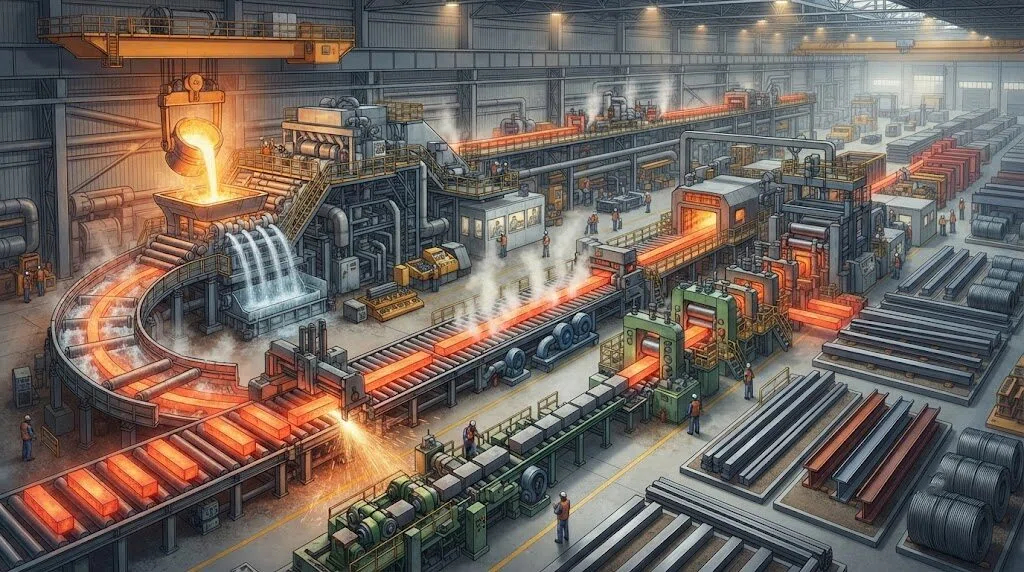
The typical steel billet manufacturing process includes:
1.Steel melting
Raw materials such as iron ore-based materials or recycled steel scrap are melted in a furnace.
The chemical composition is adjusted by adding alloying elements such as:
- carbon
- manganese
- chromium
- nicke
The required steel grade depends on the final application.
2.Continuous casting
After refining, molten steel is poured into a continuous casting machine.
The liquid steel cools and solidifies into long rectangular sections, which are then cut into specific billet lengths.
According to the World Steel Association – Steel Production Process, continuous casting is a widely used process that improves production efficiency by directly converting molten steel into semi-finished products.
3.Rolling or further processing
After casting, billets are reheated and processed through rolling mills.
Depending on the production route, they can become:
- reinforcing bars (rebars)
- round bars
- square bars
- wire rods
- other long steel products
This is why a billet is considered a foundation material in the steel manufacturing chain.
What Is the Difference Between Steel Bars and Steel Billets?
The main difference between steel bars and steel billets is their position in the manufacturing process.
A billet is an intermediate product, while a steel bar is a processed product ready for specific applications.
| Comparison Factor | Steel Billet | Steel Bar |
|---|---|---|
| Production stage | Semi-finished steel product | Finished steel product |
| Manufacturing step | Produced by casting | Produced by rolling or processing billet |
| Shape | Usually square or rectangular | Round, square, flat, or hexagonal |
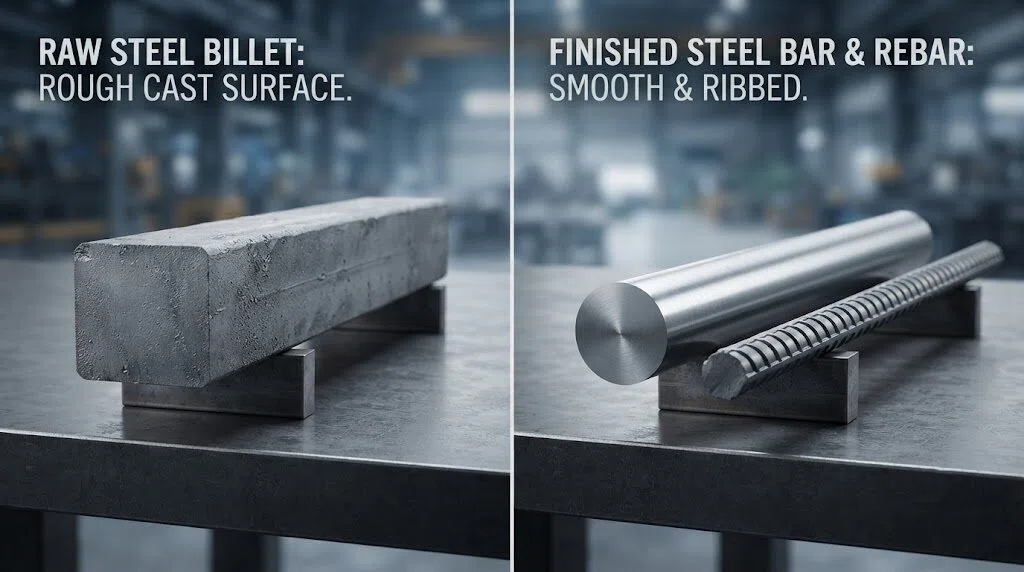
| Surface condition | Casting surface | More processed surface finish |
| Main use | Raw material for further production | Machining, construction, industrial components |
For example, a steel mill may purchase billets and use rolling equipment to manufacture steel bars with specific diameters and tolerances.
On the other hand, manufacturers that need ready-to-machine materials usually purchase finished steel bars instead of billets.
This distinction is important because buying the wrong form can increase processing costs and production time.
Are Steel Billets Used to Produce Steel Bars and Rebars?
Yes. Steel billets are commonly used as the starting material for producing both steel bars and rebars.
The process follows this general route:
Molten Steel → Steel Billet → Rolling Process → Steel Bar/Rebar
However, the final product depends on the rolling design and required application.
For example:
Steel billets for rebar production
Construction companies commonly use rebars for reinforcing concrete structures.
The billet is rolled into ribbed steel bars that improve mechanical bonding with concrete.
The American Iron and Steel Institute – Steel Manufacturing Information explains that steel production involves multiple processing stages, where semi-finished steel products are transformed into products designed for specific end uses.
Steel billets for bar production
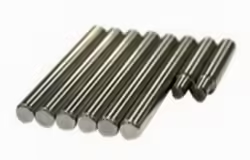
When billets are processed into steel bars, the final products are commonly used for:
- shafts
- machine components
- automotive parts
- industrial equipment
These applications often require tighter dimensional control and specific mechanical properties.
How Are Steel Billets Different From Rebars in Application?
Although both products originate from steel billets, their applications are different.
Rebars are mainly used for construction reinforcement
Typical applications include:
- concrete buildings
- bridges
- highways
- infrastructure projects
The ribbed surface of rebar improves mechanical bonding with concrete.
Steel bars are used for industrial manufacturing
Common applications include:
- machining parts
- forged components
- mechanical assemblies
- equipment manufacturing
The selection depends on whether the buyer needs a reinforcing material or a machining-grade steel product.
How Does Billet Size Affect Final Steel Products?
Billet dimensions directly influence the final product size and production efficiency.
Common billet sizes include:
- 100 × 100 mm
- 120 × 120 mm
- 130 × 130 mm
- 150 × 150 mm
- 160 × 160 mm
Larger billets can produce more finished steel, but the final output depends on:
- rolling mill capacity
- product diameter
- production losses
- required tolerances
For steel buyers, billet size should always match the supplier’s rolling process and intended product specification.
A mismatch between billet dimensions and production requirements may result in unnecessary material waste or additional processing steps.
How Much Steel Bar Can Be Produced From One Steel Billet?
One of the most common questions from steel buyers is: how much steel bar can be produced from 1 billet?
The answer depends on several factors, including billet size, steel density, final bar diameter, and rolling efficiency.
A simple calculation method is:
Finished bar weight = Billet weight × Rolling yield rate
The rolling yield rate is usually affected by:
- cutting losses
- scale loss during heating
- production efficiency
- process requirements
For example, a larger billet can produce more meters of finished steel bar, but the actual output will change depending on whether the mill produces:
- 10 mm rebar
- 20 mm rebar
- 40 mm round
- customized steel sections
A smaller diameter product usually creates more length from the same billet weight because less material is distributed into each meter of finished steel.
For buyers working with rolling mills, calculating billet-to-bar conversion is important because it directly affects:
- production planning
- raw material cost
- inventory management
How to Calculate the Weight of a Steel Billet?
Knowing the weight of a billet is essential when purchasing, transporting, or calculating production output.
The basic formula is:
Steel Billet Weight = Length × Width × Height × Steel Density
The density of carbon steel is approximately:
7,850 kg/m³
For example:
A billet size:
- Width: 150 mm (0.15 m)
- Height: 150 mm (0.15 m)
- Length: 6 m
Calculation:
0.15 × 0.15 × 6 × 7,850
≈ 1,059 kg
This means one 150 × 150 × 6000 mm billet weighs approximately 1.06 tons.
The exact weight can vary slightly depending on:
- steel grade
- dimensional tolerance
- actual billet length
- surface condition
For engineering calculations, buyers can also refer to material density information from Engineering Toolbox – Density of Metals.
How to Calculate the Length of Steel Bar Produced From One Billet?
Another important purchasing question is:
How much finished bar length can be obtained from one billet?
The calculation requires two values:
1.Total billet weight
2.Weight per meter of finished bar
The formula is:
Bar Length = (Billet Weight × Rolling Yield) ÷ Weight per Meter of Bar
Example:
A billet weighs:
1,000 kg
The finished bar weight:
10 kg/m
Assuming a 95% rolling yield:
(1,000 × 0.95) ÷ 10
= 95 meters of finished bar
This calculation helps steel manufacturers estimate:
- production output
- material consumption
- delivery quantity
However, the actual result depends on the rolling process and product specification.
Is Billet Steel Stronger Than Regular Steel?
The answer depends on what type of steel is being compared.
A billet is not a steel grade. It is a manufacturing stage.
For example:
- carbon steel billet
- alloy steel billet
- stainless steel billet
can have completely different chemical compositions and mechanical properties.
The strength of the final product depends on:
- chemical composition
- heat treatment
- rolling process
- grain structure
- cooling method
A billet itself is not automatically stronger than finished steel. In many cases, additional processing improves the mechanical properties and performance of the final product.
According to ASM International – Steel Processing and Properties Resources, steel properties are strongly influenced by processing methods, including thermal treatment and deformation.
Is Billet Steel Stronger Than Forged Steel?
This is a common question from manufacturers comparing raw material options.
Generally, forged steel has advantages in applications requiring high mechanical strength and fatigue resistance because forging changes the grain flow structure of the material.
The difference can be summarized as:
| Factor | Steel Billet | Forged Steel |
|---|---|---|
| Production method | Casting and semi-finished processing | Mechanical deformation under force |
| Grain structure | Depends on casting and rolling | More directional grain flow |
| Typical use | Raw material for rolling | Heavy-load components |
| Common applications | Bars, rebars, wire rods | Shafts, gears, pressure components |
Forged steel is often selected for:
- aerospace parts
- heavy machinery shafts
- automotive components
- high-load mechanical parts
However, this does not mean billets are unsuitable materials. Billets are the starting point for many high-performance steel products after proper rolling and heat treatment.
For a detailed explanation of forging effects on steel properties, the Total Materia – Forging and Material Properties Article provides additional technical background.
Final Thoughts
Understanding steel billets requires looking beyond the material itself and considering where it fits in the manufacturing chain.
A billet is the foundation material that connects steel production with finished products such as bars and rebars. Choosing the right billet depends on the required application, production equipment, mechanical requirements, and supplier capability.
For rolling mills, construction material producers, and industrial manufacturers, understanding billet calculation methods and processing differences helps reduce material waste and improves purchasing decisions.
FAQ
What are steel billets used for?
Steel billets are mainly used as raw materials for producing rebars, steel bars, wire rods, and other long steel products.
How are steel billets made?
Steel billets are made by melting steel, refining the chemical composition, and casting molten steel into solid semi-finished shapes.
What is the difference between steel bars and steel billets?
Steel billets are semi-finished products that require further processing, while steel bars are finished products used directly in manufacturing or construction.
How much steel bar can be produced from one billet?
The amount depends on billet weight, final bar size, and rolling efficiency.
Is billet steel stronger than forged steel?
Usually not. Forged steel often provides improved grain structure and mechanical performance for high-load applications.