Why Does Square Steel Sometimes Have Rounded Corners?
Table of Contents
A round corner square steel bar keeps its broad square faces while curved transitions replace the sharp points between neighboring faces.
Square steel can have rounded corners because metal flows through shaped rolls or dies whose contours do not produce infinitely sharp points. Later edge finishing can also soften an edge. The broad faces still give the bar its square form, while a corner radius describes the local curve joining neighboring faces.
Real manufacturing creates shapes with physical tools and flowing metal. It does not trace infinitely sharp lines. Rounded transitions are therefore a normal part of many metal profiles, rather than evidence that the word “square” has lost its meaning.
An edge is a long feature; a corner is its end-view outline
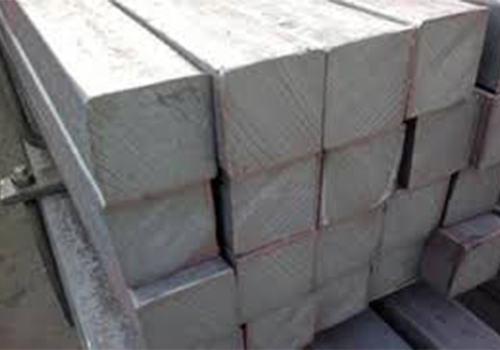
On a long square bar, two neighboring faces meet along an edge. Looking at the cut end reduces that long feature to a corner in the cross-section. When the edge is rounded along the length, the end view shows the corresponding curved corner.
This is different from rounding the end of the whole bar. An end treatment can soften the rim around a cut face while leaving most of the long edges unchanged. The phrase rounded edge becomes clearer when the location is shown rather than assumed.
Imagine painting the four long faces different colors. Where blue meets red, the rounded transition runs along the bar. At the cut end, you see the short arc connecting the blue and red face outlines. The same physical region has a three-dimensional description and a two-dimensional drawing.
A mathematical square uses lines with no thickness meeting at exact points. A manufactured section has a real surface, and a transition between faces occupies physical space. The mathematical name is still useful because it captures the dominant form without pretending that every local feature is an infinitely sharp point.
Zoom in on one corner
From a distance, a square bar looks like a long block with four faces. At the end, follow one face toward the next. Instead of making an instantaneous 90-degree turn, the outline may curve gradually between them.
The radius describes the size of this curve. For an ideal circular corner, imagine a small circle whose edge matches the curved section. The distance from that circle’s center to its edge is the corner radius. A larger circle produces a broader curve; a smaller one makes a tighter corner.
This is a local measurement. Increasing the corner radius does not necessarily move the middle of the two flat faces. A square can keep the same overall distance across flats while its corner regions become more rounded.
A radius joins the faces smoothly
In the ideal circular model, each corner arc is tangent to its neighboring flat faces. Tangent means the curve and the straight face share the same direction at the meeting point. The outline changes direction gradually through the arc instead of producing an extra kink at the join.
For an ideal square 200 mm across flats with a 10 mm corner radius, each corner uses 10 mm of the adjacent side at either end. The straight portion between neighboring arcs is therefore 200 − 10 − 10, or 180 mm.
The overall across-flats distance remains 200 mm. It is the length of the flat segment visible in the end outline that has become 180 mm. Confusing those two measurements can make a drawing seem inconsistent when it is actually describing two different features.
These dimensions are a geometric illustration. Real contours may depart from a perfect circular arc, so the circle model explains the language rather than certifying an actual rolled surface.
A chamfer is a different way to remove a sharp corner
A chamfer replaces a corner with a straight sloping face. A radius replaces it with a curve. Both can make an edge less sharp, but their end-view outlines are different.
Draw a short straight line connecting two points an equal distance along the adjacent square sides. The new line is a chamfer. Now join the same general region with a smoothly rounded arc. The curve changes direction continuously; the chamfer has a constant slope and distinct joins where it meets the original faces.
That distinction can remain visible along the entire bar. A chamfer creates a narrow additional flat face. A rounded edge creates a curved band between the broad faces. Light reflecting from the narrow flat can form a relatively uniform strip, while the curved band can carry a changing reflection.
The two should therefore not be treated as interchangeable meanings of “softened corner.” One phrase describes the broad visual effect, while radius and chamfer describe the geometry that produces it.
Metal flows into a shape
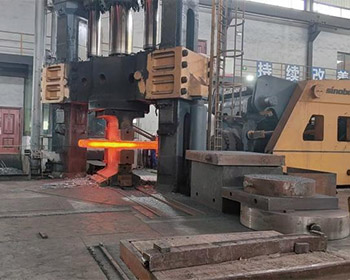
During rolling, steel is squeezed between shaped rolls. The metal changes cross-section as it passes through the available space. The tooling’s shape and the way the steel flows influence the finished outline, including its corners.
Cold drawing is another route for some bar products. Prepared steel is pulled through a die, an opening that controls the emerging profile. Again, the corner is produced by a physical passage with a particular shape, rather than by the abstract intersection of two lines.
These operations can produce different kinds of corner detail. The phrase “round corner square steel bar” describes the resulting outline; it does not, on its own, tell the entire manufacturing story.
What changes when the point disappears?
A sharp corner touches another object over a very small initial region. A rounded corner presents a curved surface instead. That changes how the two objects first meet and how contact can spread as they press together.
You can picture the difference with two blocks of soap, one with a crisp edge and one with a worn rounded edge. Their broad faces may have the same spacing, yet the edges feel and contact surrounding objects differently. For steel, the forces and deformation are different in scale, but the geometric distinction remains.
A rounded outline also sits slightly inside the sharp square near each corner. It therefore contains less cross-sectional area than the ideal sharp outline. The amount depends on the breadth and actual shape of the curves, not simply on whether the word “rounded” appears in the description.
A broader curve is not a universal guarantee of better performance. It changes the geometry, which can be helpful or unhelpful depending on what the adjacent object is meant to do. A part intended to sit against broad flats asks a different contact question from one that touches only near an edge.
A rounded corner can also leave a small gap beside a sharp inside corner in another shape. The two outlines do not coincide merely because both objects are described as square. This is a geometric observation, not an instruction to choose a particular fit.
Why one operation does not explain every corner
Rolling and drawing form the overall section by making metal flow against tooling. Later machining or edge finishing can change a local region by removing material. A similar-looking curve could therefore be associated with different steps in a product’s history.
A smooth rounded edge does not prove that it was ground after rolling. Nor does a visible corner radius identify the exact roll groove used earlier. The outside geometry records a result; reconstructing the route requires additional information about the process.
The distinction between forming and cutting is useful. Forming redistributes steel while largely retaining its volume. Cutting sends removed material away as chips or particles. Both can change the corner outline, but they move the original material in different ways.
Jiyuan’s square bar range includes carbon and alloy sections with listed sizes from 150 × 150 to 500 × 500 mm, giving large-section projects a concrete material range to discuss. Where the corner shape matters to a project, the overall section and the local edge detail belong in the same conversation. The category name establishes the family of shape, while a sketch shows the particular corner being discussed.
The end-view sketch makes all these features visible at once: four broad sides, the points where the straight portions end, and the curved or sloping transitions between them. “Square” supplies the overall organization. The corner description supplies the detail where that organization changes direction.
The Shape of a Rounded Square Corner
Is a corner radius the same as a chamfer?
No. A radius creates a curved transition between neighboring faces. A chamfer replaces the sharp corner with a straight sloping segment in cross-section. Both soften an edge, but their geometry and remaining flat portions differ, so the terms are not interchangeable.
Can a bar still be square when its corners are rounded?
Yes. The broad faces can retain a square arrangement while small curved regions join them. The across-flats dimension describes the main section, and a corner radius describes the local transition. Both pieces of information can be needed to describe the actual outline.
You can send an end-view sketch to Jiyuan with the side dimension, length, grade if known, and whether the corner is intended to be curved or chamfered. This is more precise than a request for a vaguely “rounder square,” and it avoids confusing a corner radius with a round-bar diameter.